Review: Overthrow–America’s Century of Regime Change from Hawaii to Iraq (Hardcover)

5 Star, Empire, Sorrows, Hubris, Blowback
0Shares

Amazon Page
Amazon Page

5.0 out of 5 stars Timely, read with Zinni, Leebaert, Butler, and Johnson,

April 9, 2006
Stephen Kinzer
EDITED 27 June 2007 to add thoughts from second reading (accidental). While at the beach, ran out of books, bought this not remembering I had already read it, and found new value. Using the new link feature to insert links to the books originally listed.

This is a timely review, although the facts are well known to those who follow international affairs.

In this second (as if new) reading, the following quote stayed with me from page 317: “Most American sponsored ‘regime change' operations have, in the end, weakened rather than strengthened, American security.”

I list the countries covered by this book: Hawaii, Cuba, Nicarague, Philippines, Puerto Rico, Honduras, Guatemala, Iran, Viet-Nam, Chile, Lebanon, Grenada, Panama, Afghanistan, Iraq.

I focus more on Hawaii, in 1893, the first of a new range of intrusive overthrows (beyond the land expansion actions the author chooses not to cover). I am struck–moved–by the duplicitious immoral actions of both the white landowners and the white US government representatives against the people of Hawaii.

The author discusses how Hawaiians were at the time bound by obligations, ritual, and a reverence for nature. I am reminded of how we and the Spanish genocided the native Americans, north and south, individuals who had decades if not centuries of refined knowledge on how to shape and nurture the Earth in harmony with their needs.

This time around, the author's emphasis on how the legal right to buy land led to the loss of local indigenous control and rights. I now firmly believe that foreign and absentee landlords should be eliminated.

This time around, I note the author's emphasis on how corporations are a form of national army, capturing wealth in different ways from an armed force.

This time around, I think of how Dick Cheney has raped the American dream, in so violent and so public a fashion, that America's “lost innocence” can not longer be denied.

This time around, I discover and reflect (being at the beach) on the superb bibliography.

For a broader and perhaps more disturbing overview of the costs to America of corporate-driven foreign policy, see
The Battle for Peace: A Frontline Vision of America's Power and Purpose
The Fifty-Year Wound: How America's Cold War Victory Has Shaped Our World
War Is a Racket: The Anti-War Classic by America's Most Decorated General, Two Other Anti=Interventionist Tracts, and Photographs from the Horror of It
The Sorrows of Empire: Militarism, Secrecy, and the End of the Republic (The American Empire Project)
Rogue Nation: American Unilateralism and the Failure of Good Intentions
Confessions of an Economic Hit Man
Failed States: The Abuse of Power and the Assault on Democracy
Why We Fight
The Fog of War – Eleven Lessons from the Life of Robert S. McNamara
The New Craft of Intelligence: Personal, Public, & Political–Citizen's Action Handbook for Fighting Terrorism, Genocide, Disease, Toxic Bombs, & Corruption

Vote on Review
Vote on Review

Review: The Lucifer Principle–A Scientific Expedition into the Forces of History (Paperback)

5 Star, America (Anti-America), Complexity & Catastrophe, History, Religion & Politics of Religion, Science & Politics of Science, Values, Ethics, Sustainable Evolution
0Shares

Amazon Page
Amazon Page

5.0 out of 5 stars Time to Dust This One Off–Anticipated Radical Islam and Offers Core Ideas for Surviving,

April 9, 2006
Howard Bloom
Buy and read this book if for no other reason than that the author foresaw the global radicalization of Islam against the West in terms much starker than Samuel Huntington's clash of civilizations and much broader than Yossef Bodansky's brilliant tome on “Bin Laden: the Man Who Declared War on America.

Leon Uris is quoted on the cover as saying that this book is “an act of astonishing intellectual courage,” and I will say that the author has pulled together an extraordinary collage of details in an intricately assembled “story” in which he challenges the assumptions of a number of major conventional intellects. There are 58 “parts” to this book, each part between two and six pages long, with an astounding array of multi-disciplinary quotes and footnotes. No scared ox goes ungored.

Some of the history in this book, of the origin of Mohammed as a possible lunatic and then a vengeful warrior using religion to grab real estate, and of the early split between Sunni and Shiite over the issue of the succession, is very useful today.

The author centers the disparate and very broad-ranging pieces of the book on three core ideas: Earth as a superorganism within which a tribe or religion is itself a superorganism; memes as unifying ideas that create us versus them for the sake of changing the pecking order and feeding off weaker tribes, and–in the only optimistic note in the book, at the end, of collaboration and information sharing as the only means to break out of the pattern of dog eat dog.

He specifically slams religion, and especially fundamentalist religion, as a false god that substitutes faith for control, and as a tool of controlling elites who need to keep the impoverished masses from waking up to the raw fact that masses of people can indeed “take over” factories and estates.

On page 94 the following quote struck me as applying equally to George Bush and Osama Bin Laden: “Leaders like Orville Faubus and Fidel Castro have skillfully manipulated a few basic rules of human nature: that every tribe regards outsiders as fair game; that every society gives permission to hate; that each culture dresses the demon of hatred in the garb of righteousness; and that the man who channels this hatred can rouse the superorganism and lead it around by the nose.”

There are numerous gifted phrases throughout this book, and I can understand the frustration of some in absorbing this dizzying array of data points, but it is surely worth making the effort.

He makes much of the evolution of the brain from reptile (survival) to mammalian (social) to primate (individual) and emphasizes that even the most advanced humans still have all three brains in some form, with the lower forms subject to arousal.

Overall I rate this book one of the ten most useful books relevant to understanding and defeating radical Islam, which the author says is “a meme growing ravenous,” a sleeping giant that has been awakened. He goes back in time to look at how the US, in forcing the French and English to give up the Suez Canal, actually helped inspire Arabia to plan for a day when the West might be sent packing. Similar, the first Gulf War, when the Coalition defeated Iraq, undermined secular Moslem regimes, and further inspired Islamic fundamentalists.

In the author's view we erred gravely in not understanding the asymmetric scope of the threat of Bin Laden and post-Taliban Afghanistan, and we appear to have erred in a truly gigantic way in not seeing that the second Gulf War was in fact doing Iran's bidding and accomplishing something Iran could never have done on its own. The author views Bin Laden as having replaced Russia as a “friend” to the Third World, and anticipates both a rapid spread of Islam among the poor, and a plague of animosity toward to the USA specifically.

The book includes a fascination discussion of psycho-social aspects of nations and tribes and other social groups including religions. While some have been derisive of his discussion of “pecking orders” I believe–having lived overseas most of my life–that he nails it. Not only does instability cause the accepted pecking order to go out the window, but prosperity actually destabilizes established pecking orders. When we eventually implement the grand vision of Jeffrey Sachs (see my review of “The End of Poverty” we will need to be very mindful of the animal force that will be unleashed at the same time, and not make the mistake we made in Iraq, of failing to plan for stabilization and reconstruction.

The last two ideas in this book that really grabbed me are from page 292, on how America began a perceptual shut-down and decline from 1973 onwards, culminating in the cheating culture and lazy obese children and parents that are the bane of most teachers' lives today. America is in “slow” mode and has lost its competitive drive.

The book was hugely ambitious, and it is easy to be snide, as some reviewers are, but I for one found this as close to genius and as close to breath-taking intellectual derring-do as any book I have read in a while. If America is to survive the multiple threats to the Republic, it will take leaders capable of reading and understanding this book, and implementing a 100 year strategy for winning the six front war, beginning on the home front with a draconian reform of our educational and information sharing and distance learning environment.


Vote on Review
Vote on Review

Review: The Battle for Hearts and Minds–Using Soft Power to Undermine Terrorist Networks (Washington Quarterly Readers) (Paperback)

4 Star, Asymmetric, Cyber, Hacking, Odd War, Diplomacy
0Shares

Amazon Page
Amazon Page

4.0 out of 5 stars Several excellent contributions, fails to connect to open source intelligence,

April 9, 2006
Alexander T. J. Lennon
This is a pretty good volume from 2003, with a good mix of academics, journalists, and practitioners. The most useful pieces for me personally were on the Broadcasting Board of Governors, which manages the Voice of America.

On balance this is a solid reference on all but two of the aspects of soft power: it completely neglects the importance of getting a grip on historical and cultural reality through open source intelligence (OSINT) and also neglects the strategic bottom line that demands an educated American public that is fully informed about the real world and demanding of intelligent policy choices.

The book certainly does well with the limitations of military power, the importance of nation building, the urgency of having a massive capability to do stabilization and reconstruction operations as needed, and the critical roles that public diplomacy and foreign assistance could, but do not, play in winning hearts and minds.

Of special interest to me was the failing report card on the broadcasting board of governors, whose equipment is 30 years old in many cases. I applauded the informed judgement of the author who made the case, based on experience, for keeping the short wave and middle band capabilities that too few understand is essential for Africa and other locations.

Across the book it becomes clear that the US needs to upgrade the Combatant Commanders or mirror them with a civilian coordinator for non-military strategy, power, and resources. As someone who grew up overseas with the U.S. Information Agency (USIA), and served in three Embassies overseas, it is crystal clear to me that we need to double the Department of State, in part by reconstituting USIA as a separate organization, and by placing USIA, the BBG, and a new Open Source Agency (for collecting and making sense of all public information in all languages all the time) in a tight partnership. We need to double and triple aid, develop a peacekeeping from the sea program, as well as the ability to do multiple Berlin Airlifts.

This is a good basic book for anyone thinking seriously about “soft power,” a term popularized by Joe Nye, whose varied books I have reviewed and recommend very highly.

Vote on Review
Vote on Review

Who’s Who in Peace Intelligence: Justin Raimondo

Alpha Q-U, Peace Intelligence
0Shares
Justin Raimondo
Justin Raimondo

Justin Raimondo is an American author and the editorial director of the website Antiwar.com. He describes himself as a “conservative-paleo-libertarian.”Ā  In addition to his thrice-weekly column for antiwar.com, he is a regular contributor to The American Conservative and Chronicles magazine. Raimondo also writes two columns a month for Taki's Top Drawer.

Continue reading “Who's Who in Peace Intelligence: Justin Raimondo”

Review: World Brain (Essay Index Reprint Series) (Hardcover)

6 Star Top 10%, Consciousness & Social IQ, Education (General)
0Shares

Amazon Page
Amazon Page

5.0 out of 5 stars

Essential to Thinking About Collective Intelligence,

April 6, 2006
H. G. Wells
Edit of 16 Jan 07 to add links.

This volume, reprinted in the 1990's with a superb introductory essay, is still a gem, and extremely relevant to the emerging dialog about Collective Intelligence that includes the works of people like Howard Bloom (Global Brain), Pierre Levy (Collective Intelligence), Howard Rheingold (Smart Mobs), and James Surowieki (The Wisdom of the Crowds).

Global Brain: The Evolution of Mass Mind from the Big Bang to the 21st Century
Collective Intelligence: Mankind's Emerging World in Cyberspace
Smart Mobs: The Next Social Revolution
The Wisdom of Crowds

The Internet has finally made possible the vision of H. G. Wells, as well as the vision of Quincy Wright (who called for a World Intelligence Center in the 1950's, using only open sources of information).

This specific work is the first brick in a global networked brain that is also linked to eliminating poverty and war and producing what Alvin and Heidi Toffler call “Revolutionary Wealth” (also the title of their book coming out in April 2006). Thomas Stewart (“Wealth of Knowledge”) and Barry Carter (“Infinite Wealth”) are among my other heros in this specific genre of the literature. See my List on Collective Intelligence, and my reviews of all these other books.

Revolutionary Wealth: How it will be created and how it will change our lives
The Wealth of Knowledge: Intellectual Capital and the Twenty-first Century Organization
Infinite Wealth: A New World of Collaboration and Abundance in the Knowledge Era

Published since my view, and highly pertinent:
The Wealth of Networks: How Social Production Transforms Markets and Freedom
The Fortune at the Bottom of the Pyramid: Eradicating Poverty Through Profits (Wharton School Publishing Paperbacks)

Vote on Review
Vote on Review

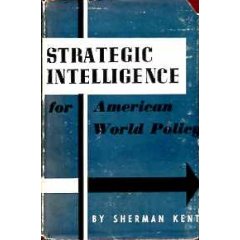
Review: Strategic intelligence for American world policy (Unknown Binding)

5 Star, Intelligence (Government/Secret)
0Shares

Amazon Page
Amazon Page

5.0 out of 5 stars Seminal Work for the Middle Period of Intelligence,

April 6, 2006
Sherman Kent
he history of national intelligence in terms of spies, satellites, and secrets can be concisely separated into three eras: the era of secret wars, the era of strategic analysis, and the era of open source intelligence.

Sherman Kent was without question the dean and the prophet for the second era, and this gem of a book remains a standard in the field and required reading for any intelligence professional (collector, analyst, or other). He did not realize his vision because the clandestine service (of which I was a member) took over the CIA and subordinated the analysts, and because in so doing, the CIA lost touch with most of the open source world.

Today Kent is succeeded by Jack Davis, whose term “analytic tradecraft” can be used to find his collection of memos on the web, and by the CIA University. However, the secret world is now under attack by the emergent World Brain, in which Collective (Public) Intelligence utilizes open sources of information to create Open Source Intelligence (OSINT) that is better than secret information, cheaper than secret information, and more useful than secret information because it can be shared broadly.

Those whose sense of self is defined by the secret world will have difficulty adjusting to this, witness the continued references in the secret world to “Open Sources.” Max nix. The war is over, and Kent's vision will ultimately be realized in the third era, the era of open sources.

Vote on Review
Vote on Review

Review: The Landscape of History–How Historians Map the Past (Paperback)

5 Star, Decision-Making & Decision-Support, Education (Universities), History
0Shares

Amazon Page
Amazon Page

5.0 out of 5 stars Brilliant Treatise on History as a “Denied Area”,

April 6, 2006
John Lewis Gaddis
He is bluntly critical of the political science and social science communities, branding them with an inability to engage in methodical research or articulation. History is a “denied area.” When we combine our current lack of appreciation of history across all the disciplines, with our long track record of disdain for religion and culture as fundamental aspects of the total intelligence picture, we must recognize that we have created many “virtual denied areas” for ourselves, Islam being but one of many. In that vein, this book can be considered a primer on how to go about understanding a “denied area” by substituting analytic tradecraft for the multiplicity of sources that characterize the more obvious targets of our interest.
Vote on Review
Vote on Review