Review: Finding Our Way–Leadership for an Uncertain Time (Hardcover)

5 Star, Leadership
0Shares

Amazon Page
Amazon Page

5.0 out of 5 stars Poetic Humanist Counterpart to Her “Serious” Book,

September 17, 2005
Margaret J Wheatley
I am a little concerned by some of the negative commentary on this book being too “touchy feely.” That is generally a sign that it has touched a nerve among “macho shit” types who think that elegance of thought and open affection for humanity is for gays and children. “Humanness” is for all of us, and if cannot cry, you cannot be human. Feelings must, as E. O. Wilson and others have documented so well, be fully factored into the whole of the human experience.

This is the poetic humanist counterpart book, a series of essays from the past from before the author was recognized as one of the most brilliant leadership gurus in the English-language. I certainly do recommend that her “serious” book, “Leadership and the New Science,” be read first, and then this one.

The author has done a superb job of taking older essays and organizing them, putting them in context, to tell a new story. This book of essays is a new book for having been re-created in the aftermath of the success of “Leadership and the New Science,” and I am choosing to give this book out to the audience of a gala leadership dinner in Washington, D.C., rather than the first book.

The author stresses that the old story of organization is the “machine” model, where people control and domination are the management paradigm, and resistance to change is seen as obstinance rather than coherent humanist understanding of the badness of the imposed conditions. The new story, by contrast, sees that everything is connected–as the author brilliantly puts it in her preface, “Independence is a political concept, not a biological concept.”

She focuses on two fundamentals: the need for all mankind to be free to experiment, and in experimenting, create unlimited diversity; and the need to enhance and expand relationships with others as part of that diversity and sustainable mutually beneficial wealth creation.

Translating that into meaning for organizational leaders, she stresses self-organization, listening, embracing all inputs, and striving to create self-identity, information-sharing, and relationships that in turn generate discovery, sharing, and fulfillment.

This is not touchy-feely, this is common sense restored to the conversation of mankind.

The other important theme in this book is the paradox of community, which sets the stage for her rather bleak conclusions about America facing an abyss. She spends a lot of time examining how the web and nations are separating clusters of individuals, isolating groups, rather than nurturing a broadening of the communal ethos, what Paul Goodman understood so well in the 1980's as the need for “communitas” from neighborhood to globe.

The author is one hundred per cent on the money when she says, in a notional conversation with America's teen-agers, “We haven't taught you well about honor, sustainability, community, or compassion. We failed to show you how to be wise stewards of the earth, how to care for one another, how to resolve conflicts peacefully, how to enjoy others creativity as well as your own. Yet miraculously, you are learning these things.”

She concludes by lamenting America's litigous society, where everyone knows their rights, but few know how to be in a community (or fulfil their civic duties to include loyalty to the Nation and engagement in the democratic process).

She tries to end the book on an uplifting note, speaking of the urgency of creating a web of hope, and of honoring those “few people who are not afraid to be insecure.” She attributes most fear to the inherent tendency of organizations and nations to fight natural resistance to change with artificial fears of the unknown. Instead of fearing the unknown, she suggests, we should embrace the new and find new paths, new hopes, new solutions by using our collective intelligence and our new-found global community.

This is one of six books that I regard as a life-affirming, “must-read” collection for any person who aspires to contributing to a sustainable future for America, for any other nation, for any tribe, for any community, for any neighborhood. If we fail to listen to Margaret Wheatley and embrace her human values–as E. O. Wilson does in “Consilience” where he explains in detail why science must have the humanities–then we are destined to lose to the bacteria that are winning the inter-species war. We are our own worst enemy. This author, and her two books, are a very powerful intellectual, moral, and spritual antidote to all that ails us.

Five other books I recommend:
Robert Buckman, “Building a Knowledge-Driven Organization”
Clayton Christensen & Michael Raynor, “The Innovator's Solution”
Steve Denning's “The Springboard: How Storytelling Ignites Action in Knowledge-Era Organizations”
Don Maruska, How Great Decisions Get Made”
Margaret Wheatley, “Leadership and the New Science”

Vote on Review
Vote on Review

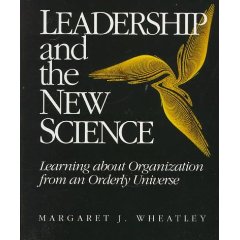
Review: Leadership and the New Science–Learning about Organization from an Orderly Universe (Hardcover)

5 Star, Leadership
0Shares

Amazon Page
Amazon Page

5.0 out of 5 stars “Tipping Point” Book, Vital for Achieving Sustainable Peace and Prosperity,

September 17, 2005
by Margaret J Wheatley
This book is beyond five stars, and not just for business, where it is receiving all the praise it is due, but within government, where it has not yet been noticed. It was recommended to me by the author of Building a Knowledge-Driven Organization and I now recommend it to everyone I know. If there are two books that can “change the world,” these are the ones.

Although the Chinese understood all this stuff centuries ago (Yin/Yang, space between the dots, the human web), the author is correct when she notes late in the book that the commoditization of the human worker (Cf. Lionel Tiger, Manufacture of Evil: Ethics, Evolution, and the Industrial System) and the emphasis on scientific objectivity and scientific manager (Cf. Jean Ralston Saul, Voltaire's Bastards: The Dictatorship of Reason in the West) were perhaps the greatest error we might have made in terms of long-run progress. Coincidentally, as I finished the book, on the Discovery channel in the background they were discussing how the leveeing of the Mississippi blocked the Louisiana watershed from cleansing the Mississippi naturally, as it once used to.

It's all about systems–the author does cite Donella Meadows' 1982 article in Stewart Brand's Co-Evolution Quarterly, but does not pay much heed to the large body of literature that thrived in the 1970's around the Club of Rome.

There are perhaps three bottom lines in this book that I would recommend to any government leader who hopes to stabilize and reconstruct our world:

1) Information is what defines who we are, what we can become, what we can perceive, what we are capable of achieving. Blocking or controlling information flows stunts our growth and virtually assures defeat if not death. It is the optimization of listening–being open to *all* information (and especially all the information the secret world now ignores)–that optimizes our ability to adjust, evolve, and grow.

2) Command & control is history, block and wire diagrams are history. General Al Gray had it right in the 1990's when he talked about “commander's intent” as the baseline. Leaders today need to be disruptive, to look for dissonant views and news, and to empower all individuals at all levels with both information, and the authority to act on that information.

3) Disorder is an *opportunity*. We have the power to define ourselves, our “opponents,” and our circumstances in ways that can either inspire protective, constricted, secretive, “armed” responses, or inclusive, open, sharing “pro-active” peaceful responses.

EDIT of 12 Dec 07: Haver ordered and will be reviewing several books that highlight the importance of diversity as a foundation for innovation.

The author is to be praised for noting early on in the book that “Ethical and moral questions are no longer fuzzy religious concepts but key elements in the relationship any organization has with colleagues, stakeholders, and communities.” I would extend that to note that social ethics and foreign policy ethics are the foundation for sustainable life on the planet, and we appear to be a long way from understanding that it is ethics, not guns, that will stabilize and fertilize…Cf Jonathan Schell, The Unconquerable World: Power, Nonviolence, and the Will of the People.

It also merits comment that the author essentially kills the industry of forecasting, scenarios, modeling, and futures simulations. I agree with her view (and that of others) that early warning is achieved, not through the theft of secret plans and intentions or the forecasting of behavior, but rather by casting a very wide net, listening carefully to all that is openly available, sharing it very widely (as the LINUX guys say, put enough eyeballs on it, and no bug will be invisible), and then being open to changed relationships. Trying to maintain the status quo will simply not do.

I give the author credit for carrying out an extraordinary survey of the literature on quantum mechanics, and for developing a PhD-level explanation of why old organization theory, based on the linear concepts of Newtonian physics, is bad for us, and how the new emergent organization theory, understood by too few, is let about the things and more about the relationships between and among the things.

This is an elegant essay and a heroic personal work of discovery, interpretation, and integration. While I would have liked to see more credit given to Kuhn, Drucker, Garfield, Brand, Rheingold, and numerous others that I have reviewed here for Amazon, on balance, given the academic narrowness of her Harvard PhD, I think the author has performed at the Olympic level. This is a radical book, somewhat reminiscent of Charles Hampden-Turner's book, Radical Man: The Process of Psycho-Social Development. which as I recall was not accepted by Harvard as a thesis at the time. Perhaps Harvard is evolving (smile).

For other key books that complement and precede this book, see my lists on information society, collective intelligence, business intelligence, and intelligence qua spies and secrecy in an open world.

Read this book BEFORE you read her new collection of essays, Finding Our Way: Leadership for an Uncertain Time

EDIT of 12 Dec 07: I must say, I am both astonished and disappointed that more of us have not found and absorbed this great work. Margaret Wheatley, whom I have not met (but I have met Tom Atlee, Juanita Brown, and Robert Buckman) strikes me as the “Mother” of a new form of continuous global education and innovation. Not sure what the answer is, but we have to pay more attention to this person's reflections.

Vote on Review
Vote on Review

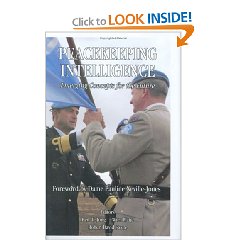
Review: Peacekeeping Intelligence–Emerging Concepts for the Future (Hardcover)

5 Star, Intelligence (Government/Secret), Intelligence (Public), Peace, Poverty, & Middle Class
0Shares

Amazon Page
Amazon Page

5.0 out of 5 stars Editor's Update on PKI Literature,

September 13, 2005
Wies Platje
Edit of 5 Apr 08 to point to first book in new Peace series.

Thanks to everyone that has ordered this book, which is published as a non-profit endeavor. The concluding leadership in peacekeeping digest which is structured as an intelligence cycle versus levels of warfare (strategic, operational, tactical, technical) matrix continues to be available at oss.net or by request to the US editor.

The third annual conference on peacekeeping intelligence by Sweden built from this book in December 2004, and the contributed papers were superb and moved the literature to a new level of detail, the operational level of detail. That book will be published in 2008 as “Peacekeeping Intelligence: The Way Ahead” co-edited by Col Jan-Inge Svensson of the Swedish Military Academy.

Six other titles are planned for 2008-2009, you can follow them (and read them free online although we do recommend the books as collector's items). Earth Intelligence Network has the details.

COLLECTIVE INTELLIGENCE: Creating a Prosperous World at Peace
PEACE INTELLIGENCE: Assuring a Good Life for All
COMMERCIAL INTELLIGENCE: From Moral Green to Golden Peace

Subject to change, 2009:
GIFT INTELLIGENCE: Optimizing & Orchestrating Global Charity
CULTURAL INTELLIGENCE: Faith, Ideology, & the Five Minds
GLOBAL INTELLIGENCE: EarthGame(tm) for All

The Swedes, with the explicit leadership of the Supreme Commander of the Swedish Armed Forces, are henceforth sponsoring a tactical peacekeeping intelligence course in March-April of each year that will be open to others–talk to your nearest Swedish defense attache. That course will lead to the third book in the series on “Peacekeeping Intelligence: Tactics for Success.”

Readers of this book who wish to recommend or write contributions to the follow-on book are urged to communicate with the US editor via email, with a decision deadline of 1 November 2005.

This book, and your purchase of it, would never have been possible without Amazon.com. They have opened new paths for information sharing that will help bring peace and prosperity to the dark corners of the world, including New Orleans.

Consider the other books in the set, also free online:
On Intelligence: Spies and Secrecy in an Open World
The New Craft of Intelligence: Personal, Public, & Political–Citizen's Action Handbook for Fighting Terrorism, Genocide, Disease, Toxic Bombs, & Corruption
Information Operations: All Information, All Languages, All the Time
THE SMART NATION ACT: Public Intelligence in the Public Interest

All future books will be published by Earth Intelligence Network, a Virginia non-profit, and sold in limited editions via Amazon, while also free by the chapter at the EIN web site.

See the first book in the new peace series, also free online, Collective Intelligence: Creating a Prosperous World at Peace

Vote on Review
Vote on Review

Review: How Great Decisions Get Made–10 Easy Steps for Reaching Agreement on Even the Toughest Issues (Hardcover)

5 Star, Decision-Making & Decision-Support, Leadership
0Shares

Amazon Page
Amazon Page

5.0 out of 5 stars 1 of 5 fundamental books for smart decision-making,

September 12, 2005
Don Maruska
This book comes recommended by Margaret Wheatley, author of Leadership and the New Science: Discovering Order in a Chaotic World which in turn inspired Robert Buckman, CEO of Buckman Labs, to write Building a Knowledge-Driven Organization. These two books, and two others, Clayton M. Christensen & Michael E. Raynor, The Innovator's Dilemma: The Revolutionary Book that Will Change the Way You Do Business (Collins Business Essentials) and Steve Denning's The Springboard: How Storytelling Ignites Action in Knowledge-Era Organizations (KMCI Press) combine with this one by Don Maruska to offer a perfect small library for any person desiring to advance “collective intelligence” and “smart teams.”

Some may consider the book simplistic, but I do not. It has just the right amount of text and white space, and its organization as well as its points are compelling.

When the author itemizing the obstacles to cooperation and information sharing: battling egos, conflicting styles, lack of commitment and follow-though, office politics, knee-jerk actions, seemingly irreconciliable differences, an atmosphere of defeatism (or a culture of unfounded arrogance), and a legacy of distrust, he is talking about the $70 billion a year U.S. Intelligence Community that I am so familiar with, and he is probably also talking about the Department of Homeland Security, every local, state, and national organization associated with the catastrophic failure to cope with Hurricane Katrina, and just about any corporation or other organization out there.

His ten easy steps merit listing here, not to rob the book of its punch, but to emphasize that each chapter on each of these steps is hugely sensible, implementable, and profitable: 1( enlist everyone including secretaries and maintenance folks; 2) discover shared hopes rather than differing problems; 3) uncover the real issues; 4) identify all options (in ignored foreign opinion, the US foregos most really implementable options); 5) gather the right information, and all of it; 6) get everything on the table; 7) write down choices; 8) map the solutions; 9) look ahead; and 10) stay charged up.

These are NOT as simple as they sound, nor are they easily implementable without an understanding of the context and the methods that the author lays out in his coherent, concise, and comprehensible manner.

His emphasis on full information, and exploring all the options (“look at the whole tree, not just the limb you are on” all resonate when one thinks about how badly the US has screwed up the so-called “Global War on Terror.” First we cut taxes, gutted the Treasury, installed political cronies in key organizations that in turn drove out all the experts long ready for retirement; then we alienated all our allies, provided special tax deductions on gas guzzlers, and invaded Iraq under false pretenses. Now we are creating more terrorists every day than we are able to kill in a year.

For a specific sense of how pathetic our national-security decision making is, see my review of David J. Rothkopf's Running The World: the Inside Story of the National Security Council and the Architects of American Power In New Orleans we had a mayor that left town ahead of the crowd; a governor in denial; a head of FEMA with no clue; and a President on vacation not to be bothered. Not a single one of these have any idea how to actually do reality-based decision-making, or even how to guide a sound inclusive non-ideological decision dialog (not a debate, which the author stresses over and over will destroy the ability to be open-minded).

America is facing some very serious challenges at all levels, from family, neighborhood, and schoolhouse, to statehouse and White House. This book is much more serious than The 7 Habits of Highly Effective People and much more likely–when read with the other books I mention above–to help serious people arrive at serious decisions.

EDIT of 12 Dec 07: See the books below for evidence that neither the Executive nor Congress practice decision-making in the public interest:
Vice: Dick Cheney and the Hijacking of the American Presidency
The One Percent Doctrine: Deep Inside America's Pursuit of Its Enemies Since 9/11
A Pretext for War: 9/11, Iraq, and the Abuse of America's Intelligence Agencies
Weapons of Mass Deception: The Uses of Propaganda in Bush's War on Iraq
The Broken Branch: How Congress Is Failing America and How to Get It Back on Track (Institutions of American Democracy)
Running on Empty: How the Democratic and Republican Parties Are Bankrupting Our Future and What Americans Can Do About It
Breach of Trust: How Washington Turns Outsiders Into Insiders
Broken Government: How Republican Rule Destroyed the Legislative, Executive, and Judicial Branches

Vote on Review
Vote on Review

Review: Running The World–the Inside Story of the National Security Council and the Architects of American Power (Hardcover)

4 Star, Decision-Making & Decision-Support, Empire, Sorrows, Hubris, Blowback, Executive (Partisan Failure, Reform), Military & Pentagon Power, Misinformation & Propaganda, Power (Pathologies & Utilization)
0Shares

Amazon Page
Amazon Page

4.0 out of 5 stars Documents Arrogance and Naivete of Top Executive Officials,

September 11, 2005
David Rothkopf
The arrogance and naivetĆ© of the National Security Council and its principal protagonists is ably reflected in the title. The pretentiousness and unreality of “Running the World” is fittingly complemented by a cover photo of a Cabinet meeting, not an NSC meeting-the latter take place in crummy little rooms with poor ventilation, not at all the kind of image one wants as an Emperor, naked or not.

There are three consistent and very useful themes throughout the book that make it extraordinarily valuable to any student of the pathologies of the national security “decision” process (I use that term *very* loosely).

First, that each Administration allows personal ambitions and an almost pathological desire for “differentiation” from the previous Administration to first destroy and then slowly rebuilt the NSC. Hence, it is dysfunctional much of the time, regardless of the ideology prevailing at the time.

The second prevailing theme, one that Amy Zegart captured so well in her seminal scholarly work, “Flawed by Design,” is the perpetual dysfunctionality, a constant dysfunctionality, between the Departments of State and Defense, and between Defense and the loosely managed U.S. Intelligence Community. The bottom line is that personalities and politics, not intelligence nor wisdom, are the prevailing drivers of U.S. national security.

Lastly, the irrelevance of secret intelligence to the White House decision process, regardless of what Administration is in power, is documented. Page 361 is an especially good indictment of the Central Intelligence Agency (CIA) in particular, and with specific reference to its complete incompetence at economic intelligence needed by the Department of the Treasury. In general, intelligence in this book is portrayed, accurately, as either irrelevant or a pawn to the politically-driven preferences of the White House.

This is not a scholarly work, but merits great credit for the many interviews. Over-all the author has leveraged close access to a large variety of U.S.players over time, while not engaging the other players, including foreign players, private sector players, and non-governmental players. The book, even with its focus only on US players would have benefited from an annex charting and comparing the approaches of various NSC iterations to various issues and topics, to include number of action officers, number of meetings, and number of decision papers, but that kind of hard work does not appear to have been part of the plan. There is also little mention of the role lobbying and blatant corruption play in making foreign and security policy–for example, there is no mention of how the White House and the U.S. Senate, from 1974-1979, knew full well that Peak Oil (the end of cheap oil) had arrived, but in what may well be the most treasonous and retrospectively impeachable offence against the public interest, both the White House and the Senators decided to “live the dream” and waste 25 years during which we could have achieved energy independence and sanity.

The book, by virtue of its focus on primary research, does not address the substantive literature on global issues, nor the scholarly and practical literature on the NSC. Morton Halperin's seminal work on “Bureaucratic Politics and Foreign Policy” and other works on the NSC such as those edited by Dr. Loch Johnson, the foremost academic observer of secrecy and policy, are essential complements to this author's offering.

The book whitewashes Tony Lake, whose incapacity as an advisor merits note. Most of what the author puts forward about Lake is contradicted by other accounts including those of Dick Clarke, who says he could not get Lake's support until the time came for the latter to leave government and write a book. Naturally there are different points of view.

The book is a hatchet job on the Reagan era, even catty in its tone, but the author avoids appearing to be a sycophant to Bush II in that he very properly documents the grotesque dysfunctionality of the Bush II team (and the extraordinary competence of Vice President Cheney in getting his way as co-President). The author has done a good job of leading up to a severe indictment of the Bush II national security decision process, and excels at showing how Condi Rice was “run over” and side-lined by Cheney, Rumsfeld, and the neo-conservatives. His documentation on Cheney as a de facto prime minister is quite good, and these few pages are alone worth the price of the book. Pages 428-429 are “hot” and make it clear that the Bush II Administration, where Cheney was given the terrorism mandate in passing (something not widely known to the public), chose to emphasize invading Iraq, national missile defense, and energy sweetheart deals over counter-terrorism during the critical three months leading to 9-11.

There are a few disconcerting errors or failures in the book. In lambasting Reagan for invading Grenada, he says that 8,612 medals were handed out. Had he troubled to check with the military, he might have learned the difference between medals and campaign ribbons. He seriously over-sells both Burger and Lake while ignoring the blatant manner in which the Clinton Administration, and Madeline Albright in particular, sought to down-play terrorism to the point of suppressing alarmist reporting and ignoring or side-lining Dick Clarke. He claims, on page 387, that the Clinton Administration “foiled plots against trans-Pacific jumbo jet traffic.” Not so fast. The terrorist blew himself up in the Philippines prior to executing the plot, which was completely undetected by U.S. intelligence, and it was that error that revealed the plot when Philippine authorities responded to the resulting fire. On page 457 he makes the observation that the Congress has less turnover than the Soviet politburo. This should have been credited to Peggy Noonan and Ronald Reagan, who used it in an address to a joint session of Congress. He ends the book wisely, saying, “The ultimate check is an educated American public,” which thought tallies nicely with Thomas Jefferson, who said “A Nation's best defense is an educated citizenry.”

This is a book that needed to be written. It documents the pathetic manner in which U.S. national security is in the hands of a small group of people that place loyalty to one another above intelligence, wisdom, and strategic thinking. We all suffer. It is a primary reference for all who would wish to understand why the greatest Nation on the planet has such a pathetic lack of strategic culture, vision, process, and outcome.

The Exective, and the Congress, and Broken. Here are some other books, with my reviews:
Vice: Dick Cheney and the Hijacking of the American Presidency
The One Percent Doctrine: Deep Inside America's Pursuit of Its Enemies Since 9/11
State of War: The Secret History of the CIA and the Bush Administration
A Pretext for War: 9/11, Iraq, and the Abuse of America's Intelligence Agencies
Weapons of Mass Deception: The Uses of Propaganda in Bush's War on Iraq
Running on Empty: How the Democratic and Republican Parties Are Bankrupting Our Future and What Americans Can Do About It
The Broken Branch: How Congress Is Failing America and How to Get It Back on Track (Institutions of American Democracy)
Breach of Trust: How Washington Turns Outsiders Into Insiders
The Battle for the Soul of Capitalism

Vote on Review
Vote on Review

Review: The Tiger’s Way–A U.S. Private’s Best Chance for Survival (Paperback)

5 Star, Survival & Sustainment, War & Face of Battle
0Shares

Amazon Page
Amazon Page

5.0 out of 5 stars Heresy–Why America Will Lose WWIII,

September 11, 2005
H. John Poole
Edit of 5 April to add ten links supporting error of US ways.

This is an extraordinary book, one that should guide all U.S. and Western infantry training, and in a larger sense, leadership development and acquisition strategy as well.

The author examines, in a careful, objective manner, the many ways in which Asian and Middle Eastern and other “Third World” insurgent infantry are trained in the art of stealth and close quarters infiltration and ambush. The bottom line is as the author ends the book: [Our enemy] prepares its privates to loosely follow orders, outwit enemy technology, and take on many times their number. In contrast, the American military prepares its privates to strictly follow orders, master their own technology, and seek a 3 to 1 advantage.”

In combination with Jonathan Schell's book “Unconquerable World,” and other books about the larger losses of moral status and legitimate alliances that American has suffered since 9-11, this book, at a grass-roots “down in the gutter” level, is daunting, troubling, provocative, and deeply critical.

It has been updated to address the current situation in Iraq, where foreign fighters and indigenous insurgents are slowly grinding down the U.S. occupying forces, while the improvised explosive device and suicidal terrorism techniques of Hezbollah spread rapidly to other countries.

Sad to say, but this book is also a manual for how easily our homeland infrastructure, nuclear and chemical plants, and other key notes, will be penetrated and taken down by a handfull of skilled individuals, most of whom need not die in the endeavor. “The Tiger's Way” is at once an indictment of U.S. military infantry training, and a handbook for just how vulnerable we are across every county in America.

The author is in many ways a complement to Ralph Peters, our own Lawrence of Arabia. The two together offer all that we need to know to transform our military and reassert our morality.

See for the larger context:
The Fifty-Year Wound: How America's Cold War Victory Has Shaped Our World
The Sorrows of Empire: Militarism, Secrecy, and the End of the Republic (The American Empire Project)
Breaking the Real Axis of Evil: How to Oust the World's Last Dictators by 2025
Sleeping with the Devil: How Washington Sold Our Soul for Saudi Crude
Wilson's Ghost: Reducing the Risk of Conflict, Killing, and Catastrophe in the 21st Century
Web of Deceit: The History of Western Complicity in Iraq, from Churchill to Kennedy to George W. Bush
The Looming Tower: Al Qaeda and the Road to 9/11 (Vintage)
9/11 Synthetic Terror: Made in USA, Fourth Edition
DVD Why We Fight
Vice: Dick Cheney and the Hijacking of the American Presidency

Vote on Review
Vote on Review