Review: Joystick Nation–How Videogames Ate Our Quarters, Won Our Hearts, and Rewired Our Minds

4 Star, Culture, Research
0Shares

Amazon Page
Amazon Page

4.0 out of 5 stars 1997 Look, Still Relevant, Deeper Than Some May Think,

July 31, 2004
J. C. Herz
This is a rich-kids/rich-parents book, in the sense that those who buy it probably will not think for an instant of the fact that 90% of the world will never, ever, play a video game or have a computer. Having said that, I give the book a solid four stars on three planes:

1) Believe it or not, this book is in vogue within Army training circles and has even been recommended to the Commanding General of the Special Operations Command.

2) As a parent of three boys, 15, 12, 9, this book helped me appreciate the “new” knowledge that they have which offsets my annoyance at their being online too much. Every parent of young teens who have at least one computer in their home should read this book or one of the alternative recommended books–it will increase your appreciation for them. On page 117 the book makes it clear that kids have *better* judgment than their parents in evaluating high-tech as well as in navigating cyber-space, because they have different metrics, different patterns that they apply.

3) For my young teen himself, I marked pages 94-97, 102, 105, 109, 118, 123-124, and 129-130. He read those, liked them, and agreed that he would like to read the book. Super!

The book's opening is packed with insights–we're entering third generation of kids, six generation of videogaming, 50 million adults have now been “programmed” by earlier gaming, it is moving us from passive watching to interactive manipulation, and–well before Microsoft got this–it is creating an adult generation (at least in the US and Japan) that is juggling sixteen different information streams at once, with a result that most adults–including US general officers–are in what is called “constant partial attention” mode all of the time.

The author touches upon but does not discuss the offsets of millions (more like billions) in lost-time cost to those who play at work, versus how it changes our productivity. A very nice timeline of game evolution from 1962 to 1996 is provided early on. Somewhat interesting to me is the author's observations that the games and the new computer power have not changed the “basic plots” which tend to pursue the same enduring patterns that Shakespeare and others did…

Relevant to Department of Defense and Homeland Security: on page 35 there is a discussion that confirms my long-held belief that while DoD investments in very expensive earlier generations of computers helped spawn the consumer industry, the time has come for DoD to get out of the unilateral C4I business, and concentrate on improving security and functionality for the generic whole. We must depart from secret unilateral expensive C4I systems, toward open (but secure) generic inexpensive systems that can be thrown away easily while the data is ported over. This merits emphasis–on page 77 the author emphasizes that as hardware and software get fancier, they actually make it *harder and more expensive* to port data forward, and the author suggests that the true test of a new system should be FIRST, its ease of “reach back” to old data, and ONLY then, its ability to excel with new data. This is an extremely important point that I am fairly certain neither CIA nor DoD nor JFCOM take seriously.

Page 41 is helpful in discussing the “wife/whore” mindset that prevents the US in particular from merging tools–one complete set for “work”, one complete different set for “play”, leading to the obvious point that lots of money could be saved, and functionality cross-migrated, if we could break out of this mindset trap.

Page 89 sums up some really excellent coverage of how the earlier games rocketed in both sales and sophistication because of their commitment to giving out free simplified samples and the open source code. If we are ever to stabilize the world, we need to learn from this: generic open source software, open source intelligence, and open spectrum are the heart of 21st Century peacekeeping and capitalism, and anyone that does not get this is part of the problem. Open source (3) is the key to harnessing COLLECTIVE INTELLIGENCE (great Google search).

Unexpectedly for me, the author covers the “model Prisoner of War” or gulag/sweatshop of the modern videogame industry, and for those aspiring to working in this field, absolutely worth the price of the book.

Three final points that many will miss:

1) The book does a good job of noting that most games represent a form of cultural imperialism, value-free games that promote dominance through violence, and are not nuanced at all.

2) Boy games and girl games are different because boys and girls are different–boy games focus on violence and take-over, girl games focus on problem solving and peacekeeping. Obvious thought to me: use them to cross train boys and girls with one another's strengths.

3) Games are limited in both possible outcomes, and in terms of who is able to create them. THEY DO NOT PROVIDE FOR THE FOG OF WAR–while useful in terms of improving *technical* skills, they are NOT a substitute for real-world training with respect to *judgment*, *nuance*, and *situational awareness*. These games are lacking INTELLIGENCE in the combat sense. I was reminded by this section of an old Isaac Asimov short story, in which the world evolved to where everyone had to qualify to run an “expert system” and those that did not were “executed.” In the conclusion we learn that the ones executed were actually exported to a moon where they WROTE the expert systems, keeping the fiction alive that everything was okay with the machines back home. DoD is in that trap right now.

I liked this book–of the 10 or so recommended to the Special Operations leadership, this book and Marc Sageman's book on Understanding Terrorism are the only two that have been really worth my while.


Vote on Review
Vote on Review

Review: Losing America–Confronting a Reckless and Arrogant Presidency

5 Star, Congress (Failure, Reform), Democracy, Empire, Sorrows, Hubris, Blowback, Executive (Partisan Failure, Reform)
0Shares

Amazon Page
Amazon Page

5.0 out of 5 stars Spine of Iron,Brain to Match–Voice Against Theft of Power,

July 28, 2004
Robert C. Byrd
Edit of 20 Dec 07 to add links.

This author has a spine of iron and a brain to match. What I see here is a unique combination of Senatorial seniority (seen it all), an acumen with regard to Constitutional history, a deep burning angst over the failure of the Senate to honor its heritage in the run up to the unjust and unjustified war on Iraq, and a relatively careful documentation of specific lies and misdeeds carried out by the Executive in its evidently unprecedented campaign to rob Congress of both the power of the purse and the power to declare war.

The book offers up some real gems, including a devastating “character” analysis of George W. Bush (p. 19, p. 107, p. 146), a useful comparison between Herbert Hoover who helped bring on the Great Depression, and George W. Bush (pp. 30-31), a helpful comparison of how Congress tries to balance the Executive while having only 31,033 employees versus 2,673,100), a brutally accurate comparison of how John Ashcroft chose to spend his time, avoiding testimony, substituting news conferences calling on Congress to pass the law without review (p. 47), the return of the multi-billion dollar Presidential slush fund (p. 68), the importance of independent information to Congress in confronting deceitful Executive officers (p. 70), a troubling catalog of the billions in funding for homeland security that the Executive has refused, seemingly wanting to “starve the beast.” (pp. 10-114); special reference to Eisenhower, his warnings of the military-industrial complex, and a very troubling page of what the trade-offs are, such as buying a single destroyer versus building new homes for 8,000 people (pp. 141-142), an examination of Don Rumsfeld's prevarication when being questioned about the bio-chemical weapons that Rumsfeld helped supply to Iraq during the Reagan Administration (p. 149), and an absolutely BRUTAL, RIVETING comparison of the billions the current Administration has asked to spend in Iraq, where Halliburton can steal it, versus in the US for the same kinds of things: $4.6 billion for Iraqi water and sanitation, only $3.1 billion for the USA–the list goes on and it is DAMNING (p. 202).

Despite the author's clear fury over the misbehavior of the Executive, he gives George W. Bush credit where credit is due, and particularly in relation to the inaugural and the national appearances in the immediate aftermath of 9-11.

The end of the book offers several speeches from the eighty that were delivered on the floor of the Senate, and I remember watching them on C-SPAN and thinking to myself that this was one of the only real men left in the Senate–truly a man of integrity and gravitas.

The book is well put together, and integrates in a very important fashion a deep understanding of the separation of powers and how the Constitution relates to our liberty; a deep understanding and ability to articulate and document the “shell game” that has been placed by the Administration with its tax cuts for the rich, deficits for the poor and unborn, and “transfer authorities” for stealing money approved for one thing in order to do another, and finally, a devastating dissection of the naked boy that would be Emperor yet in comparison with ten other Presidents known to the author, the senior Senator from West Virginia, is but “ineptitude supreme” (p. 107).

Senator Byrd saw the future. The other Senators were cowards and fools.

See also, with reviews:
Vice: Dick Cheney and the Hijacking of the American Presidency
Blood Money: Wasted Billions, Lost Lives, and Corporate Greed in Iraq
Weapons of Mass Deception: The Uses of Propaganda in Bush's War on Iraq
Crossing the Rubicon: The Decline of the American Empire at the End of the Age of Oil
Twilight in the Desert: The Coming Saudi Oil Shock and the World Economy
Blood and Oil: The Dangers and Consequences of America's Growing Dependency on Imported Petroleum
Blood Money: Wasted Billions, Lost Lives, and Corporate Greed in Iraq

Vote on Review
Vote on Review

Review: Stealing the Network–How to Own a Continent

5 Star, Information Operations, Information Technology
0Shares
5.0 out of 5 stars A Real Hoot, Way Better than Spy Stories–Be Afraid…,
July 28, 2004
FX
Edit of 20 Dec 07 to add links and a comment.

I picked this book up at Hackers on Planet Earth, and got Kevin Mitnick to sign a poster at the same time. The book is a hoot. I've done the spy stuff, it's boring compared to the persistent intelligence shown by these cyber-spooks, a couple of whom I am pleased to know.

I suppose the disclaimer is necessary: this is a novel, for educational and entertainment purposes only. If you want to be cyber-spy, this book strikes me as a great way to start getting hooked. If you are a security manager, be afraid, very afraid…you need to read this book.

20 Dec 07 Comment: The US Government does not want you to know that all of the SCADA (Supervisory Control and Data Acquisition) systems are totally open to the Internet. These are the computers that control power, natural gas, water and fuel pipelines and storage tansk.

For a great idea of exactly what this book talks about, watch:
Live Free or Die Hard (Full Screen Edition)

Vote on Review
Vote on Review

Review: The Outlaw Sea–A World of Freedom, Chaos, and Crime

4 Star, Complexity & Catastrophe, Crime (Organized, Transnational), Environment (Problems), Geography & Mapping, Water, Energy, Oil, Scarcity
0Shares

Amazon Page
Amazon Page

4.0 out of 5 stars Threat From the Sea–75% of the Planet,

July 28, 2004
William Langewiesche
This is not the book I was expecting. Normally it would only have gotten three stars, for recycling three articles, only one of which was really of interest to me (on piracy), but the author is gifted, and his articulation of detail lifts the book to four stars and caused me to appreciate his final story on the poisonous deadly exportation of ship “break-up” by hand. It is a double-spaced book, stretched a bit, and not a research book per se.

Two high points for came early on. The author does a superb job of describing the vast expanse of the ungovernable ocean, three quarters of the globes surface, carrying 40,000 wandering merchant ships on any given day, and completely beyond the reach of sovereign states. The author does a fine job of demonstrating how most regulations and documentation are a complete facade, to the point of being both authentic, and irrelevant.

The author's second big point for me came early on as he explored the utility of the large ocean to both pirates and terrorists seeking to rest within its bosom, and I am quite convinced, based on this book, that one of the next several 9-11's will be a large merchant ship exploding toxically in a close in port situation–on page 43 he describes a French munitions ship colliding with a Norwegian freighter in Halifax. “Witnesses say that the sky erupted in a cubic mile of flame, and for the blink of an eye the harbor bottom went dry. More than 1,630 buildings were completely destroyed, another 12,000 were damaged, and more than 1,900 people died.”

There is no question but that the maritime industry is much more threatening to Western ports than is the aviation industry in the aftermath of 9-11, and we appear to be substituting paperwork instead of profound changes in how we track ships–instead of another secret satellite, for example, we should redirect funds to a maritime security satellite, and demand that ships have both transponders and an easy to understand chain of ownership. There is no question that we are caught in a trap: on the one hand, a major maritime disaster will make 9-11 look like a tea party; on the other the costs–in all forms–of actually securing the oceans is formidable.

Having previously written about the urgent need for a 450-ship Navy that includes brown water and deep water intercept ships (at the Defense Daily site, under Reports, GONAVY), I secure the fourth star for the author, despite my disappointment over the middle of the book, by giving him credit for doing a tremendous job of defining the challenges that we face in the combination of a vast sea and ruthless individual stateless terrorists, pirates, and crime gangs collaborating without regard to any sovereign state.

I do have to say, as a reader of Atlantic Monthly, I am getting a little tired of finding their stuff recycled into books without any warning as to the origin. Certainly I am happy to buy Jim Fallows and Robert Kaplan, to name just two that I admire, but it may be that books which consist of articles thrown together, without any additional research or cohesive elements added (such as a bibliography or index), should come with a warning. I for one will be more alert to this prospect in the future.

Having said that, I will end with the third reason I went up to four stars: the third and final story, on the poisonous manner in which we export our dead ships to be taken apart by hand in South Asia, with hundreds of deaths and truly gruesome working conditions for all concerned, is not one of the stories I have seen in article form before, it is a very valuable story, and for this unanticipated benefit, I put the book down a happy reader, well satisfied with the over-all afternoon.

See also, with reviews:
Illicit: How Smugglers, Traffickers, and Copycats are Hijacking the Global Economy
Water: The Fate of Our Most Precious Resource
Blue Frontier: Dispatches from America's Ocean Wilderness

Vote on Review
Vote on Review

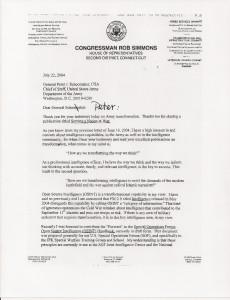
2004 Simmons (US) to Schoomaker (US) Concern of Army Mis-Definition of Open Source Intelligence (OSINT) as a Category of Information Instead of a Transformational Discipline in its Own Right

Historic Contributions, History of Opposition, Policy
0Shares

General Schoomaker and Congressman Rob Simmons understood each other.Ā  The letter below, from Congressman Simmons to General Schoomaker, was intended to give General Schoomaker an opportunity to instruct LtGen Keith Alexander, then Assistant Chief of Staff for Intelligence , as to his duties.Ā  A change in Army doctrine resulted, and separate Open Source Intelligence (OSINT)doctrine was developed, but developed very badly.Ā  The Army G-2 mafia never took OSINT serioiusly as a separate discipline, and together with the Foreign Broadcast Information Service (FBIS) never growing past its broadcast monitoring role, was a severe impediment to progress in this arena.Ā  LtGen Alexander, today the Director of the National Security Agency (NSA) understood how to use OSINT in support of ABLE DANGER and in support of NSA missions, but he never understood the urgency of making OSINT a discipline in its own right that could be used to support all of the Army's mission areas, Whole of Government inter-agency planning, programming, and campaign execution, and even less so, coalition and multinational multifunctional operations with Non-Governmental Organizations (NGO), such as the Defense Advanced Programs Agency (DARPA) has consistently supported with its annual STRONG ANGEL exercise.

When Congressman Simmons lost by 80 votes in 2006, in large part because two newspapers in his District did not do their homeword and turned against him for not having “big ideas”–nothing could have been further from the truth–the Army G-2 mafia immediately down-graded OSINT, relegating it to contractors who know nothing of OSINT and refuse to sub-contract experts who do.Ā  With the exception of the OSINT unit at the US Special Operations Command, Army OSINT is totally hosed today, and much in need of a G-2 that understands both “full-spectrum” HUMINT and “full-spectrum” OSINT.Ā  They have no bench from which to find such a person.

"The Letter"
"The Letter"

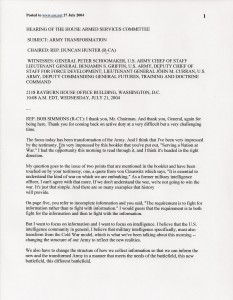
2004 Simmons (US) & Schoomaker (US) Hearing on Army Transformation Remarks on Open Source Intelligence (OSINT)

Historic Contributions, Legislation
0Shares

General Peter Schoomaker, USA (Ret), brought back from retirement to be Chief of Staff of the U.S. Army, was among a tiny handful of seniors who understood the importance of moving ahead with Open Source Intelligence (OSINT), having himself created the first modern “full spectrum” OSINT unit at the U.S. Special Operations Command (USSOCOM) in 1997.Ā  In the below exchange led by Congressman Rob Simmons of Connecticutt, the two are executing a public “dance” that moves OSINT up the priority ladder.

Hill Testimony
Hill Testimony