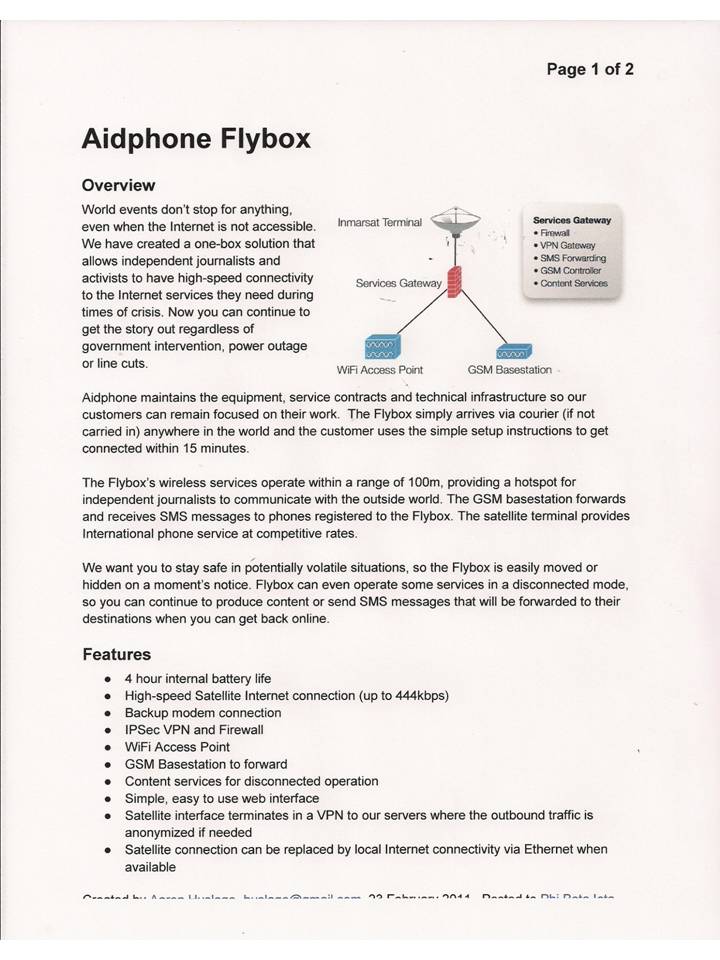
Two Pages Online . . Aaron Huslage . . ContactCon

The truth at any cost lowers all other costs — curated by former US spy Robert David Steele.
Two Pages Online . . Aaron Huslage . . ContactCon

It's not easy. It's hard to get straighter than straight.
Over time, processes that seek to decrease entropy and create order are valued, but improving them gets more difficult as well. If you're seeking to make the organized more organized, it's a tough row to hoe.
Far easier and more productive to create productive chaos, to interrupt, re-create, produce, invent and redefine.
Robert Garigue: Feedback for Dynamic System Change
Reference: Russell Ackoff on Doing Right Things Righter
Review: Reflexive Practice–Professional Thinking for a Turbulent World

Jon Lebkowsky is, among many things, contributing editor of Extreme Democracy (Lulu.com, 2005). His briefing below brings up many points, among which three stand-out:
1. There is no lack of intelligence–what is lacking are the tools for achieving extreme democracy in the face of a tsunami of noise and electronic pollution, with five core functional requirements: gather data, analyze data, generate options, choose/vote, and implement.
2. The principle challenge to democracy at this point in time is not from governments, but rather from those corporations that presume to “own” the Internet and all content irrespective of who generates it.
3. Freedom Box (and what we have begun calling the Autonomous Internet) are an alternative–while he does not go into detail it is clear that there is a sufficiency of both money and knowledge to create a distributed Autonomous Internet.
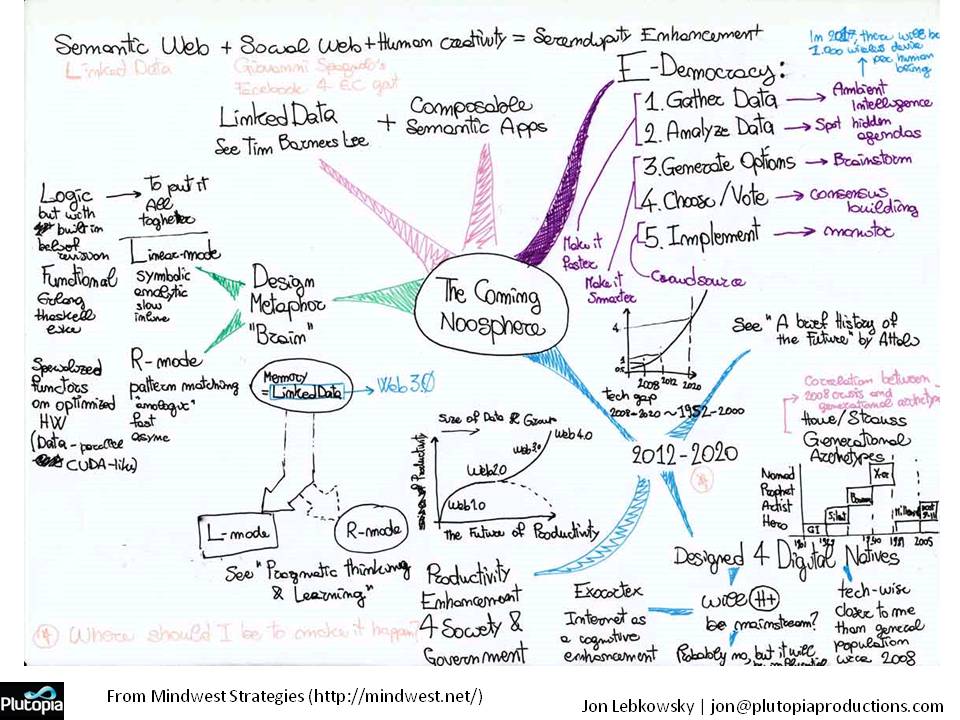
Briefing Online (Downloadable, No Notes)
See Also:
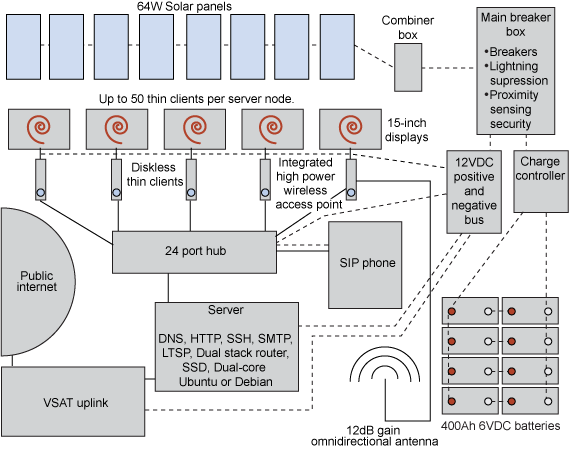
SolarNetOne: Solar-powered networking for anyone
Linux and open technologies deliver the Internet anywhere
Summary: In many parts of the world, the power grid is shoddy, computers are scarce, and connectivity is even rarer. Thus, as with many other modern practices and technologies, populations are increasingly bifurcated into the “computing haves” and the “computing have-nots.” But many are addressing the divide. SolarNetOne is a turnkey Internet hotspot—power, computers, and satellite uplink—you can install virtually anywhere, for less than the cost of a subcompact car.
Phi Beta Iota: This is not to be confused with OpenBTS and $2 a month cellular service, but it does appear to be promising. Read more at the IBM developerWorks page for SolarNetOne.

Dear friends,
Recently I've seen a swirl of information (mostly on the National Coalition for Dialogue and Deliberation listserv) about participatory budgeting. Below, you'll find a sampling of this info, in relatively raw form. I do not know enough to sort it all out, but it looks really fascinating.
Most of this material is about online public budgeting exercises, but some of it also describes the kind of face-to-face, seriously empowered mass-participatory civic budgeting processes developed in Brazil which have spread widely in the last decade or so.
I had no idea there was so much activity in this arena. Given
(a) the attention currently focused on the budget crisis,
(b) the dire impact of that crisis at all levels of government in so many places,
(c) the extreme consequences that could arise from this or that approach to addressing the crisis, and
Continue reading “Participatory Budgeting Practices, Games, Resources”
 HOW TO COMMUNICATE IF THE U.S. GOVERNMENT SHUTS DOWN THE INTERNET
02-07-2011 8:48 pm – Wallace
Liberty News Online
Scenario: Your government is displeased with the communication going on in your location and pulls the plug on your internet access, most likely by telling the major ISPs to turn off service.
This is what happened in Egypt Jan. 25 prompted by citizen protests, with sources estimating that the Egyptian government cut off approximately 88 percent of the country's internet access. What do you do without internet? Step 1: Stop crying in the corner. Then start taking steps to reconnect with your network. Here’s a list of things you can do to keep the communication flowing.
———————
PREVENTIVE MEASURES:

16+ Projects & Initiatives Building Ad-Hoc Wireless Mesh Networks
For those interested in alternative internet infrastructures, I’ve been assembling a list of projects and initiatives working to build mesh network solutions, as well as communities and resources around this topic. I’ve also posted this on Quora. Please feel free to add any projects I’ve missed. We’re hoping to understand the landscape of this initiative and how these projects & communities can better coordinate their efforts, in preparation for the Contact Conference in NYC this October 20, 2011.
 Projects:
– Open Mesh Project – building a mesh network for Egypt
– Open Source Mesh – group looking at how to build a reliable open source meshing software
– B.A.T.M.A.N. – better approach to mobile ad-hoc networking; routing protocol for multi-hop ad-hoc mesh networks
– Roofnet – 802.11b/g mesh network in development at MIT CSAIL
– GNUnet – framework for secure p2p networking that doesn not use any centralized or otherwise trusted services
– Dot-P2P – a free, decentralized, and open DNS system
– SMesh – seamless wireless mesh network being developed at John Hopkins University
– Coova – open source software access controller for captive portal (UAM) and 802.1X access provisioning
– Babel – a loop-free distance-vector routing protocol for IPv6 & IPv4
– SolarMESH – solar powered IEEE 802.11 wireless LAN mesh network and relaying infrastructure solution
– WING – wireless mesh network for next-generation internet; partially built on Roofnet
– Daihinia – a tool for WiFi; turns a simple ad-hoc network into a multi-hop ad-hoc network
– P2P DNS – building a distributed p2p DNS system
– Digitata.org – develop an inexpensive infrastructure (low bandwidth internet terminals) for basic internet exposure to children in African countries
– Netsukuku – an ad-hoc netowork that uses only WiFi connectivity and a specifically-built adddress system that allows direct communications between machines without resorting to the HTTP protocol
– Tonika – open source organic network project; administration-free platlform for large-scale open-membership (social) networks with robust security, anonymity, resilience and performance guarantees
