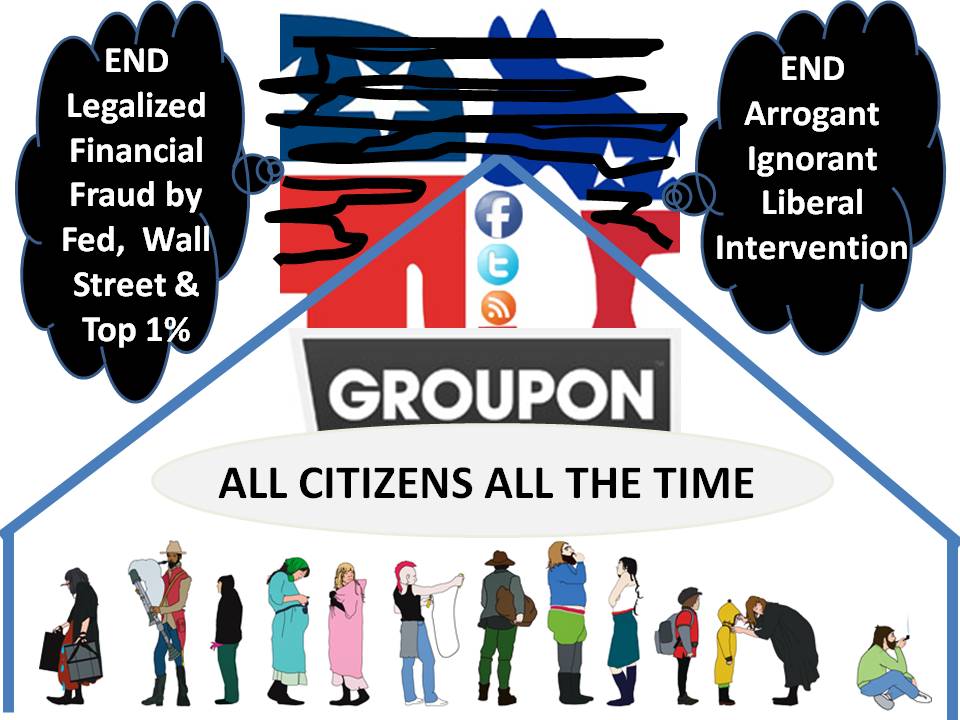
This week's Book post, Infinite Wealth for All, set the stage for this week's Politics post, which focuses on The New Craft of Cyber-Intelligence–a blending of advanced public intelligence and advanced Information Operations (IO). Let's start with a great Mashable piece, 4 Predictions for the Future of Politics and Social Media, from which I have remixed the graphic showing the two-party tyranny sniffing at social media.
1. Stuxnet
2. TARP is Cheap
3. Common School Standards
4. Rise of Natural Gas
5. Twilight of the Desktop
20 Hopeful Stories (YES! Magazine)
1. Climate Crisis Response Takes a New Direction
2. Wikileaks Lifts the Veil
3. Momentum is Building for the Abolition of Nuclear Weapons
4. Resilience is the New Watchword
5. Health Care—Still in Play
6. Corporate Power Challenged
7. A local economy movement is taking off
8. Cooperatives Make a Comeback.
9. A Turn Away from Homophobia
10. Social Movements Still Our Best Hope
Institute for Science and International Security (ISIS)
Phi Beta Iota: US Supervisory Control and Data Acquisition (SCADA) computer systems are still on the Internet and still very vulnerable to internal and external interference, as well as the standard 50% “errors and omissions” that come with sloppy computer work so characteristic of US vendors. Many sounded the alarm in 1990 (Winn Schwartau, Peter Black) through 1994 (Robert Steele, various field grade officers at the Air War College) but no one wanted to listen. The US is as close to a complex melt-down (political-legal, socio-economic, ideo-cultural, techno-demographic, natural-geographic) as we have witnessed in our lifetime.
Although other papers have been written since then, the three “originals” in the author's view are Major Gerald R. Hust, “Taking Down Telecommunications”, School of Advanced Airpower Studies, 1993); Major Thomas E. Griffith, Jr., “Strategic Attack of National Electrical Systems”, School of Advanced Airpower Studies, 1994; and H. D. Arnold, J. Hukill, and A. Cameron of the Department of the Air Force, “Targeting Financial Systems as Centers of Gravity: ‘Low Intensity' to ‘No Intensity' Conflict”, in Defense Analysis (Volume 10 Number 2, pages 181-208), 1994.
The two greatest visions of a future dystopia were George Orwell’s “1984” and Aldous Huxley’s “Brave New World.” The debate, between those who watched our descent towards corporate totalitarianism, was who was right. Would we be, as Orwell wrote, dominated by a repressive surveillance and security state that used crude and violent forms of control? Or would we be, as Huxley envisioned, entranced by entertainment and spectacle, captivated by technology and seduced by profligate consumption to embrace our own oppression? It turns out Orwell and Huxley were both right. Huxley saw the first stage of our enslavement. Orwell saw the second.
We have been gradually disempowered by a corporate state that, as Huxley foresaw, seduced and manipulated us through sensual gratification, cheap mass-produced goods, boundless credit, political theater and amusement. While we were entertained, the regulations that once kept predatory corporate power in check were dismantled, the laws that once protected us were rewritten and we were impoverished. Now that credit is drying up, good jobs for the working class are gone forever and mass-produced goods are unaffordable, we find ourselves transported from “Brave New World” to “1984.” The state, crippled by massive deficits, endless war and corporate malfeasance, is sliding toward bankruptcy. It is time for Big Brother to take over from Huxley’s feelies, the orgy-porgy and the centrifugal bumble-puppy. We are moving from a society where we are skillfully manipulated by lies and illusions to one where we are overtly controlled.
Orwell warned of a world where books were banned. Huxley warned of a world where no one wanted to read books. Orwell warned of a state of permanent war and fear. Huxley warned of a culture diverted by mindless pleasure. Orwell warned of a state where every conversation and thought was monitored and dissent was brutally punished. Huxley warned of a state where a population, preoccupied by trivia and gossip, no longer cared about truth or information. Orwell saw us frightened into submission. Huxley saw us seduced into submission. But Huxley, we are discovering, was merely the prelude to Orwell. Huxley understood the process by which we would be complicit in our own enslavement. Orwell understood the enslavement. Now that the corporate coup is over, we stand naked and defenseless. We are beginning to understand, as Karl Marx knew, that unfettered and unregulated capitalism is a brutal and revolutionary force that exploits human beings and the natural world until exhaustion or collapse.
Back in 2009, Daniel Domscheit-Berg applied to the Knight News Challenge in the name of Wikileaks for $532,000 to fund a project to “improve the reach, use and impact of a platform that allows whistle-blowers and journalists to anonymously post source material.” At the time Domscheit-Berg was known to the world by the pseudonym “Daniel Schmitt” and made frequent appearances on behalf of Wikileaks alongside its editor-in-chief Julian Assange (including at the October 2009 Personal Democracy Forum Europe conference in Barcelona). Now, as is widely known, he and Assange have parted ways and Domscheit-Berg is part of a group organizing the launch of OpenLeaks.org, which is being described as more of a technological service provider to media organizations than as a central hub for leaks, and which is promising to roll out a detailed description of its organization and plans in January 2011.
It's illuminating to compare the 2009 Wikileaks News Challenge proposal–which made it to the final round of the prestigious program but was ultimately rejected by the Knight News Challenge judges–to Domscheit-Berg & Co's current plans for OpenLeaks. Obviously, until OpenLeaks starts functioning, we are comparing two different versions of “vaporware,” but in the same way that Wikileaks itself has evolved over the last year, I think you can see a parallel evolution how Domscheit-Berg and the others in his group are thinking about how best to expand the open information model as well.
IMPORTANT MONETARY NEWS ALERT: MAJOR, HISTORIC PROGRESS BEING MADE
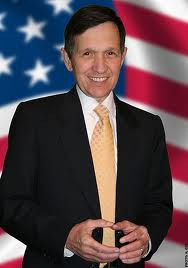
On Friday December 17th Congressman Dennis Kucinich (D,Ohio, 10th District) took a crucial and heroic step to resolve our growing financial crisis and achieve a just and sustainable money system for our nation by introducing the National Emergency Employment Defense Act of 2010, abbreviated NEED. The bill number is HR6550.
While the bill focuses on our unemployment crisis, the remedy proposed contains all the essential monetary measures being proposed by the American Monetary Institute in the American Monetary Act. These are what decades of research and centuries of experience have shown to be necessary to end the economic crisis in a just and sustainable way, and place the U.S. money system under our constitutional checks and balances. Yes it can be done!
We expect this bill will also be re-introduced next year in the 112th Congress. By putting it in now Congressman Kucinich accomplishes these important things:
* First, the seriousness of intent is underscored;
* Second, it gives our nation the opportunity to view, discuss and understand the necessary provisions, giving the chance to make improvements for re-introduction;
* Third it serves as a beacon to our beleaguered people, cutting through the error, vested interest and disinformation that has blocked monetary reform understanding and action in the past.
The American Monetary Institute has activated its blog to discuss and review any questions about this act. Just click on the blog link at our homepage.
To participate in this process, please sign up at the bottom of our home page at . Then, after reading the proposed legislation feel free to make comments or put questions on the blog, including thoughtful suggestions on how it might be improved.
Nearly one-fourth of the students who try to join the U.S. Army fail its entrance exam, painting a grim picture of an education system that produces graduates who can't answer basic math, science and reading questions, according to a new study released Tuesday.
. . . . . .
The military exam results are also worrisome because the test is given to a limited pool of people: Pentagon data shows that 75 percent of those aged 17 to 24 don't even qualify to take the test because they are physically unfit, have a criminal record or didn't graduate high school.
Phi Beta Iota: Information Operations (IO) starts in the public schoolhouse. On the battlefield, the “strategic corporal” may have the fate of an entire division in their hands. It's time to get back to basics. Side note: corporations struggling with the failure of schools including colleges are now focusing on identifying “trainable” individuals who can be remediated toward full performance. Restoring universal service and creating a common boot camp followed by branching into Home Service, Peace Corps, or Armed Forces would be one way to raise the over-all level. Dumping the age requirements and creating both mid-career and retired categories of specialists is another solution. IO is about human brains–collective intelligence–it more about humanity in action than it is about technology or the security of bits and bytes–the latter are support functions, not primary functions.