
SmartPlanet: Glasses provide live language translation

Advanced Cyber/IO, Civil Society, Collective Intelligence, Commercial Intelligence, Hacking, Liberation Technology, Mobile
Home Page

Glasses provide live language translation

Here’s the scene: you’re traveling, and you walk into a little restaurant and the menu is entirely in a language you don’t understand, without pictures. You’ve got a couple of choices. You can leave, and try to find a place with English translations. You can try to hack your way through a conversation with the waiter, who also doesn’t speak your language. Or, you can point randomly at the menu and live with the consequences.

Well, in the future there will be another, better, answer. Live, realtime translation built into your glasses. Enter: Project Glass. British hacker and DIYer Will Powell has built a pair of glasses that can (albeit roughly) project a translation of your conversation onto your glasses. Here’s what it looks like:

Read full post with images.

Michel Bauwens: Peer-to-peer production and the coming of the commons | Red Pepper

03 Economy, Advanced Cyber/IO, Civil Society, Commerce, Commercial Intelligence, Cultural Intelligence, Economics/True Cost, Ethics, Government, Hacking
Michel Bauwens

Peer-to-peer production and the coming of the commons | Red Pepper

Michel Bauwens examines how collaborative, commons-based production is emerging to challenge capitalism. Below, Hilary Wainwright responds

Capitalism in its present form is facing limits, especially resource limits, and in spite of the rapid growth of the BRICS (Brazil, Russia, India, China and South Africa) economies, is undergoing a process of decomposition. The question is whether the new proto-mode can generate the institutional capacity and the alliances able to break the political power of the old order.

Continue reading “Michel Bauwens: Peer-to-peer production and the coming of the commons | Red Pepper”

Smart Planet: In the Philippines, turning plastic waste into fuel

05 Energy, Commercial Intelligence, Earth Intelligence, Knowledge

In the Philippines, turning plastic waste into fuel

Plastic waste is a problem all over the world. And it is especially troubling in the Philippines where plastic waste piles up in Manila’s Payal landfill, unable to decompose. But one inventor thinks he might have found the answer to this chronic problem.
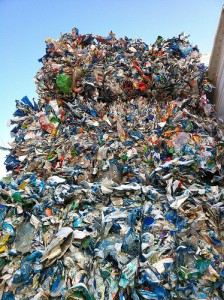
Jayme Navarro, founder of Poly-Green Technology and Resources is converting plastic waste into fuel through a process known as Pyrolysis.

ECO-Tech explains how it works:

“Pyrolysis is a fairly simple process, it starts by drying plastics to be processed. They are then shredded into smaller pieces, and heated in a thermal chamber. The melted plastic is continually heated until it boils and produce vapors. The vapor is passed into cooling pipes and distilled into a liquid, which is chemically identical to regular fuel.”

And one of the great benefits of converting plastic to fuel is that the fuel burns cleaner because of a low sulfur content. Navarro estimates that the fuel will be 10-20 percent cheaper because of the low production costs since the raw material is available in such large quantities.

The method has already been approved for industrial use and it is being tested for use in vehicles.

Reuters reporter Elly Park says: “While plastic fuel technology isn’t anything new, Navarro believes that an industrial scale version of his technology can not only help drivers on the road, but help the country dig itself out of its trash problem.”

Inventor turns plastic trash into liquid gold  [Reuters]

Filipino Inventor Turns Plastic Trash Into Liquid Gold  [ECO-Tech]

Photo via flickr/JMacPherson

See Also:

Paul Fernhout: Open Letter to the Intelligence Advanced Programs Research Agency (IARPA)

Video: Japanese Machine Making Fuel from Plastic, “Trash into Treasure”

Anthony Judge: 30 Disabling Global Trends (Article)

Collective Intelligence, Commercial Intelligence, Cultural Intelligence, Earth Intelligence
Anthony Judge

Convergence of 30 Disabling Global Trends

Mapping the social climate change engendering a perfect storm

Introduction
Checklist of 30 disabling trends
Spiraling trends: cyclones in a climate of change?
Interweaving “cyclones” and “anti-cyclones” in a global system
Emergent polyhedral configuration of alternating systemic functions
Insights from the Conference of the Birds?
Conclusion
References

EXTRACT:

Checklist of 30 disabling trends

Continue reading “Anthony Judge: 30 Disabling Global Trends (Article)”

Josh Kilbourn: David Stockman on Political Gridlock & Irresponsibility

03 Economy, Commerce, Commercial Intelligence, Corruption, Cultural Intelligence, Government
Josh Kilbourn

OMB's Stockman: “We're At The Fiscal Endgame”

To those on the hill and elsewhere who suggest this growing ‘fiscal cliff' and ‘debt ceiling' crisis will all get solved, former Office of Management and Budget (OMB) Director David Stockman tells Bloomberg TV that “they will punt, punt, punt and kick the can with partial solutions driven by eleventh hour crisis-based extensions that will go on for the whole of the next term!” When asked whether this economy will be mired in the doldrums, he rather ominously states “it will be worse, because we will be in recession” and notes that when the lame ducks re-look at the budget numbers with a realistic recession (instead of the current assumption of no recession within 12 years) it will be far worse and in a political environment where ‘we cannot possibly raise taxes – and we cannot possibly cut spending'. With a 78% disapproval rating for the ‘do nothing' Congress, Stockman is surprised that 16% somehow approve – approve of what? His warning is that unlike in past periods, today “we are completely paralyzed, there is an ideological divide on taxes and entitlement like we've never had before” and while he realizes that “the debt problem doesn't become a debt problem until the market suddenly have a wake up call and realize that if the Fed doesn't keep printing, it's game over.”

Continue reading “Josh Kilbourn: David Stockman on Political Gridlock & Irresponsibility”

Carnegie Council Competitive Ethics Just Business: Two Interviews on Competitive Intelligence – Richard Horowitz and Cynthia Cheng Correia

Commercial Intelligence, Knowledge
Julia Taylor Kennedy

Two Interviews on Competitive Intelligence – Richard Horowitz and Cynthia Cheng Correia

Carnegie Council Competitive Ethics Just Business

July 3, 2012

JULIA TAYLOR KENNEDY: Welcome to Just Business. I'm Julia Taylor Kennedy.

Thomas Jefferson once said, “I consider ethics, as well as religion, as supplements to law in the government of man.”

One field that really illustrates the distinction we all draw in our professional lives between ethics and law is competitive intelligence. Today on the show I'll talk to two competitive intelligence specialists to unpack the legal and ethical lines they draw each day.

First, a primer on competitive intelligence, known as CI for short. When the renowned Harvard Business School professor Michael Porter broke types of business competition into five categories in the 1970s, he established his legacy. Nearly every first-year MBA student now must internalize Porter's five forces. They are competitive threats, like substitute products, long-time industry rivals, and others.

Porter's forces also spawned a new industry, competitive intelligence. It's a service that some companies develop internally. Others hire a consulting firm. The main goal is to keep tabs on the competition and to project what competitive threats lie ahead.

This is a vital resource, but it's also one that businesses don't like to talk about because it seems kind of shadowy.

Continue reading “Carnegie Council Competitive Ethics Just Business: Two Interviews on Competitive Intelligence – Richard Horowitz and Cynthia Cheng Correia”

Winslow Wheeler: GAO’s June 14 F-35 Report Understates Its Own Findings; Uses Misdirecting DOD Criteria

Commerce, Commercial Intelligence, Corruption, Economics/True Cost, Government
Winslow Wheeler

Phi Beta Iota:  Until governments commit to true-cost economics (and of course to telling the truth and being fully transparent) they will not achieve full legitmacy and efficacy in serving the public interest.  The work of one man, Winslow Wheeler, should shame all governments by example, but especially the US Government, where no fraud, waste, or abuse is neglected as long as Members of Congress get their 5% kick-back.

How the F-35 Nearly Doubled In Price (And Why You Didn’t Know)

On June 14 — Flag Day, of all days — the Government Accountability Office released a new oversight report on the F-35: Joint Strike Fighter: DOD Actions Needed to Further Enhance Restructuring and Address Affordability Risks. As usual, it contained some important information on growing costs and other problems. Also as usual, the press covered the new report, albeit a bit sparsely.

Fresh bad news on the F-35 has apparently become so routine that the fundamental problems in the program are plowed right over. One gets the impression, especially from GAO’s own title to its report, that we should expect the bad news, make some minor adjustments, and then move on. But a deeper dive into the report offers more profound, and disturbing, bottom line.

Continue reading “Winslow Wheeler: GAO's June 14 F-35 Report Understates Its Own Findings; Uses Misdirecting DOD Criteria”

noble gold