Michel Bauwens: The Emerging Fourth Sector

Collective Intelligence, Commercial Intelligence, Communities of Practice, Cultural Intelligence, Culture, Earth Intelligence, Economics/True Cost, P2P / Panarchy
Michel Bauwens

Richly deserving of careful attention.

The Emerging Fourth Sector

The Three Traditional Sectors

Businesses create and distribute goods and services that enhance our quality of life, promote growth, and generate prosperity. They spur innovation, reward entrepreneurial effort, provide a return on investment and constantly improve their performance responding to market feedbacks. They draw on the skills, effort and ingenuity of individual workers, and share with them the economic value created by the enterprise.

Non-profit organizations give us ways to celebrate, build and protect the many human values that give rise to healthy, thriving communities. They have worked to ensure that all people have adequate necessities of life, including clean air, water, food and shelter; an equitable share of wealth and resources; and opportunity to develop their full physical, mental and spiritual potential. They create spaces to celebrate the joy of culture and artistic expression, and reveal opportunities for generosity. They have helped protect the environment, working to ensure that human capacities, technologies and organizations sustain and support, not systemically alter, degrade or destroy, the Earth, its diversity of life or the ecological systems that support life. They remind us that many species share this planet and depend on each other, and that humanity must not only care for itself, but must steward an entire world.

Continue reading “Michel Bauwens: The Emerging Fourth Sector”

DefDog: Can Crowd-Sourcing Save the US Economy?

Collective Intelligence, Commercial Intelligence
DefDog

Infographic – Can Crowdfunding Save The U.S. Economy?

About Rock The Post. Rock The Post is a crowdfunding website designed to fund small businesses, entrepreneurs, and nonprofits. It is the ideal tool for entrepreneurs to leverage networks, reach out to new contacts, and fill in the missing pieces of their projects. Rock the Post provides budding businesses with the means necessary to amass resources and flourish.

Click on Image to Enlarge


Michel Bauwens: Renewables Changing Energy Market in 5 Years

05 Energy, Commercial Intelligence, Extraterrestial Intelligence
Michel Bauwens

How renewables will change electricity markets in the next five years

Ruggero Schleicher-Tappeser

Science Direct, 3 June 2012

Abstract

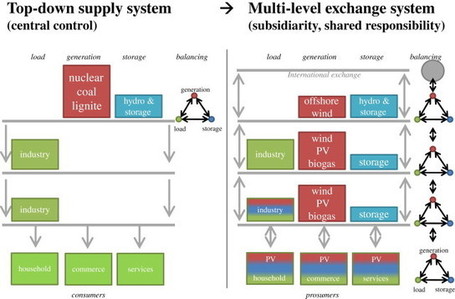
Photovoltaic (PV) cells, onshore wind turbines, internet technologies, and storage technologies have the potential to fundamentally change electricity markets in the years ahead. Photovoltaic cells are the most disruptive energy technology as they allow consumers of all sizes to produce power by themselves—new actors in the power market can begin operating with a new bottom-up control logic. Unsubsidised PV markets may start to take off in 2013, fuelling substantial growth where PV power is getting cheaper than grid or diesel backup electricity for commercial consumers.

Click on Image to Enlarge

Managing loads and achieving a good match between power consumption and weather-dependent power production will likely become a key issue. This consumption—production balance may trigger massive innovation and investment in energy management technologies involving different kinds of storage and controls. Increasing autonomy and flexibility of consumers challenges the top-down control logic of traditional power supply and pushes for a more decentralised and multi-layered system. How rapidly and smoothly this transformation occurs depends to a large extent on the adaptation speed of the regulatory framework and on the ability of market players to develop appropriate business models. The paper discusses conflicts of interest; hurdles and drivers; opportunities; and traps for this perspective.

See Also:

05 Energy (148)

Paul Craig Roberts: Collapse at Hand – and ONE THING an Honest Government Could Do To Make It All Right

03 Economy, 07 Other Atrocities, 09 Justice, 10 Transnational Crime, 11 Society, Blog Wisdom, Budgets & Funding, Commerce, Commercial Intelligence, Corruption, Cultural Intelligence, General Accountability Office, Government, Law Enforcement, Money, Banks & Concentrated Wealth, Office of Management and Budget
Paul Craig Roberts

Collapse At Hand

Ever since the beginning of the financial crisis and quantitative easing, the question has been before us: How can the Federal Reserve maintain zero interest rates for banks and negative real interest rates for savers and bond holders when the US government is adding $1.5 trillion to the national debt every year via its budget deficits? Not long ago the Fed announced that it was going to continue this policy for another 2 or 3 years. Indeed, the Fed is locked into the policy. Without the artificially low interest rates, the debt service on the national debt would be so large that it would raise questions about the US Treasury’s credit rating and the viability of the dollar, and the trillions of dollars in Interest Rate Swaps and other derivatives would come unglued.

In other words, financial deregulation leading to Wall Street’s gambles, the US government’s decision to bail out the banks and to keep them afloat, and the Federal Reserve’s zero interest rate policy have put the economic future of the US and its currency in an untenable and dangerous position. It will not be possible to continue to flood the bond markets with $1.5 trillion in new issues each year when the interest rate on the bonds is less than the rate of inflation. Everyone who purchases a Treasury bond is purchasing a depreciating asset. Moreover, the capital risk of investing in Treasuries is very high. The low interest rate means that the price paid for the bond is very high. A rise in interest rates, which must come sooner or later, will collapse the price of the bonds and inflict capital losses on bond holders, both domestic and foreign.

The question is: when is sooner or later? The purpose of this article is to examine that question.

Continue reading “Paul Craig Roberts: Collapse at Hand – and ONE THING an Honest Government Could Do To Make It All Right”

Owl: China Swamps US Across the Board – Made in China Computer Chips Have Back Doors, 45 Other “Ways & Means” Sucking Blood from US

02 China, 10 Security, 11 Society, Civil Society, Commerce, Commercial Intelligence, Corruption, Cultural Intelligence, Government, Idiocy, IO Deeds of War, Military
Who? Who?

Two Ways the Chinese May Take Over the World and the US:

1) Chinese Stuxnet for the Rest of the World

If what this analyst says is true, it paints a truly astonishing in implication and very, very ugly picture of the national security situation in store for most governments – especially in the US:

Hardware Assurance and its importance to National Security

Current issues. UK officials are fearful that China has the capability to shut down businesses, military and critical infrastructure through cyber attacks and spy equipment embedded in computer and telecommunications equipment. The Stuxnet worm is the most famous and best case example of a cyber attack on a network which wreaked devastation having easily compromised conventional software defensive systems. There have been many cases of computer hardware having backdoors, Trojans or other programs to allow an attacker to gain access or transmit confidential data to a third party. Considerable focus and expense has been invested in software computer networks and system defences to detect and eradicate such threats. However, similar technology with antivirus or anti Trojan capability for hardware (silicon chips) is not available. The computer or network hardware underpins and runs all the software defence systems. If the hardware has a vulnerability then all the energy in defending at the software level is redundant. An effort must be made to defend and detect at the hardware level for a more comprehensive strategy.

Our findings. Claims were made by the intelligence agencies around the world, from MI5, NSA and IARPA, that silicon chips could be infected. We developed breakthrough silicon chip scanning technology to investigate these claims.

We chose an American military chip that is highly secure with sophisticated encryption standard, manufactured in China. Our aim was to perform advanced code breaking and to see if there were any unexpected features on the chip.

We scanned the silicon chip in an affordable time and found a previously unknown backdoor inserted by the manufacturer. This backdoor has a key, which we were able to extract. If you use this key you can disable the chip or reprogram it at will, even if locked by the user with their own key. This particular chip is prevalent in many systems from weapons, nuclear power plants to public transport. In other words, this backdoor access could be turned into an advanced Stuxnet weapon to attack potentially millions of systems. The scale and range of possible attacks has huge implications for National Security and public infrastructure.

Read full article.

2) 45 Signs That China Is Colonizing America

Continue reading “Owl: China Swamps US Across the Board – Made in China Computer Chips Have Back Doors, 45 Other “Ways & Means” Sucking Blood from US”

Howard Rheingold: Google’s Next Step in Search

Advanced Cyber/IO, Commercial Intelligence
Howard Rheingold

This is what “Metaweb” was working on before they were acquired by Google — Howard

“When you search, you’re not just looking for a webpage. You’re looking to get answers, understand concepts and explore.

The next frontier in search is to understand real-world things and the relationships among them. So we're building a Knowledge Graph: a huge collection of the people, places and things in the world and how they're connected to one another.

This is how we’ll be able to tell if your search for “mercury” refers to the planet or the chemical element–and also how we can get you smarter answers to jump start your discovery.”

Introducing the Knowledge Graph

Phi Beta Iota: Google continues to do math hacks on digital garbage. While it is beneficial to connect the Internet of things with the Internet of words and numbers, Google is a) not a search company, something most do not understand, and b) not at all committed to making sense in the public interest. When Google can cannot every mind, written and spoken word, thing, and location relevant to understanding poverty, then we will be impressed. Until then, like Microsoft, Google is part of the problem, not the solution.

noble gold