Art as Evidence. A panel with Trevor Paglen, Jacob Appelbaum and Laura Poitras. Moderated by Tatiana Bazzichelli. Friday January 30, 2014, Haus der Kulturen der Welt, Berlin.
Documentary film director Laura Poitras, independent security analyst Jacob Appelbaum and artist and geographer Trevor Paglen reflect on upcoming frontiers of action and awareness for hackers, activists and artists in the present context of geopolitical surveillance and control. This conversation aims to trace a possible path towards investigating the deconstruction of power structures through experiencing them from within, critically reflecting on the role of art and activism today in the context of the post-9/11 politics and society. Crossing various practices and disciplines, from film documentary, computer security, hacking, experimental geography, photography, this talk reveals the role of art as evidence, as a practice of making people regain and reclaim their autonomy, have agency and live consciously in a networked world. Reconnecting with the courageous practice of whistleblowing and ethical resistance, Appelbaum, Paglen and Poitras highlight contradictions between public visibility and individual privacy, information disclosure and data protection in the digital and physical info-sphere.
Are informal intergovernmental organizations such as the BRICS the answer to our future security problems? Felicity Vabulas believes that states are beginning to see their virtues, which include diplomatic flexibility, rapid crisis response, and an unquestioning respect for national interests.
By Felicity Vabulas for ISN
Around the world, the efficacy, equity, and legitimacy of intergovernmental organizations (IGOs) are increasingly being questioned. As Stewart Patrick of the Council on Foreign Relations notes, “there has been no movement to reform the composition of the UN Security Council to reflect new geopolitical realities. Meanwhile, the World Trade Organization (WTO) is comatose, NATO struggles to find its strategic purpose, and the International Energy Agency courts obsolescence by omitting China and India as members.”
IGOs have never been a “magic bullet” solution for the world’s security challenges. Because they embody path dependence, they always reflect distributions of power that are quickly outpaced by reality. Today, states are increasingly making use of forms of governance outside of traditional institutions such as the European Union or the United Nations. In particular, informal intergovernmental organizations (a term I coined in an article co-authored with Duncan Snidal) are emerging as both substitutes and complements to existing formal IGOs—in areas as diverse as finance and security. The interplay between informal and formal institutions is what is generating the “messy multilateralism” that has characterized the opening decades of the 21st century.
Why informal intergovernmental organizations?
Informal IGOs are defined as an explicit group of associated states having explicitly shared expectations (rather than formalized treaties) that participate in regular meetings but have no independent secretariat, headquarters, or permanent staff. In its initial years, the Basel Committee on Banking Supervision (BCBS) was a good example of an informal IGO: states shared a common goal to cooperate on banking supervision, but they did not codify their agreement under international law. Other examples include the G8, the Concert of Europe, the Nuclear Suppliers Group, and the Paris Club.
Typically, states have preferred informal IGOs for five reasons:
It's about ‘combat experiences,' not length of deployment
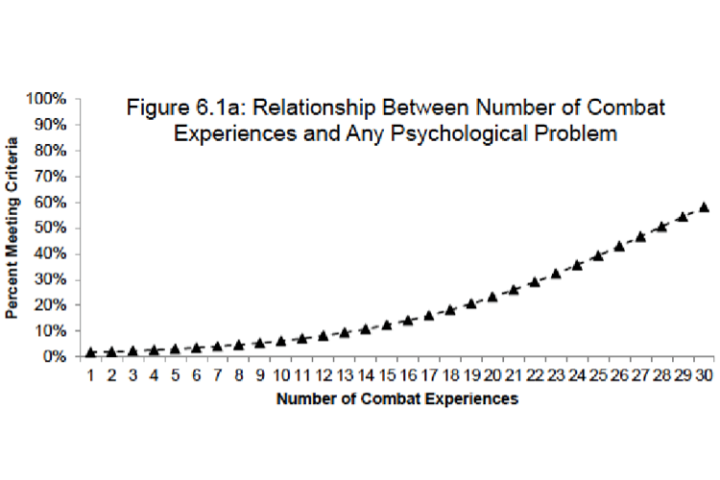
This Army graph makes crystal clear what many U.S. troops, and their loved ones, have long suspected: the more combat events they experience, the more mental-health problems they will suffer. In fact, according to this illustration from a new Army report, there is a direct linear relationship between combat exposure and resulting mental maladies.
Click on Image to Enlarge
While that notion is hardly surprising, this chart confirms what troops have long believed.
“As would be expected, there is a dose-dependent relationship between levels of combat experiences and well-being indices,” the Army’s just-released ninth Mental Health Advisory Team report says. “This relationship is clearly demonstrated for the percentage of Soldiers meeting screening criteria for any psychological problem.”
After years of debating to what degree repeated deployments and other factors play a role in post-traumatic stress and traumatic brain injuries—and the anxiety, depression and suicidal tendencies they can trigger—this chart indicates that it is the number of combat events, more than the time deployed, that drives up mental-health problems (of course, the two tend to travel together, but not always).
The U.S. military has been plagued by epidemics of mental-health problems since the wars in Afghanistan and Iraq began. The graphic shows that while troops can withstand several of what the Army calls “combat experiences,” their mental armor begins breaking down once they experience 10 or more such events.
Cryptocurrency: MtGox, the oldest and once-largest bitcoin exchange, appears to have a serious problem. Since about a week ago, clients’ bitcoin withdrawals have been deducted from their account, but the clients never received the money – the money withdrawn was effectively disappeared into thin air. The community is furious and as of now, MtGox has racked up over USD 38 million in such unfulfilled withdrawals.
MtGox was once the undisputed king of the hill among bitcoin exchanges. If MtGox froze its trading, which has happened, then bitcoin trading froze as a whole – the exchange was that dominant. In the past year, other exchanges have gradually sprung up, and today, MtGox accounts for about one-third of trade – it’s still a very strong player, even if not dominant.
MtGox has always had various regulatory problems transferring funds in and out of US Dollars, but according to client testimonies and reviews, other central-bank currencies – euros, yen – have always worked like clockwork. Since about a week back, though, withdrawals of bitcoin – the opposite of central-bank currency – from the exchange have started to fail in a seemingly random fashion.
When bitcoin funds are transferred, that normally happens instantly – the received sees the funds within seconds. That’s one of the strengths of bitcoin: you can transfer money, unlimited amounts of money, anywhere in the world instantly and unstoppably.
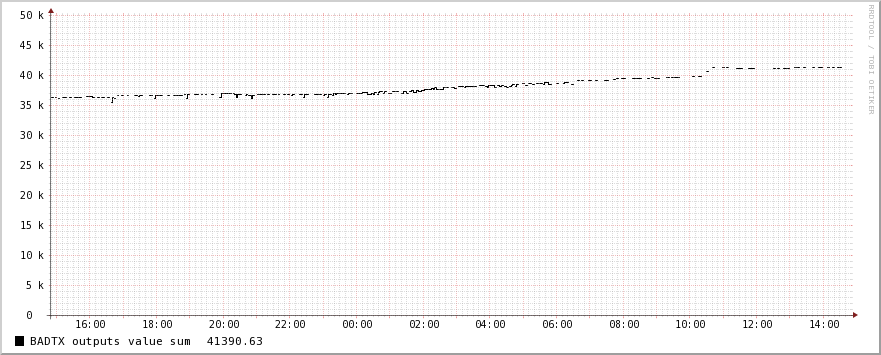
Since about a week ago, MtGox has not processed all requested bitcoin withdrawals and many clients have not received their bitcoins. Instead, some of the withdrawals were processed while the rest of the withdrawals remain frozen in an undetermined condition. Affected users are upset by this since the money is gone from their account, but the bitcoins have not been transferred to the client’s control. As of noon on February 4, The Gox Report has this chart, which is based on MtGox’ own internal data:
Note the bottom, the sum of all “failed transactions” (BADTX), which is technospeak for “withdrawals where the money is gone from the client’s account but where the funds were not actually transferred to the client”. The total of such withdrawals, a total that has been steadily climbing since about January 25, has now reached 41,390. That amount is in bitcoin, and each bitcoin is worth $934 by MtGox’s own rate, making the disappeared client money exceed 38 million US dollars. That’s not exactly small change.
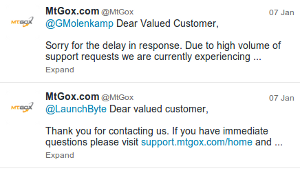
MtGox’ twitter account as of noon on Feb 4. It’s full of autoreplies, the newest response to a client being one month old.
Three years ago, I highlighted exchanges as one of four areas where the bitcoin community positively must improve to go mainstream. The above problem of the missing 38 million dollars is exacerbated by the fact that MtGox does not respond to clients’ questions until well over a week has passed, at which point a canned autoresponse is given. Additionally, there has not been any communication whatsoever about the ongoing problem. The lack of a phone number, the non-responses to client concerns over tens of millions of missing dollars, and the complete absence of messages about the situation does not make a professional operation.
Instead, clients of tens of millions of dollars are left on their own trying to figure out what is going on, if they’ll get their funds or not, and if so, when, and what the underlying problem could possibly be.
(I was recently asked by the Wall Street Journal in what ways MtGox failed to live up to Wall-Street-level professionalism, and declined to respond at the time. This is one of those ways. There are others, that are worse, that I have not published yet. That WSJ article concerned delays in withdrawals to dollars and euros, which could be explained by legacy-banking inertia; up until ten days ago, MtGox had executed bitcoin withdrawals perfectly.)
Looking at the bitcoin services forum, there are tons of complaints with the current exchange services. The entrepreneur should identify several opportunities here, just by looking at the front page of “discussions”, which read more like outraged complaints – mostly about MtGox.
As of February 4, clients are left speculating in these threads what the reason for this behavior is – whether it’s legitimate technical problems coupled with abysmal communication, deliberate fraud, possible insolvency, a technical attack on MtGox, or a number of other theories.
DISCLOSURE
The author is personally affected by MtGox’ behavior, having a six-figure dollar amount in such non-executed withdrawals. He considered Gox to be a safer repository for bitcoin than his own probably-hackable computer. That judgment may not have been accurate.
UPDATE: One hour after this article was published, MtGox broke the week-long silence with a statement saying little more than “we’re working on it”. In the statement, they also claim that the problem applies “primarily to large transactions”, a statement that doesn’t seem entirely correct when compared to client statements and testimonies on the bitcoin forums.
This is what is coming. The issue is not if, but how we will react.
This transition, in my view, is also part of the End of White Dominance Trend. A great deal of American politics today, as I have repeatedly noted, arises from the existential crisis in which, for the first time since Jamestown and the Mayflower, being born White will not automatically confer privilege. For many, particularly in the South, this causes enormous stress. Having the largest economy in the world be an economy of non-Whites will just add to this.
The self-censorship in American corporate media, as well as the deliberate obfuscation that arises from focusing attention on the meaningless and ephemeral, in my mind, is a trend that is becoming a major issue. It is almost impossible to get the level of news required for an informed electorate from mainstream sources.




 MtGox’