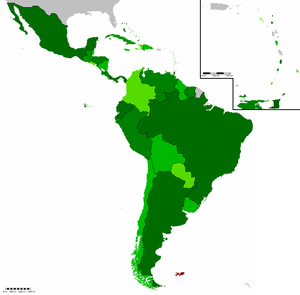
TheCommunity of Latin American and Caribbean States (Spanish: Comunidad de Estados Latinoamericanos y Caribeños, CELAC, Portuguese: Comunidade de Estados Latino-Americanos e Caribenhos, French: Communauté des États Latino-Américains et Caribéens, Dutch: Gemeenschap van de Latijns-Amerikaanse en Caribische landen) is the tentative name[1] of a regional bloc of Latin American and Caribbean nations created on February 23, 2010, at the Rio Group–Caribbean CommunityUnity Summit held in Playa del Carmen, Quintana Roo, Mexico.[2][3] It consists of all sovereign countries in the Americas, except for Canada, France, the Netherlands and the United States. British and Danish dependencies in the Americas are also not represented in CELAC.
CELAC is an example of a decade-long push for deeper integration within the Americas.[4] CELAC is being created to deepen Latin American integration and to reduce the once overwhelming influence of the United States on the politics and economics of Latin America, and is seen as an alternative to the Organization of American States (OAS), the regional body organized largely by Washington in 1948, ostensibly as a countermeasure to potential Soviet influence in the region.[4][5][6]
Feminist and anti-oppression activists, the human potential movement, and other ongoing organizers and movements for human betterment have played important roles in the emergence and nature of the Occupy movement. (The articles below are just a few examples.) Such movements have been organizing demonstrations, communities and networks and transforming people's consciousness and behavior in one form or another for hundreds of years. They've been training and empowering people and exposing them to the dark side of the social systems they live in and the possibilities for a better world, even as they themselves have become more experienced, aware, and skilled at new ways of living and being together.
Many people became leaders and practitioners of these organizing and transformational skills, forming a dispersed pool of resources for disparate transformational activities over the last many decades. The high purpose, tremendous passion, propitious timing, evocative non-specificity and intense community of OWS attracted a wide variety of these folks to its various centers of activity – the Occupations themselves – and into diverse support, leadership, and teaching roles. And then much was learned, experienced, created, modified… Had there been no past movement activities generating this pool of experience and skill, the Occupy movement would have looked very different indeed. And now the Occupy movement itself has become part of that ongoing learning, deepening, evolving collective experience…
As Occupy encampments are broken up by authorities, various commentators wonder if the movement is falling apart. They forget that through the activities of OWS in the last several months, tens of thousands of people have not only been inspired but have also taken leaps in awareness, experience and skill and that new leaders have emerged and new networks and groups have formed and new questions are being asked by newly focused and empowered citizens. The fact that this development is diffuse and nonlinear does not mean it does not exist. It only means that mainstream eyes will not necessarily recognize the new forms in which it will surface, over and over and over, expanding and adapting as it goes.
As one OWS sign insightfully said – in words whose significance not everyone will grasp – “This is a movement, not a protest.”
I have a feeling we ain't seen nothin' yet…
Blessings on the Journey. It has been a long time.
Open Source Works, which is the CIA’s in-house open source analysis component, is devoted to intelligence analysis of unclassified, open source information. Oddly, however, the directive that established Open Source Works is classified, as is the charter of the organization. In fact, CIA says the very existence of any such records is a classified fact.
“The CIA can neither confirm nor deny the existence or nonexistence of records responsive to your request,” wrote Susan Viscuso, CIA Information and Privacy Coordinator, in a November 29 response to a Freedom of Information Act request from Jeffrey Richelson of the National Security Archive for the Open Source Works directive and charter.
“The fact of the existence or nonexistence of requested records is currently and properly classified and is intelligence sources and methods information that is protected from disclosure,” Dr. Viscuso wrote.
This is a surprising development since Open Source Works — by definition — does not engage in clandestine collection of intelligence. Rather, it performs analysis based on unclassified, open source materials.
Thus, according to a November 2010 CIA report, Open Source Works “was charged by the [CIA] Director for Intelligence with drawing on language-trained analysts to mine open-source information for new or alternative insights on intelligence issues. Open Source Works’ products, based only on open source information, do not represent the coordinated views of the Central Intelligence Agency.”
As such, there is no basis for treating Open Source Works as a covert, unacknowledged intelligence organization. It isn’t one.
Big changes are coming. How you fare will be a function of the choices you make.
The threat is the ongoing breakdown of the global economic and political system. Things are already bad for many of us, and they will get worse for nearly everyone as the decades wear on. In almost all cases, if you stick with the current economic system: you and your family will suffer.
The opportunity is to build something new at the local level. A networked resilient community that produces most of what it needs and shares/sells/buys the rest virtually. An economic and political environment that you can have a say in.
One of the key parts of this opportunity for networked resilient communities? Local fabrication. The ability to make locally, using simple/inexpensive machines and designs downloaded from the Internet, the products we currently buy from China. This is a big idea. It's hard to get your head around. Once you do, it will change the way you think about the future. Here are three attempts to explain the idea (start with the video first).
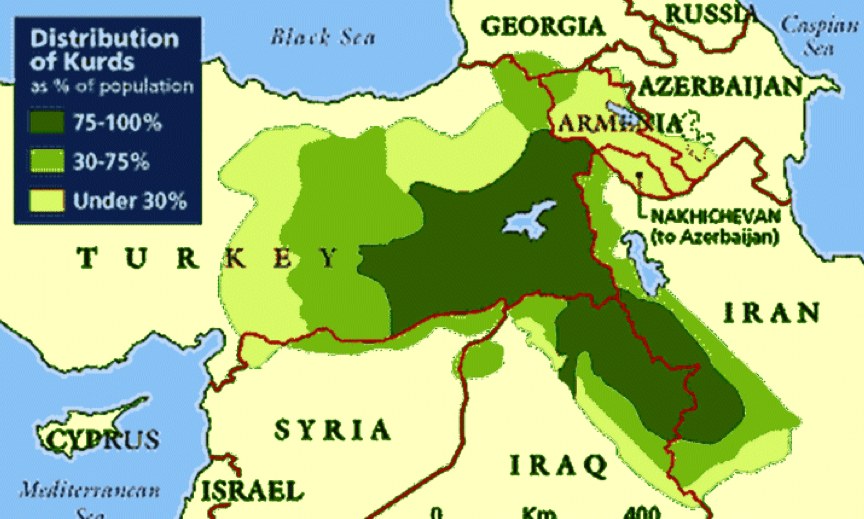
The below report by Patrick Cockburn, one of the best reporters now covering the Middle East, describes the growing tensions in Iraq over the question of sharing its oil wealth among its constituent regions. Although his report is important in its own right, its contents become even more ominous when they viewed in a larger historical context:
The long view of history is likely to record the greatest ‘sins' of Iraq, Iran, and Libya prompting interventions by the West have been related to the control of oil — not nuclear weapons; not any communist leanings during the Cold War; not support of worldwide terrorism.
Each country committed the unforgivable sin of being governed at one time by nationalistic leaders who believed the oil under each country belonged to that country and should be controlled by the government of that country — therefore, these leaders had to be removed:
Iran – Mohammed Mosaddegh, a popularly elected Prime Minister of Iran and social reformer, removed by a CIA/MI6 coup in August 1953.
Iraq – Saddam Hussein, a murderous neo-Stalinist dictator and social reformer (e.g., major achievements in women's rights and education), removed by military force in 2003.
Libya – Muammar Qaddafy, a quirky tribal dictator and social reformer (e.g., major achievements in women's rights and education) removed by military force in 2011.
Click on Image to Enlarge
One short-term common denominator in these imposed regime changes was that the nationalist leader was replaced by a more compliant government that agreed to an opening of that country's oil fields to exploitation by privately owned western oil companies.
While history does not repeat itself, memories of the past condition events in the future. Over the longer term, perceived wrongs are not forgotten, and such interventions can provoke blowbacks, which in turn provoke counteractions that enmesh the intervener in a welter of increasingly complicated conflicts. In the case of Iran, for example, the 1953 coup eventually backfired in 1979, when Reza Shah Pahlavi was overthrown by the Islamic revolution led by the Ayatollah Khomeini. Khomeini then established a regime retook control of Iran's oil fields, among other things. But the Iranian game is not over, and the historical pattern of move and countermove is in play, with the nationalist (Islamic) regime of Iran again in the West's crosshairs, allegedly because of its nuclear ambitions and support of international terror. Nevertheless, the glittering temptations of re-privatizing Persian oilfields are lurking in the background, attracting the private oil capitalists of the West like flies to honey.
Finish long comment from Spinney, plus reference, plus See Also.
Here's a scenario from William Buiter (the chief economist at Citi) on what could happen if the EU collapses:
Disorderly sovereign defaults and eurozone exits by all five periphery states would drag down not just the European banking system but also the north Atlantic financial system and the internationally exposed parts of the rest of the global banking system. The resulting financial crisis would trigger a global depression that would last for years, with GDP likely falling by more than 10 per cent and unemployment in the West reaching 20 per cent or more. Emerging markets would be dragged down too.
I have a couple of additions to William's scenario:
We are seeing crisis and depression scenarios like this with regularity now. They are all presented as being on the cusp of occurring. It should be very clear to everyone by now, that something fundamental is wrong with the global system and the crisis de jour is just its symptom. Nobody “in charge” seems to be able to diagnose the real problems with our system.
The solutions being proposed are either a) more confidence (through bailouts) and b) more confidence (through more deficit spending). In other words: the problem is merely psychological and all you and I need to do is take some anti-depressants to eradicate any lingering pessimism (why worry, let's party!). In short: there aren't any real solutions being offered.
None of the bad actors that profit from the behavior that led us into this crisis, either in government or in the financial sector, are held to account. The moral hazard here is so vast, it can (and likely will) swallow the current economic system.
WIM: What does it Mean?
It's very simple. It is almost a certainty that a global economic depression is on its way and there is absolutely nothing you or I can do to stop it (a ballot box solution now would be as effective as replacing the Captain of the Titanic after the ship hit the iceberg). So, what can you and I do? We can take control of our environment. Our objective is to build or buy access to a community that has the resilience to not only help us survive a global depression, but thrive during it. A resilient community that:
Negates the impact of inevitable supply disruptions, rationing, and price spikes.
Protects you from the political violence that will erupt (mobs and police states).
Has a functional local economy that has the potential to network with other functional local economies.
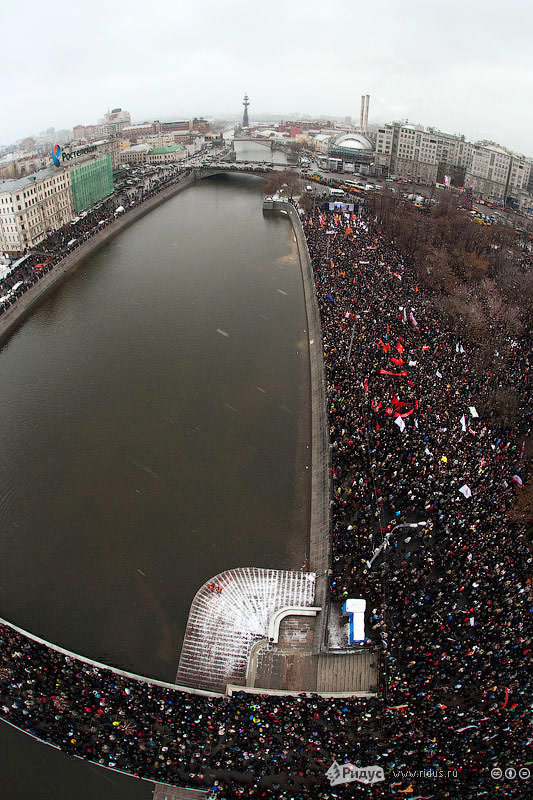
Open source protest, an organizational method that allows many, many small groups to come together to take on larger foes, has been spreading by leaps and bounds. It's now reached Moscow. A picture from today: The crowds on Moscow's Bolotnaya Square (and the spires of the Kremlin beyond). Here are some nice aerial shots.