Information revealing the truth about the level of surveillance just continues to pour out. We are beginning to get a sense of the scale of it. I find it notable that I get most of these stories from non-U.S. media. And if you have been following the stories I have been publishing in SR, and understand what is behind this, it gets really ! quite freaky
The President calls them a threat to national security. the Internet calls them heroes. A new wave of hacktivists is changing the way we handle secrets.
By Michael Scherer
Time, June 24, 2013, Pg. 22
The 21st century mole demands no payments for his secrets. He sees himself instead as an idealist, a believer in individual sovereignty and freedom from tyranny. Chinese and Russian spooks will not tempt him. Rather, it's the bits and bytes of an online political philosophy that attract his imagination, a hacker mentality founded on message boards in the 1980s, honed in chat rooms in the '90s and matured in recent online neighborhoods like Reddit and 4chan. He believes above all that information wants to be free, that privacy is sacred and that he has a responsibility to defend both ideas.
Phi Beta Iota: The rest of the world is sick of US misbehavior, upset at the continued posture of the US Government in covering up rather than remediating such persistent abuses, and saddened by the idiocy and passivity of the US public in the face of such atrocities. The national shame is enduring — and an obstacle to any possible progress on any front as long as the current Administration remains in lock-step with the mis-steps of its predecessor's crimes against humanity.
Three Explicit Photos and Full Article Below the Line
(Beirut) – The short answer is Iran and Hezbollah according to Congressional sources. “The Syrian army’s victory at al-Qusayr was more than the administration could accept given that town’s strategic position in the region. Its capture by the Assad forces has essentially added Syria to Iran’s list of victories starting with Afghanistan, Lebanon, Iraq, as well as its growing influence in the Gulf.”
Other sources are asserting that Obama actually did not want to invoke direct military aid the rebels fighting to topple the Assad government or even to make use of American military power in Syria for several reasons. Among these are the lack of American public support for yet another American war in the Middle East, the fact that there appears to be no acceptable alternative to the Assad government on the horizon, the position of the US intelligence community and the State Department and Pentagon that intervention in Syria would potentially turn out very badly for the US and gut what’s left of its influence in the region. It short, that the US getting involved in Syria could turn out even worse than Iraq, by intensifying a regional sectarian war without any positive outcome in sight.
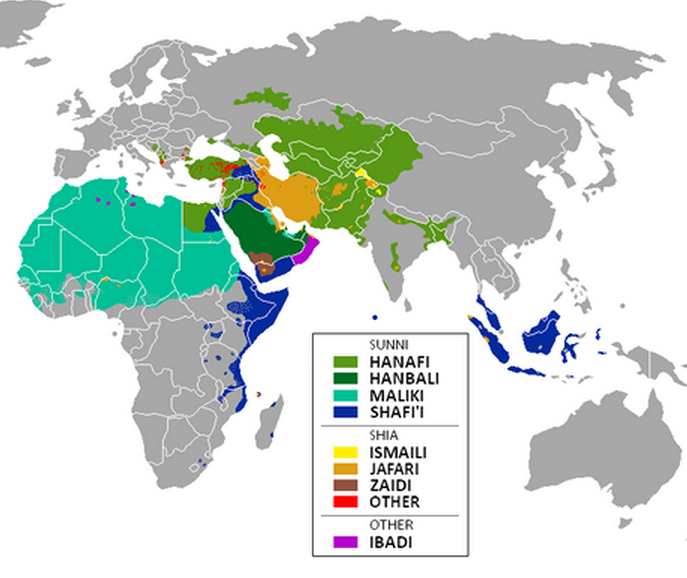
Americans were largely ignorant of the Muslim faith prior to 9/11, but in the years since we have at least learned that there are two major branches and that not all Muslims are Arab. I came across this graphic of global Muslim sects in other reading a few days ago and saved it for an opportune moment, not realizing how quickly I would need it.
The geographic display of the divide between Sunni and Shia is a fair match for the count of adherents – about 85% of all Muslims are Sunni. There are several conflicts where the sectarian differences are important. These include:
Alawite Syrians on the coast, terrified of the coming Sunni majority government
Majority Shia Bahrain chafing under a Sunni monarchy
Yemeni Shia fighting to restore the North/South Yemen divide
Click on Image to Enlarge
One bright spot has been NATO relations with the ethnic Hazara minority in Afghanistan. They are clearly visible in the global sects map as a yellow Jafari Shia donut hole in the middle of what is otherwise Hanafi Sunni territory.
In 1984 — the year not the book, but it was fitting — and five years before she died, Barbara Tuchman published a book called The March of Folly: From Troy to Vietnam. In one part of the book she looked at the destructive work of a series of a half-dozen popes, work destructive of the papacy, work that brought into being the protestant secession from the Catholic church. This was offered as an example of folly, of rulers acting against the interest of their own institution. It was also an example of what we so casually label “the imperial presidency.” That is, in these popes we watched the mad and cumulative concentration of power and normalization of abuses that Tuchman almost certainly was aware she was living through again — along with the debasement of an institution previously imagined to embody certain principles and integrity.
Does history repeat itself?
Is the Pope Catholic?
. . . . . . . . .
Clement VII, Pope from 1523 to 1534 / Barack Obama, President since 2009
“The new Clement's reign proved to be a pyramid of catastrophes. Protestantism continued its advance. . . . Supreme office, like sudden disaster, often reveals the man, and revealed Clement as less adequate than expected. Knowledgeable and effective as a subordinate, Guicciardini writes, he fell victim when in charge to timidity, perplexity, and habitual irresolution. . . . By 1527, hardly a part of Italy had escaped violence to life and land, plunder, destruction, misery, and famines. Clement's misjudgments having prepared the way, Rome itself was now to be engulfed by war.”
“The folly of the popes was not pursuit of counter-productive policy so much as rejection of any steady or coherent policy either political or religious that would have improved their situation or arrested the rising discontent. Disregard of the movements and sentiments developing around them was the primary folly. . . . When private interest is placed before public interests, and private ambition, greed, and the bewitchment of exercising power determine policy, the public interest necessarily loses, never more conspicuously than under the continuing madness from Sixtus to Clement. The succession from Pope to Pope multiplied the harm. Each of the six handed on his conception of the Papacy unchanged. . . . St. Peter's See was the ultimate pork barrel. Their three outstanding attitudes — obliviousness to the growing disaffection of constituents, primacy of self-aggrandizement, illusion of invulnerable status — are persistent aspects of folly. While in the case of the Renaissance popes, these were bred in and exaggerated by the surrounding culture, all are independent of time and recurrent in governorship.”

 Information revealing the truth about the level of surveillance just continues to pour out. We are beginning to get a sense of the scale of it. I find it notable that I get most of these stories from non-U.S. media. And if you have been following the stories I have been publishing in SR, and understand what is behind this, it gets really ! quite freaky