INFORMATION SHARING AND COLLABORATION IN THE UNITED STATES INTELLIGENCE COMMUNITY: AN ETHNOGRAPHIC STUDY OF THE
NATIONAL COUNTERTERRORISM CENTER
Bridget Rose Nolan
A DISSERTATION in Sociology Presented to the Faculties of the University of Pennsylvania in Partial Fulfillment of the Requirements for the Degree of Doctor of Philosophy
On balance, then, the combination of structural and cultural issues discussed in this dissertation—the role of status, the flow of information, and the tension between secrecy and openness—suggests that NCTC has not achieved the information sharing and collaboration envisioned by the 9/11 Commission.
“The potential of the surveillance state goes way beyond anything in George Orwell's 1984, (said Guardian Editor) Alan Rusbridger . ‘Orwell could never have imagined this concept of scooping up everything all the time’. The NSA stories were ‘clearly’ not about totalitarianism, but an infrastructure had been created that could be dangerous if it fell into the wrong hands. ‘In history, all the precedents are unhappy. The ability of these big agencies to keep entire populations under a system of monitoring and surveillance, is astonishing.’”
“George Orwell’s classic dystopian novel 1984 described a fictitious totalitarian society control(ing its) population through invasive surveillance. Today, as the Snowden documents make clear, it is the NSA that keeps track of phone calls, monitors communications, and analyzes people’s thoughts through data mining of Google searches and other online activity. Of course the US is not a totalitarian society. Still, the US intelligence agencies also seem to have adopted Orwell’s idea of doublethink—`to be conscious of complete truthfulness,’ he wrote, `while telling carefully constructed lies.’”
— “They Know Much More Than You Think”, James Bamford, N.Y. Review of Books, August 15, 2013
Below our fifth and final segment on what must be done to end the U.S. Executive Branch’s present creation of a Surveillance State and infrastructure for a future Police State. Because surveillance is largely invisible, many economically comfortable journalists remain complacent, and so many other issues – Syria, a government shutdown, gun control, climate change, economic inequality, food stamp cuts, Iran, etc. etc. – call for our attention, the enormity and unprecedented nature of the Executive Branch’s assault on democracy itself has not yet sunk in for many. It is those closest to the story, like Alan Rusbridger and NSA expert James Bamford, who understand the full implications of the Orwellian threat to everything in which we believe.
Inside the beltway, it’s doofuses ‘R us and perhaps the world’s biggest collection of gangsters, liars, criminal psychopaths and incompetents.
And now it’s getting exposed, even in the major mass media and the alternative Internet Media is going wild exposing the dark criminal underbelly of the USG and American Intel leaders who have now lost all the respect of “we the people” and have damaged their agencies beyond repair.
Phi Beta Iota: Full post provided below or available at link above. This is a solid example of a growing body of literature illustrative of the gap between the American public and its government.
I lived in Iraq during the 2003 Shock and Awe bombing. On April 1st, about two weeks into the aerial bombardment, a medical doctor who was one of my fellow peace team members urged me to go with her to the Al Kindi Hospital in Baghdad, where she knew she could be of some help. With no medical training, I tried to be unobtrusive, as families raced into the hospital carrying wounded loved ones.
Amazon Page
At one point, a woman sitting next to me began to weep uncontrollably. “How I tell him?” she asked, in broken English. “What I say?” She was Jamela Abbas, the aunt of a young man, named Ali. Early in the morning on March 31st, U.S. war planes had fired on her family home, while she alone of all her family was outside. Jamela wept as she searched for words to tell Ali that surgeons had amputated both of his badly damaged arms, close to his shoulders. What’s more, she would have to tell him that she was now his sole surviving relative.
I soon heard how that conversation had gone. It was reported to me that when Ali, aged 12, learned that he had lost both of his arms, he responded by asking “Will I always be this way?”
Returning to the Al Fanar hotel, I hid in my room. Furious tears flowed. I remember pounding my pillow and asking “Will we always be this way?”
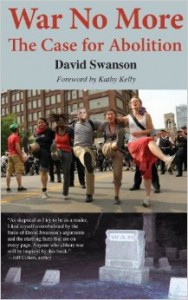
David Swanson reminds me to look to humanity’s incredible achievements in resisting war, in choosing the alternatives which we have yet to show our full power to realize.
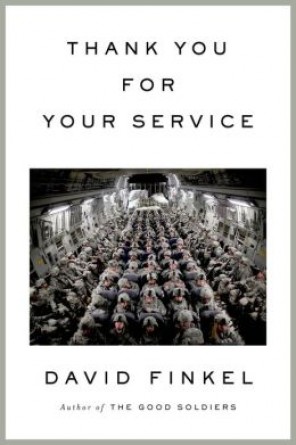
Nominally a sequel to The Good Soldiers, his 2009 account of an American infantry battalion at war in Iraq, David Finkel’s new book actually serves as a perfect companion to George Packer’s recent bestseller, The Unwinding. Like Packer, Finkel examines the human detritus left in the wake of fraudulent promises and collapsed illusions. In The Unwinding, Packer contemplates the fate of those victimized by cataclysmic economic change. In Thank You for Your Service, Finkel looks at those victimized by egregious military malpractice.
The post-industrial, high-tech, information-age economy unveiled near the end of the 20th century supposedly offered a template for permanent prosperity. The Great Recession upended such expectations. Although some Americans have gotten very rich indeed, far larger numbers of ordinary citizens find themselves unemployed and unemployable. With impressive sensitivity, Packer tells their story.
Amazon Page
Concocted at about the same time, a post-industrial, high-tech, information-age approach to waging war supposedly offered a template for assured victory. Iraq and Afghanistan have shredded such pretensions. Although some high-ranking military and civilian officials found ways to cash in, far larger numbers of ordinary soldiers (and their families) suffered, many of them grievously. In painful, intimate and at times almost voyeuristic detail, Finkel tells their story.
More specifically, Finkel, a reporter with The Washington Post, attends to what he calls the “after war.” His concern is with the soldiers who return from the war zone bearing wounds — and with the loved ones on whom those wounds also become imprinted. Above all, he is concerned with wounds that may not be fully visible: the post-traumatic stress disorder (PTSD), traumatic brain injury and related conditions that affect roughly a half-million younger veterans. Make that a half-million and counting.
To translate this disturbing statistic into flesh and blood, Finkel checks in on some of the soldiers featured in his previous book. What he finds is anger, anxiety, shame, depression, guilt, sleeplessness, self-abuse, spousal abuse, child abuse, alcohol abuse, drug abuse and suicidal tendencies, sometimes acted on, sometimes not. Shouting matches, crying jags and bizarre behavior along with guns and two-pack-a-day smoking habits abound, but not much in the way of useful therapy. Of one soldier, Finkel writes: “He began to take sleeping pills to fall asleep and another kind of pill to get back to sleep when he woke up. He took other pills, too, some for pain, others for anxiety. He began to drink so much vodka that his skin smelled of it, and then he started mentioning suicide.”
Western dialectics are beyond any doubt the pinnacle of human achievements. “Democracy” means “rule of corporations and oligarchs,”+ “Law” means “what civil servants need for their own profit”* while dictionaries define Ev·i·dence [noun] 1: False claim made by a government.
“Terrorists” are those fighting Western regimes; “freedom fighters” are those fighting for Western regimes. All others are slaves to be exploited by their governments.
The large image below belongs to the Ronald Reagan Library, where it is catalogued “President Reagan meeting with Afghan Freedom Fighters to discuss Soviet atrocities in Afghanistan. 2/2/83″ According to His Honorable Eminency, the President of the USA and its Colonies Reagan, the Afghani Mujahideen fighting against the illegitimate Soviet occupation were Freedom Fighters while their spinoff, the Taliban, were defined “terrorists” after they liberated their country.