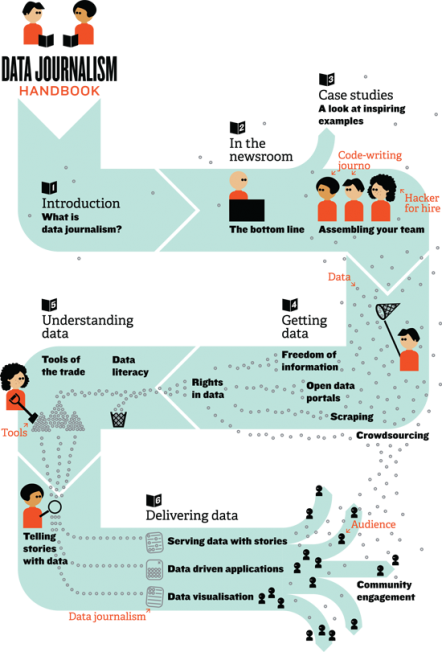
6 months ago at Mozilla Festival 2011, the Data Journalism Handbook was born. Thanks for your interest in the book – I have great pleasure in announcing that the Handbook is now live!
The Handbook features contributions from over 70 leading practitioners of data journalism from every corner of the globe, from Japan to Finland, Nigeria to the US and from leading news outlets such the New York Times, Zeit Online, the BBC and the Guardian. The Handbook is an open educational resource, under a creative commons licence (CC-BY-SA) so please share it with your friends and remix it. We hope that it will encourage many budding data journalists to look at data as a source and give them courage to tackle it, as well as showcasing some great examples of journalism using data as inspiration for future stories.
Also available for pre-order is the e- and print version from O'Reilly Media – http://oreil.ly/ddj-e-print – so if you are interested in a version to read offline, take a look!
We will soon have the facility to submit feedback via the website if you spot any errors or have any improvements for the next version,
—
Lucy Chambers
Infographic impresario Lulu Pinney created this superb poster, which gives an overview of the contents of the Data Journalism Handbook.
Phi Beta Iota: This is one of the most elegant trenchant discussions we have seen on the imperatives for arriving at collective intelligence through open methods. The entire contribution is below the line.
These are further elements to the debate (between Zeynep Tufekci and others) as to whether and how the Iron Law of Bureaucracy, which affects initially egalitarian distributed networks, can be countered.
1. Clay Shirky: inequality is not always unfair
Classic discusion of how the power law operates in blogs, and why it is inevitable, by one of the most influential commentators, by Clay Shirky.
“A persistent theme among people writing about the social aspects of weblogging is to note (and usually lament) the rise of an A-list, a small set of webloggers who account for a majority of the traffic in the weblog world. This complaint follows a common pattern we’ve seen with MUDs, BBSes, and online communities like Echo and the WELL. A new social system starts, and seems delightfully free of the elitism and cliquishness of the existing systems. Then, as the new system grows, problems of scale set in. Not everyone can participate in every conversation. Not everyone gets to be heard. Some core group seems more connected than the rest of us, and so on.
Prior to recent theoretical work on social networks, the usual explanations invoked individual behaviors: some members of the community had sold out, the spirit of the early days was being diluted by the newcomers, et cetera. We now know that these explanations are wrong, or at least beside the point. What matters is this: Diversity plus freedom of choice creates inequality, and the greater the diversity, the more extreme the inequality.”
As I said in the interview, the reason I started the letter was because I strongly believe that the most successful, happiest people on the planet in twenty years will be living in resilient communities.
Lots of good stuff in the RC letter — from DiY sewage systems to how to power an entire neighborhood with solar energy.
Phi Beta Iota: Creating resilient communities from the bottom up is what the federal government should be but is not facilitating. We're on our own.
No institution on planet Earth – no matter how allegedly “respectable” – seems exempt from lies, fraud, graft, corruption, and so on, and all of them are highly intent on exterminating the “whistleblowers” within them, even the Catholic Church:
“Vatican staffers who have been leaking embarrassing letters about corruption and nepotism inside the tiny city state are to be hunted down by a crack squad of cardinals led by a senior member of the religious group Opus Dei.
Irritated by the anonymous release of documents to the press this year, Pope Benedict has named Cardinal Julian Herranz, 82, to lead a three-man team which will haul in staffers for questioning and rifle through files until they catch the perpetrators of what has been dubbed “Vatileaks”.
A short statement printed on Thursday on the front page of the Vatican's daily newspaper warned the team had a full “pontifical mandate” to “shed complete light” on the whistle blowers, who have lifted the lid on alleged theft and false accounting.”
Phi Beta Iota: First off, whistleblowers are becoming more active in t he 21st Century — not only is a “public mind” coming alive with integral consciousness and integrity but the Internet is making it very very easy to do secure whistleblowing. The Catholic Church — as with any “institution” that thinks it is above all evolved standards of human decency, has been corrupt since the myths took over. Priests are required to be celibate for one reason and one reason only: to enable the Church to avoid family and survivor benefits. Child molestation and other perversions are an “acceptable” alternative to this corrupt mind-set. The Church has been financially corrupt since time immemorial. We applaud the whistleblowers — they are doing God's work against venal betrayers of the public trust.
Interesting…..as pointed out in the article, most people defer to the eminence of the individual and not to the substance of the message…..and then there is the criminal obfuscation of Wall Street.
Johnny Carson was in top form, but the show could have bogged down if his guest had delved into subtleties or overly serious discussion. However, Ehrlich had the perfect solution. He took a piece of posterboard and wrote in large letters for the TV audience:
D = N * I
“In this equation,” he explained, “D stands for damage to the environment, N stands for the number of people, and I stands for the impact of each person on the environment. This equation shows that the more people, the more pollution. We cannot control pollution without controlling the number of people.”
Johnny Carson looked at the equation, scratched his head, made a remark about never having been good at math, and commented that it all looked quite impressive.
Gene Sharp pioneered the study of nonviolent civil resistance. Some argue that his books were instrumental to the success of activists in a number of revolutions over the past 20 years ranging from the overthrow of Milosevic to ousting of Mubarak. Civil resistance has often been referred to as “nonviolent guerrilla warfare” and Sharp’s manual on “The Methods of Nonviolent Action,” for example, includes a list of 198 methods that activists can use to actively disrupt a repressive regime. These methods are divided into three sections: nonviolent protest and persuasion, noncooperation, and nonviolent intervention.
While Sharp’s 198 are still as relevant today as they were some 40 years ago, the technology space has changed radically. In Sharp’s “Dictionary of Power and Struggle: Language of Civil Resistance in Conflicts” published in 2012, Gene writes that “a multitude of additional methods will be invented in the future that have characteristics of the three classes of methods: nonviolent protest and persuasion, noncooperation, and nonviolent intervention.” About four years ago, I began to think about how technology could extend Sharp’s methods and possibly generate entirely new methods as well. This blog post was my first attempt at thinking this through and while it was my intention to develop the ideas further for my dissertation, my academic focus shifted somewhat.
With the PhD out of the way, my colleague Mary Joyce suggested we launch a research project to explore how Sharp’s methods can and are being extended as a result of information and communication technologies (ICTs). The time was ripe for this kind of research so we spent the past few months building a database of civil resistance methods 2.0 based on Sharp’s original list. We also consulted a number of experts in the field to help us populate this online database. We decided not to restrict the focus of this research to ICTs only–i.e., any type of technology qualifies, such as drones, for example.
This database will be an ongoing initiative and certainly a live document since we’ll be crowdsourcing further input. In laying the foundations for this database, we’ve realized once again just how important creativity is when thinking about civil resistance. Advances in technology and increasing access to technology provides fertile ground for the kind of creativity that is key to making civil resistance successful.
We invite you to contribute your creativity to this database and share the link (bit.ly/CivRes20) widely with your own networks. We’ve added some content, but there is still a long way to go. Please share any clever uses of technology that you’ve come across that have or could be applied to civil resistance by adding them.
Our goal is to provide activists with a go-to resource where they can browse through lists of technology-assisted methods to inform their own efforts. In the future, we envision taking the database a step further by considering what sequencing of said methods are most effective.
Phi Beta Iota: We continue to believe that the fastest — and perhaps the only near-term and non-violent — means to restore the Republic and restore democracy as well as moral capitalism in the USA is an Electoral Reform Summit that demands of our two-party corrupt Congress the Electoral Reform Act of 2012. Learn more at We the People Reform Coalition.