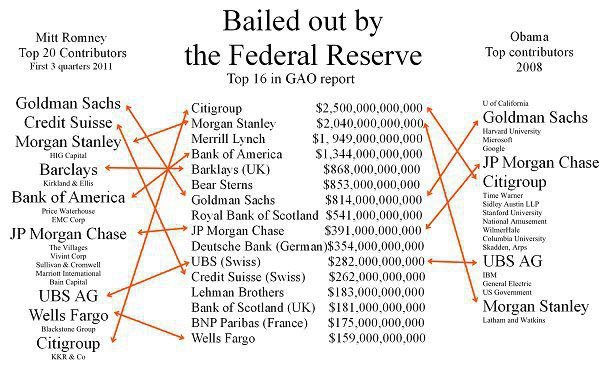
Source and More Data
Continue reading “Graphic: GAO Audit In One Graphic – Banks Buying Politicians”

The truth at any cost lowers all other costs — curated by former US spy Robert David Steele.
Source and More Data
Continue reading “Graphic: GAO Audit In One Graphic – Banks Buying Politicians”
 Public Banking in America
Democratizing Money – Restoring Prosperity

The Crazy Things That One Whistleblower Says Are Happening At JP Morgan Will Blow Your Mind
The Economic Collapse Blog,18 March 2012
Rampant silver manipulation? Rampant gold manipulation? Rampant LIBOR manipulation? Hiding MF Global client assets? These are all happening at JP Morgan according to an open letter reportedly written by an anonymous employee of the firm. The whistleblower also warns of a “cascading credit event being triggered” by derivatives related to Greek government debt. Unlike Greg Smith at Goldman Sachs, this whistleblower has chosen to remain anonymous for now. According to the letter, the whistleblower is still an employee of JP Morgan and has not resigned. But that does make it much more difficult to confirm what he is saying. With Greg Smith, we know exactly who he is and what he was doing at Goldman. As far as this anonymous whistleblower is concerned, all we have is this letter. So we must take it with a grain of salt. However, the information in this letter does agree with what whistleblowers such as Andrew Maguirehave said in the past about silver manipulation by JP Morgan. And this letter does mention Greg Smith's resignation from Goldman, so we know that it must have been written in the past few days. Hopefully this letter will cause authorities to take a much closer look at the crazy things that are going on over at JP Morgan and the other big Wall Street banks.
This anonymous letter was addressed to the CFTC, but unfortunately it looks like the CFTC has already chosen to ignore it.
The original letter from this anonymous whistleblower has already been taken down from the CFTC website. When you go there now, all you get is this message….
“The Comment Cannot Be Found. Please Return to the Previous Page and Try Again.”
Fortunately, there are many in the alternative media that copied this entire letter from the CFTC website.
The following is a copy of the original letter that the anonymous whistleblower from JP Morgan submitted to the CFTC….
———-
Continue reading “Josh Kilbourn: JP Morgan Whistleblower Being Ignored?”
Nine Years Later: More Shocked, Less Awed
When I lived in New York 20 years ago, the United States was beginning a 20-year war on Iraq. We protested at the United Nations. The Miami Herald depicted Saddam Hussein as a giant fanged spider attacking the United States. Hussein was frequently compared to Adolf Hitler. On October 9, 1990, a 15-year-old Kuwaiti girl told a U.S. congressional committee that she’d seen Iraqi soldiers take 15 babies out of an incubator in a Kuwaiti hospital and leave them on the cold floor to die. Some congress members, including the late Tom Lantos (D., Calif.), knew but did not tell the U.S. public that the girl was the daughter of the Kuwaiti ambassador to the United States, that she’d been coached by a major U.S. public relations company paid by the Kuwaiti government, and that there was no other evidence for the story. President George H. W. Bush used the dead babies story 10 times in the next 40 days, and seven senators used it in the Senate debate on whether to approve military action. The Kuwaiti disinformation campaign for the Gulf War would be successfully reprised by Iraqi groups favoring the overthrow of the Iraqi government twelve years later.
Elections: What Are They Good For?
I think two opposing trends have been at work in U.S. history. One is that of allowing more people to vote. This is an ongoing struggle, of course, but in some significant sense we've allowed poor people and women and non-white people and young people to vote. The other trend, which has really developed more recently, is that we've made voting less and less meaningful. Of course it was never as meaningful as many people imagine. But we've legalized bribery, we've banished third parties and independents, we've gerrymandered most Congressional districts into meaningless general elections and left one party or the other to exercise great influence over any primary. Rarely does any incumbent lose, and rarely does a candidate without the most money win. Extremely rare is a winning candidate who lacks some major financial backing. Rarer still is a candidate who even promises to pursue majority positions on most major issues, or who convincingly commits to following the will of the public over the will of the party. Most Congress members are pawns in a government with two partisan voices, not the voices of 535 individual representatives and senators. Rare, as well, is any possibility in a close primary or general election of verifying the accuracy of a vote count.
There appears to many observers little, sometimes even nothing, to be gained by voting. A lack of decent education and news media, combined with negative campaign ads that make the whole process seem filthy are probably a turn off. Yet roughly 55% of voting age people in the U.S. continue to vote in presidential elections and roughly 35% in off-year elections. And those numbers would probably go up if we didn't take people's right to vote away when we convict them of crimes, if we didn't deny citizenship to so many immigrants, or if we made voter registration automatic, stopped trying to intimidate people out of voting or forcing them to vote on second-class provisional ballots, made election day a holiday, etc.
We've also created a dominant media cartel that can — without any exaggeration — instruct large numbers of people whom to vote for — a situation that outrages some of us, but by definition is deemed acceptable by many others. Or, rather, it's not deemed acceptable, but it's either unnoticed or it's viewed as a tragedy of the commons that cannot be countered by any individual alone. On the Kucinich 04 presidential campaign, he would win the most applause, but then people would say “I'd vote for him if he were serious,” because their televisions had told them he wasn't one of the real, serious, viable choices, and either they believed that or they believed that everyone else believed it which left them powerless to single-handedly do anything about it.
Why I Am Leaving Goldman Sachs
The New York Times, 14 March 2012
TODAY is my last day at Goldman Sachs. After almost 12 years at the firm — first as a summer intern while at Stanford, then in New York for 10 years, and now in London — I believe I have worked here long enough to understand the trajectory of its culture, its people and its identity. And I can honestly say that the environment now is as toxic and destructive as I have ever seen it.
The Koch Brothers, The Cato Institute, And Why Nations Fail
Simon Johnson, Baseline Scenario, 8 March 2012
A dispute has broken out between the Cato Institute, a leading libertarian think tank, and two of its longtime backers – David and Charles Koch. The institute is not the usual form of nonprofit but actually a company with shares; the Koch brothers own two of the four shares and are arguing that they have the right to acquire additional shares and thus presumably exert more control. The institute and some of its senior staff are pushing back.
According to Edward H. Crane, the president and co-founder of Cato, “This is an effort by the Kochs to turn the Cato Institute into some sort of auxiliary for the G.O.P.” Bob Levy, chairman of the Cato board, told The Washington Post: “We would take closer marching orders. That’s totally contrary to what we perceive the function of Cato be.”
Far from being just an unseemly row between prominent personalities on the right, this showdown reflects a much deeper set of concerns for American politics and society. And it raises what I regard as the central question of an important book, “Why Nations Fail: The Origins of Power, Prosperity and Poverty,” by Daron Acemoglu and James Robinson that will be published on March 20.
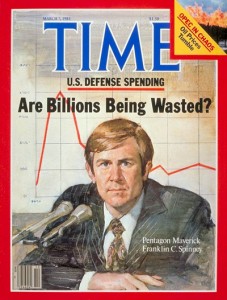
Continue reading “Chuck Spinney: Koch Brothers, Cato, Why Nations Fail”
IN 1976, NSA WAS TASKED TO HELP SECURE PRIVATE COMMS
As long ago as the Gerald Ford Administration, the National Security Agency was directed to help secure non-governmental communications networks against intrusion and interception by foreign — or domestic — entities, according to a recently declassified presidential directive.
“The President is concerned about possible damage to the national security and the economy from continuing Soviet intercept of critical non-government communications, including government defense contractors and certain other key institutions in the private sector,” wrote National Security Advisor Gen. Brent Scowcroft in National Security Decision Memorandum (NSDM) 338 of September 1, 1976.
“The President further recognizes that U.S. citizens and institutions should have a reasonable expectation of privacy from foreign or domestic intercept when using the public telephone system. The President has therefore decided that communication security should be extended to government defense contractors dealing in classified or sensitive information at the earliest possible time. He has also directed that planning be undertaken to meet the longer-term need to protect other key institutions in the private sector, and, ultimately, to provide a reasonable expectation of privacy for all users of public telecommunications.”
The directive ordered that “in confirmed threat areas,” existing communications networks involving classified information should be transitioned from microwave circuits to secure cable “as soon as possible.” A broader plan to protect non-governmental communications was also to be prepared.
“The President further directs the Director of the Office of Telecommunications Policy, with the participation and assistance of DOD and NSA, to prepare a detailed Action Plan setting forth the actions and schedule milestones necessary to achieve a wide degree of protection for private sector microwave communications. The Plan should identify needed policy and regulatory decisions, describe in detail the roles of industry and government, including management and funding considerations, and integrate the schedule for these actions with the technical development milestones.”
“The Action Plan should be based on the fundamental objective of protecting the privacy of all users of public telecommunications, as well as satisfying specific needs of the government,” the directive stated.
The 1976 directive was originally marked TOP SECRET / SENSITIVE (XGDS), where XGDS stood for “exempt from general declassification schedule.” It was declassified on September 13, 2011. The document had been requested through the mandatory declassification review process by Dr. John Laprise of Northwestern University.
The directive prefigures an ongoing controversy over the proper role, and the actual extent, of National Security Agency involvement in securing public communications.
In response to a FOIA lawsuit brought by the Electronic Privacy Information Center, the NSA said (and a court affirmed) that it could “neither confirm or deny” a relationship between the Agency and Google. NSA has also refused to release the 2008 National Security Presidential Directive 54, which reportedly tasks the Agency with certain cybersecurity functions.
Phi Beta Iota: This would be an excellent case study for the retrospective court martial, conviction, and demotion by two grades in retirement (affects pension) of every NSA director since then, with special attention to those serving after the alarm was sounded again in 1994. NSA today does not have the public interest in mind and could care less about presidential directives. It exists to create millionaires among NSA senior executives jumping to sweetheart “soft landings.” NSA and the Cyber-Command are an ideal candidate for the first joint GSA-OMB deep audit of secret spending since 2001.
