His Holiness the 14th Dalai Lama and Nobel Peace Laureates Rigoberta Menchu of Guatemala and Archbishop Desmund Tutu of South Africa, joined six other Nobel Peace Laureates urging President Obama to reject the Keystone XL pipeline, an environmental disaster in the making.
Phi Beta Iota: We find it fascinating that the activists are ignoring the larger crime, the use of fresh water to flush the tar sands in the first place.
Osama bin Laden spoke often of a strategy of “economic warfare” against the United States, a low-level war aimed at bankrupting the world's economic superpower. A decade after the 9/11 attacks, it's hard to argue that bin Laden's strategy was ineffective. The attacks themselves, according to the September 11 commission, cost Al Qaeda between $400,000 and $500,000 to execute. They have cost America, by our estimate, more than $5 trillion – a “return on investment” of 10,000,000 to one.
In addition to making the United States a global laughing stock, last month's dismaying political circus over what used to be routine legislation to increase the debt ceiling solidified the “let them eat cake” politics among the courtiers and plutocrats calling the shots from behind the curtains in the hall of mirrors that is Versailles on the Potomac. The general view is that there is nothing that can be done help the American people economically — at least some of the people — and those in trouble must tough it out on their own. Of course the funding for the perpetual war on terror will continue, and money will continue to flow to the welfare queens in the Military – Industrial – Congressional Complex, although perhaps at a slower rate in the short term, not mention the continued subsidies flowing to the banksters, agribusiness, big pharma, etc.
One outcome is out in the open, however: Obama may talk about jobs, but a fiscal policy designed to put common folk back to work is a non starter.
Joseph Stiglitz is perhaps the most erudite exponent of fiscal policy among the mainstream economists. To be sure, in this age of name-calling, he would be labeled as being left of center, or perhaps branded as a dreaded progressive, or even worse, a hated lefty socialist, but no one (irrational nut cases excepted) would call him a whacko.
In the op-ed below, he makes the clearest and most concise argument for an activist fiscal policy that I have yet read. Even readers viscerally disposed to hate the Keynes' theory of fiscal policy make an effort to deconstruct his arguments, to see if they have the intellectual wherewithal to refute his points without resorting to name-calling.
[note: I reformatted the op-ed slightly to highlight his main points, but did not change any text — readers will find original version at the link.]
Chuck Spinney
Sanary sur Mer, France
Published on Thursday, September 8, 2011 by Politico.com
Defining Psychological Operations is straightforward enough, but
determining where exactly it ends is extremely tricky. The US Department of Defense has infiltrated institutions around the world, they expend billions every year on domestic and foreign propaganda, yet they still only represent a single slice of the spectrum. Intelligence agencies, private think tanks and public corporations are all competing for attentional bandwidth, too. PSYOPS has become ubiquitous, metastasized into Standard Operating Procedure for the entire edifice of Western Culture. Our news and our entertainment, scientific studies, history books, political campaigns and activist movements are all just sponsored messages and paid promotions. From advertisements to astroturfing, everyone's got “desired effects” and everyone's got a “target audience” now.
Phi Beta Iota: PSYOP succeed when education fails. Education fails and PSYOP succeed when integrity fails. This ultimately boils down to Philosophy and the Social Problem (Will Durant, 2008 x 1916).
Below the line: structured and expanded list with links.
Historians will label the events of that September morning 10 years ago as the most destructive act of terrorism ever committed up to that time. But I suspect they will also judge America’s last decade as one of history’s worst overreactions.
Of course overreaction is what terrorists hope to provoke. If judged by that standard, 9/11 was also one of history’s most successful terrorist acts, dragging the United States into two as yet unresolved wars, draining the treasury of $1 trillion and climbing, as well as damaging America’s power and prestige. These wars have empowered our enemies and hurt our friendships, and have almost certainly generated more terrorists than they have killed.
Like other victims of terrorism, the United States believed that somehow the answer could be found in brute force. But ideas seldom yield to force, and militant Islam is an idea. The result has been the militarization of U.S. foreign policy.
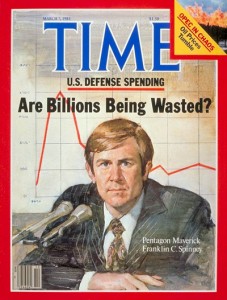
For years and years, advocates of big defense spending have argued there is a major economic benefit — jobs. These claims are ever more strident now because of high unemployment and threats to further growth in the defense budget. Hearing the footsteps on the unaffordable, underperforming F-35, Lockheed, among others, touts the jobs they pretend the program creates.
The defense budget does create jobs, but it is highly inefficient at it. Large portions of the total defense budget are spent on things that have nothing to do with jobs in the US; even the procurement and R&D accounts (i.e. the portions that porkers in and out of Congress claim to be US-jobs-rich) are terrible investments for employment.
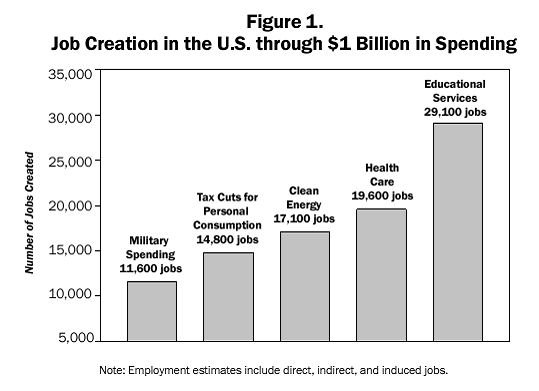
The question is not whether military spending creates jobs – it is whether more jobs could be created by the same amount of money invested in other ways. The evidence on this point is clear.
A billion dollars spent for military purposes creates 25% fewer jobs than a tax cut;
one and one-half times fewer jobs than spending on clean energy production;
and two and one-half times fewer jobs than spending on education.
And though average overall compensation is higher for military jobs than the others, these other forms of expenditure create more decent-paying jobs (those paying $64,000 per year or more) than military spending does.[1]
Ten years after 9/11, top cops in the nation's biggest cities feel there
are still significant gaps in the intelligence and analysis they receive
about terrorism, even as the homegrown terror threat looms larger.
A survey of intelligence commanders from America's 56 biggest cities conducted by the Homeland Security Policy Institute found the police chiefs believe the nation's intelligence enterprise is less robust than it could be, and that 62 percent of the chiefs felt this lack left them “unable to develop a complete understanding of their local threat.”
Phi Beta Iota: The “top cops” are great people, they just do not understand that the terror threat is fradulent and that the homeland security industrial complex is working precisely as intended, wasting hundreds of billions on fraudulent dysfunctional white and white-collar employment while channeling hundreds of billions in unearned profits to the homeland security industrial complex.