The below article includes an interactive chart of the beneficiaries of the Federal Reserve's largesse–a graph of corruption on a scale not equaled in history.
Phi Beta Iota: Top ten (first three over $100 billion each):
01 Morgan Stanley … 02 Citigroup Inc. … 03 Bank of America … 04 Royal Bank of Scotland Group … 05 State Street Corporation … 06 UBS AG … 07 Goldman Sachs Group … 08 JP Morgan Chase & Company … 09 Deutsche Bank AG … 10 Barclays Plc
The banks aren’t required to mark down most of their holdings of government debt to market prices. If they did, some would be forced to default or seek a bailout.” (“How Long Can the ECB Prop Up Europe’s Sick Banks?”, Businessweek)
Are you kidding me? The banks are sitting on a mountain of garbage paper and EU regulators haven’t even forced them to write down the losses. Is it any wonder why public confidence is at all-time lows?
. . . . . . .
Doomsday Scenario seems to be on the mind of central bankers at the ECB, too. According to CNBC: “The Sunday Times in the UK reported that policy makers in Brussels are drawing up radical plans to offer central guarantees over certain types of debt issued by banks. The move is reported to be a direct response to the sharp fall in U.S. funding for Europe’s banks. If true, this is clearly something the boss of the ECB can’t be discussing in public….” (“Trichet Gives Master Class in Saying Nothing”, CNBC)
Indeed, how can one publicly discuss their intention to disregard the democratic process altogether, overstep their mandate, and underwrite hundreds of billions in garbage bonds held by thieving bankers? That’s hardly the kind of policy that would elicit a riotous display of support from the people.
So, it’s a mess, and it’s going to get a whole lot messier because EU banks need to roll over more than $4.5 trillion in the next two years and the funding flywheel is already gummed up. So, if there’s not a political solution to the trans-EU fiscal issues in the next few months, the eurozone is toast. When the credit markets start to groan, bad things can happen fast.
First, this wastefulness is seen as inefficient only if one falsely assumes that its real objective is to combat Terrorist threats. That is not the purpose of what the U.S. Government does. As Daniel Weeks explains today, the Congress — contrary to popular opinion — is not “broken”; it is working perfectly for its actual owners. Or, as he puts it, “Washington isn't broken — it’s fixed”:
Our problem today is not a broken government but a beholden one: government is more beholden to special-interest shareholders who fund campaigns than it is to ordinary voters. Like any sound investor, the funders seek nothing more and nothing less than a handsome return — deficits be darned — in the form of tax breaks, subsidies and government contracts.
The LA Times, and most people who denounce these spending “inefficiencies,” have the causation backwards: fighting Terrorism isn't the goal that security spending is supposed to fulfill; the security spending (and power vested by surveillance) is the goal itself, and Terrorism is the pretext for it. For that reason, whether the spending efficiently addresses a Terrorism threat is totally irrelevant.
There are multiple indications in the large cache of US State Embassy cables WikiLeaks has been releasing (extended summary here) that the US State Department is willing to do just about anything to ensure the multinational agricultural biotech corporation, Monsanto, has its interests protected in countries around the world.
Cables show the State Department has been very active in defending Monsanto in France during the past decade. In one particular case, a French documentary, “The World According to Monsanto,” was released. A diplomat with the US embassy in Madrid immediately felt the need for “talking points” so it knew what to say in response to the content in the film. (Full article here)
The recording industry doesn’t have the most respectable history when it comes to lawsuits. Between asking for millions for trivial acts of piracy, and asking potentially for trillions in more serious cases, they’ve shown that they’re not only completely disconnected from reality, but totally unheeding of the actual effects of their litigation. So it’s not surprising to see them tilting at yet another windmill.
Sierra Club executive director Michael Brune slammed the department's review as “an insult to anyone who expects government to work for the interests of the American people.”
Phi Beta Iota: Neither the Department of State, nor any other branch of government nor even the environmentalists themselves, are doing holistic analytics. At root this project is wrong for two reasons: it uses water we cannot afford to waste to flush the tar, and it creates a third rate oil follow-on ecology–doing the wrong thing writer as Russell Ackoff would say. The US Government lacks the ability to do holistic analytics, and therefore it is incapable of rendering sound decisions in a complex world.
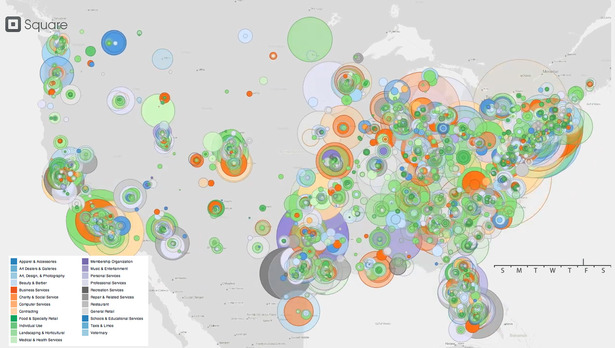
But really, the reason Square is exciting isn't as a direct swap-out of existing payment methods. Square is exciting because its mobility and low up-front costs allow entirely different types of business to move money with credit cards. Individuals, freelancers, farmers, nursery owners, Etsy DIY types, and a whole bunch of other people can actually treat cards as cash.