TWO COUNTRIES competed this week for first place in news programs all over the world: Scotland and the Islamic State in Iraq and Syria.
There could not be a greater difference than between these two countries. Scotland is damp and cold, Iraq is hot and dry. Scotland is called after its whisky (or the other way round), while for ISIS fighters, drinking alcohol is the mark of unbelievers, who should lose their head (literally).
However, there is one common denominator of both crises: they mark the approaching demise of the nation-state.
STRIKE ONE: Refuses counterintelligence on domestic enemies.
STRIKE TWO: Refuses Whole of Government.
STRIKE THREE: Refuses Acquisition.
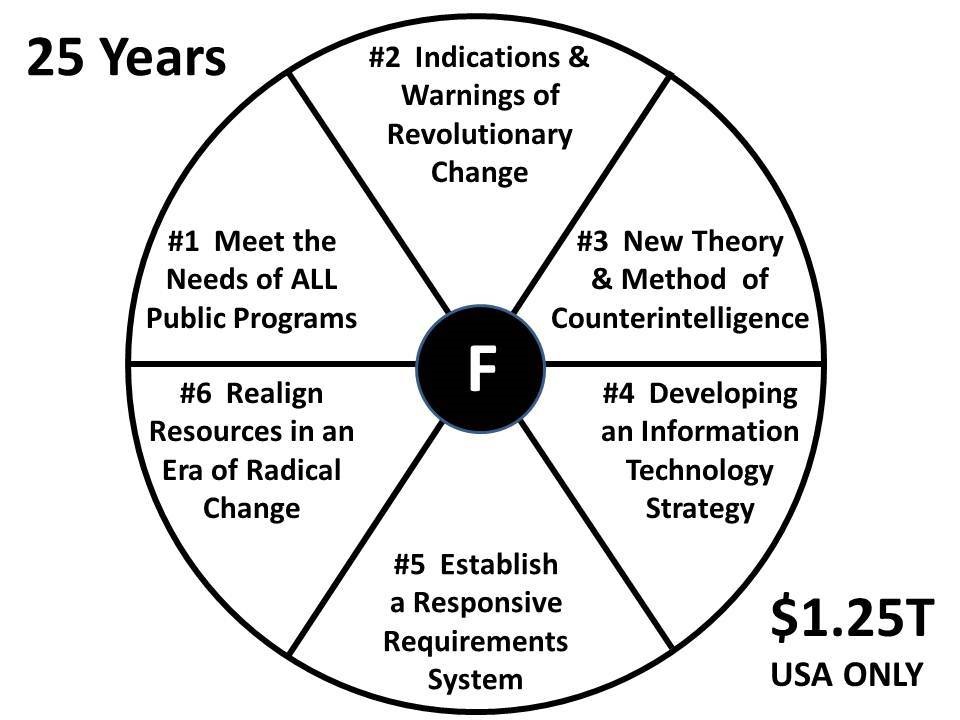
The six sucking chest wounds identified in 1990 continue. HUMINT/CI are dead in the water, followed by OSINT and mature holistic analytics integrating true cost economics. We continue to process 1% of what we collect by technical means, while being so far removed from human-centric ground truth about everything as to cause one to wonder, just who is the US IC supposed to be helping?
Twenty five per cent of Americans are open to secession and the break up of the United States. To this add that better than 3 out of 4 Americans are unhappy. And that 64 per cent can't even name the three branches of government. This is a country in crisis.
The failed Scottish vote to pull out from the United Kingdom stirred secessionist hopes for some in the United States, where almost a quarter of people are open to their states leaving the union, a new Reuters/Ipsos poll found.
Some 23.9 percent of Americans polled from Aug. 23 through Sept. 16 said they strongly supported or tended to support the idea of their state breaking away, while 53.3 percent of the 8,952 respondents strongly opposed or tended to oppose the notion.
The urge to sever ties with Washington cuts across party lines and regions, though Republicans and residents of rural Western states are generally warmer to the idea than Democrats and Northeasterners, according to the poll.
From my point of view, the academic community in some ways is even more remiss [than the media]. During my brief fledgling career as a novice academic, I have come to the conclusion that most university-level courses on the American foreign policy process are absolutely mute on this subject [intelligence sharing with Congress, and the repercussions thereof, as a major change in the US foreign policy process]. It is as if time was frozen in the 1960's. I believe the current scholarly literature on foreign policy processes has little discussion of this — almost none. I am not aware of any Ph.D. theses being done in this area, although I can think of some wonderful case studies that could be the basis for doctoral dissertations. The media and the academic community do not quite get it.
Australian counterterrorism forces detained 15 people Thursday in a series of suburban raids after receiving intelligence that the Islamic State movement was planning public beheadings in two Australian cities to demonstrate its reach.
About 800 federal and state police officers raided more than a dozen properties across 12 Sydney suburbs as part of the operation — the largest in Australian history, Australian Federal Police Deputy Commissioner Andrew Colvin told the Associated Press. Separate raids in the eastern cities of Brisbane and Logan were also conducted.
The Australian Broadcasting Corporation reported that the plan involved kidnapping randomly selected members of the public off the streets in Sydney and Brisbane, beheading them on camera, and releasing the recordings through Islamic State's propaganda arm in the Middle East.
Over the objections of government attorneys, a federal judge said yesterday that he would require in camera review of documents that the government says are protected by the state secrets privilege. The issue arose in the case of Gulet Mohamed v. Eric Holder, challenging the constitutionality of the “no fly” list.
The government had argued that it is “inappropriate” for a court to review such records to verify that they are validly privileged, and that instead the court should grant dismissal of case on the basis of official declarations. (Gov’t Resists Court Review of State Secrets, Secrecy News, August 27). The government moved for reconsideration of an August 6 order to produce the records for in camera review.
Yesterday, Judge Anthony J. Trenga of the Eastern District of Virginia granted the government's motion for reconsideration, but he said that having reconsidered the matter, he determined that he had been right the first time around.
“Upon reconsideration of its Order, however, the Court finds that none of [the] objections justifies vacating the Order, as the defendants request. The Court therefore affirms its Order.”
“This case involves complex and unsettled issues pertaining to the respective roles of the legislative, executive and judicial branches,” Judge Trenga wrote. “One central issue is the extent to which the War on Terrorism may expand the ability of the executive branch to act in ways that cannot otherwise be justified.”