Sentenced to 10 hours of Community Service and a $10 fee.Judge Claire warns of harsher consequences next time due to “ban & bar” orders served to them at the time of arrest.
Phi Beta Iota: Over 7,000 Occupy protesters jailed — no bankers even arrested. A revolution vastly greater than anything the USA has seen since 1776, is emergent. The two-party tyranny and Wall Street are a precise parallel to King George and the East India Company. ENOUGH!
Public pressure has helped push back against a bill in Congress that would have torn up the negotiated agreement with Iran by imposing yet more sanctions on the people of that country. The people of this country are not eager for another war, and have not accepted that sanctions lead away from war rather than into it.
But supporters and opponents of that bill tend to agree that Iran has a nuclear weapons program, and that this program must be stopped by one means or another. This underlying assumption is not supported by any evidence and never has been. We've heard it propounded for over thirty years, and the repetition has had its intended effect, but any evidence at all has always been lacking. A belief without evidence is a myth.
Iran has a nuclear energy program because the U.S. and European governments wanted Iran to have a nuclear energy program. The U.S. nuclear industry took out full-page ads in U.S. publications bragging about Iran's support for such an enlightened and progressive energy source. The U.S. was pushing for major expansion of Iran's nuclear program just before the Iranian revolution of 1979.
Since the Iranian revolution, the U.S. government has opposed Iran's nuclear energy program and misled the public about the existence of a nuclear weapons program in Iran. This story is well-told in Gareth Porter's new book, Manufactured Crisis: The Untold Story of the Iran Nuclear Scare, and by Porter is his upcoming interview this week on Talk Nation Radio.
The U.S. assisted Saddam Hussein's Iraq in a war against Iran in the 1980s, in which Iraq attacked Iran with chemical weapons. Iran's religious leaders had declared that chemical, biological, and nuclear weapons must not be used, even in retaliation. And they were not. Iran could have responded to Iraqi chemical attacks with chemical attacks of its own and chose not to.
Iran is committed to not using or possessing weapons of mass destruction. The results of inspections bear that out. Iran's willingness to put restrictions on its legal nuclear energy program — a willingness present both before and after sanctions — bears that out. Inspections should continue. All steps should be taken to move the world toward safe and sustainable energy sources. But can we drop the idea that Iran wants to nuke us?
“It is now six weeks since I arrived in Ecuador as part of an international team of researchers and activists that are working with the government to radically transform the nation’s economic model.
John Restakis
In what may be one of the most innovative change programs in Latin America, the administration of Rafael Correa is proposing to transition from a neo-liberal, free market economic model to what they are calling a social knowledge economy based on a combination of commons-based economics and the promotion of open knowledge systems. It’s heady stuff and the project is placing Ecuador at the forefront of global efforts to advance human knowledge as a commons and to apply this knowledge to the creation of a new economic model based on the commons, co-operative models of production, open-source systems of sharing, and free access to information.
The numbers we use in development, and most of what we think of as facts, are actually estimates. It's time for a data revolution
Claire Melarned
The Guardian, 31 January 2014
You know a lot less than you think you do. Around 1.22 billion people live on less than a $1.25 (75p) day? Maybe, maybe not. Malaria deaths fell by 49% in Africa between 2000 and 2013? Perhaps. Maternal mortality in Africa fell from 740 deaths per 100,000 births in 2000 to 500 per 100,000 in 2010? Um … we're not sure.
These numbers, along with most of what we think of as facts in development, are actually estimates. We have actual numbers on maternal mortality for just 16% of all births, and on malaria for about 15% of all deaths. For six countries in Africa, there is basically no information at all.
In the absence of robust official systems for registering births and deaths, collecting health or demographic data, or the many other things that are known by governments about people in richer countries, the household survey is the foundation on which most development data is built. Numbers from the surveys are used to estimate almost all the things we think we know – from maternal mortality to school attendance to income levels. Household surveys are run by governments or by external agencies such as the World Bank, USAid or Unicef.
But it's a shaky foundation. First, to make the survey representative of the population, you need to know a lot about the population to make a good sampling frame. This knowledge comes from a population census. But only around 12 of the 49 countries in sub-Saharan Africa have held a census in the past 10 years. So there might be large population groups missing – especially in countries undergoing rapid change. There are likely to be big urban informal settlements, for example, which are not included in the most recent census, and therefore don't exist for sampling purposes. They also don't happen very often – 21 African countries haven't had a survey in the past seven years.
And they're not all done in the same way, which makes comparing countries or combining data from different countries very difficult – and illustrates how hard it is to know the “real” number. There are, for example, seven perfectly acceptable ways of asking questions in surveys about how much people eat. A recent experiment by World Bank researchers in Tanzania, comparing results from the different methods, found that estimates of how many people in the country are hungry varied from just under 20% to nearly 70%, depending on the method chosen.
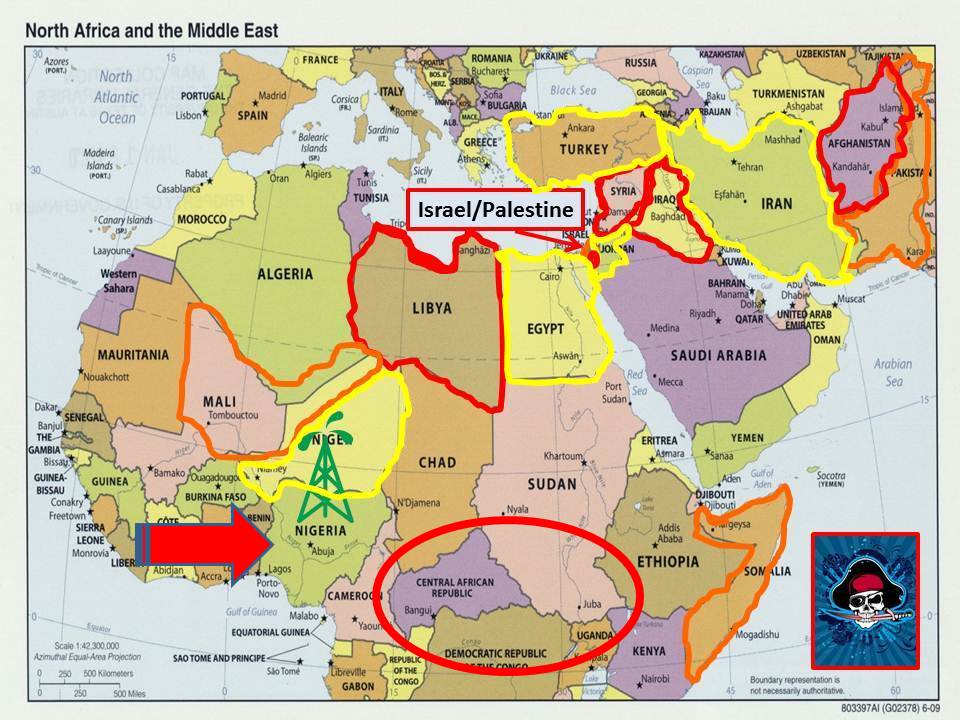
US Dirty Modus Operandi in Middle East: “Regime Change” Everywhere It Can
The 9/11 incident has polarized global politics into two distinct eras: pre-9/11 period and post-9/11 period with the latter wreaking havoc on the entire world, particularly on the Muslim world.
Click on Image to Enlarge
The pre-9/11 era witnessed terrorism, carnage, and mass murder across the globe on the part of the US government. Their atrocities ranged from the Philippines to Vietnam and Japan and any mentionable places on the planet.
However, the post-9/11 discourse changed drastically. The US emerged as the victim and the entire Muslim world was shown to be the guilty party.
In other words, the post-9/11 era provided the US government with a pretext to wage a war on terror or to put it more precisely, to wage a crusade against the Muslim world and to accelerate and vindicate their efforts in destabilizing regional strategic governments, thereby drawing nigh to their monstrous objectives.
In point of fact, the Muslims are bearing the brunt of a tragedy carefully choreographed by Washington with the express intention of spearheading a sinister agenda in the Middle East which is evidently ‘regime change’ on a massive scale.
This is a horrible story that should surprise no one. When you run prisons as profit making operations — a business only sleazy people would be involved with — this is what one should expect. At least the story has a good ending in that some of the creeps went to prison. This is who we have become in the United States. I hate it. Profit prisons should be illegal.
Today a special on “kids for cash,” the shocking story of how thousands of children in Pennsylvania were jailed by two corrupt judges who received $2.6 million in kickbacks from the builders and owners of private prison facilities. We hear from two of the youth: Charlie Balasavage was sent to juvenile detention after his parents unknowingly bought him a stolen scooter; Hillary Transue was detained for creating a MySpace page mocking her assistant high school principal. They were both 14 years old and were sentenced by the same judge, Judge Mark Ciavarella, who is now in jail himself – serving a 28-year sentence. Balasavage and Transue are featured in the new documentary, “Kids for Cash,” by filmmaker Robert May, who also joins us. In addition, we speak to two mothers: Sandy Fonzo, whose son Ed Kenzakoski committed suicide after being imprisoned for years by Judge Ciavar! ella, and Hillary’s mother, Laurene Transue. Putting their stories into context of the larger scandal is attorney Robert Schwartz, executive director of the Juvenile Law Center. The story is still developing: In October, the private juvenile-detention companies in the scandal settled a civil lawsuit for $2.5 million.