Phi Beta Iota: All our sources call into question all claims that CW has been used by anyone. The highest probability is that the rebels are faking it hoping to lure the USA into Syria the way the USA lured Russia into Afghanistan. We tend not to believe that the USA is behind the effort, or it would have come off much more credibly (witness the Boston false flag endeavor). Truth is a casualty across all fronts on the matter of Syria.
This story was sent to me by several people, two of whom live in the Texas towns described here where water, as a result of Fracking, has become a very real issue.
More than 30 towns in West Texas will soon be out of water as a direct result of diverting their underground water supplies for use in hydraulic fracking. Largely unregulated fracking, it should be said. Largely unregulated fracking that is definitely putting arsenic into the ground it happens to be drying out. Before you start acting horrified, though, consider: this is exactly what Texas’ mental-midget teabillies voted for.
Despite the vast consensus of climate scientists, the highly publicized destructive effects of fracking on water supplies, fracking’s seismic impact, and the evidence of their own senses, the mentally deficient residents of Texas keep electing politicians who believe climate change is a myth, and who think the best course of action to address Texas’ crippling drought is several days of organized prayer. Really.
Maybe Rick Perry and the idiots that voted him back into office will be able to pray in some new drinking water while the non-stupid people of Texas pray for a governor with a triple-digit IQ. While you’re waiting to see how that works out for the citizens of West Texas, take some time to watch this interview with Antonia Juhasz, an oil and energy analyst, author, and journalist.
Fair warning, though: if you live in Texas, you probably won’t enjoy it.
Emphasis below added by Milt Bearden, former CIA chief in Pakistan also responsible for the field aspects of the CIA's covert support against Soviet forces in Afghanistan.
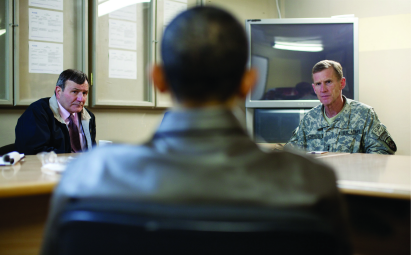
Eikenberry, Obama, and General Stanley McChrystal in Afghanistan, March 2010. (Pete Souza / White House)
KARL W. EIKENBERRY is William J. Perry Fellow in International Security at the Center for International Security and Cooperation at the Freeman Spogli Institute for International Studies at Stanford University. He served as Commanding General of the Combined Forces Command–Afghanistan from 2005 to 2007 and as U.S. Ambassador to Afghanistan from 2009 to 2011.
Since 9/11, two consecutive U.S. administrations have labored mightily to help Afghanistan create a state inhospitable to terrorist organizations with transnational aspirations and capabilities. The goal has been clear enough, but its attainment has proved vexing. Officials have struggled to define the necessary attributes of a stable post-Taliban Afghan state and to agree on the best means for achieving them. This is not surprising. The U.S. intervention required improvisation in a distant, mountainous land with de jure, but not de facto, sovereignty; a traumatized and divided population; and staggering political, economic, and social problems. Achieving even minimal strategic objectives in such a context was never going to be quick, easy, or cheap.
Of the various strategies that the United States has employed in Afghanistan over the past dozen years, the 2009 troop surge was by far the most ambitious and expensive. Counterinsurgency (COIN) doctrine was at the heart of the Afghan surge. Rediscovered by the U.S. military during the wars in Afghanistan and Iraq, counterinsurgency was updated and codified in 2006 in Field Manual 3-24, jointly published by the U.S. Army and the Marines. The revised
doctrine placed high confidence in the infallibility of military leadership at all levels of engagement (from privates to generals) with the indigenous population throughout the conflict zone. Military doctrine provides guidelines that inform how armed forces contribute to campaigns, operations, and battles. Contingent on context, military doctrine is
meant to be suggestive, not prescriptive.
Broadly stated, modern COIN doctrine stresses the need to protect civilian populations, eliminate insurgent leaders and infrastructure, and help establish a legitimate and accountable host-nation government able to deliver essential human services. Field Manual 3-24 also makes clear the extensive length and expense of COIN campaigns: “Insurgencies are protracted by nature. Thus, COIN operations always demand considerable expenditures of time and resources.”
The press stories that follow a document release like this often do not bother to do this. They look, instead, for a key—or the key—fact, around which the news story then develops. In this case, unsurprisingly, the key fact is that the NSA gathered tens of thousands of email communication by Americans before the FISA Court declared its actions unconstitutional. As the Washington Post puts it in its lead:
For several years, the National Security Agency unlawfully gathered tens of thousands of e-mails and other electronic communications between Americans as part of a now-revised collection method, according to a 2011 secret court opinion.
Since the revelations of confirmed National Security Agency spying in June, three different “investigations” have been announced. One by the Privacy and Civil Liberties Oversight Board (PCLOB), another by the Director of National Intelligence, Gen. James Clapper, and the third by the Senate Intelligence Committee, formally called the Senate Select Committee on Intelligence (SSCI).
All three investigations are insufficient, because they are unable to find out the full details needed to stop the government's abuse of Section 215 of the PATRIOT Act and Section 702 of the Foreign Intelligence Surveillance Act. The PCLOB can only request—not require—documents from the NSA and must rely on its goodwill, while the investigation led by Gen. Clapper is led by a man who not only lied to Congress, but also oversees the spying. And the Senate Intelligence Committee—which was originally designed to effectively oversee the intelligence community—has failed time and time again. What's needed is a new, independent, Congressional committee to fully delve into the spying.
The PCLOB: Powerless to Obtain Documents
The PCLOB was created after a recommendation from the 9/11 Commission to ensure civil liberties and privacy were included in the government's surveillance and spying policies and practices.
But it languished. From 2008 until May of this year, the board was without a Chair and unable to hire staff or perform any work. It was only after the June revelations that the President asked the board to begin an investigation into the unconstituional NSA spying. Yet even with the full board constituted, it is unable to fulfill its mission as it has no choice but to base its analysis on a steady diet of carefully crafted statements from the intelligence community.
As we explained, the board must rely on the goodwill of the NSA's director, Gen. Keith Alexander, and Gen. Clapper—two men who have repeatedly said the NSA doesn't collect information on Americans.
An article titled NSA Says It Can’t Search Its Own Emails on ProPublica brings up an interesting glitch in the NSA’s surveillance technology. In spite of having the capability to sort through big data with a supercomputer, when it comes to doing a search of NSA’s over 30,000 employees they are at a loss. The article explains,
“There’s no central method to search an email at this time with the way our records are set up, unfortunately,” NSA Freedom of Information Act officer Cindy Blacker told me last week. The system is “a little antiquated and archaic,” she added… It’s actually common for large corporations to do bulk searches of their employees email as part of internalinvestigations or legal discovery.”
The article also brings up the point that federal agencies often don’t have the funding they need for public records. However, if any agency should have the capability to keep tabs on its employees, it is the agency charged with surveillance of the nation. Lacking that ability limits NSA operatives to searching emails by individuals one at a time instead of searching for keywords or in bulk. This is very interesting in light of recent events, no further comment.
The Historical Collections Division is the latest casualty of sequester cuts. The office handling Freedom of Information Act requests will take over the work.
WASHINGTON — The budget ax has fallen on a CIA office that focused on declassifying historical materials, a move scholars say will mean fewer public disclosures about long-buried intelligence secrets and scandals.
The Historical Collections Division, which has declassified documents on top Soviet spies, a secret CIA airline in the Vietnam War, the Cuban missile crisis and other major operations, has been disbanded. The office that handles Freedom of Information Act requests will take over the work.