Chuck Spinney & Mike Lofgren: Is War Good for the Economy?

03 Economy, 10 Security, 11 Society, Commerce, Corruption, Government, Media, Military, Officers Call, Peace Intelligence
Chuck Spinney
Chuck Spinney

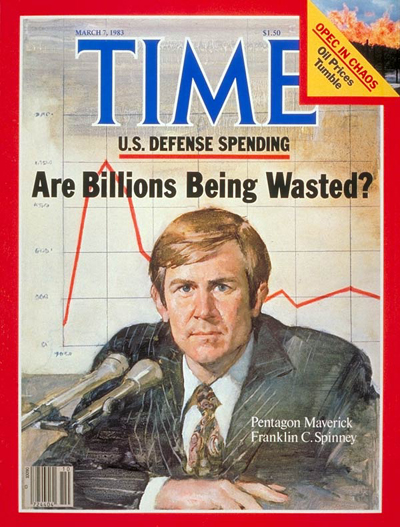
In the attached essay, my very good friend Mike Lofgren raises the question of whether defense spending is good for the economy.  This is a current issue because the threat of defense budget reduction is being countered by arguments asserting that these reductions will push the economy into recession.  More generally, the political addiction to defense spending has been a major contributor to our nation's economic decline and our political stagnation — i.e., what I have called Americas Defense Dependency, the subject of an essay I wrote last November for Counterpunch.  Mike comes at these issues from a different albeit complimentary and equally important angle.

Readers interested in learning more about this important subject will find the work of the late Professor Seymour Melman of Columbia University to be particularly edifying.  In his prescient book, Profits Without Production (Knopf, 1983), Melman explained how the growing militarization of our economy was one of the central causes of the decline in America’s manufacturing competitiveness.  This decline started in  the 1970s, but Melman showed how it grew out of seeds planted by the permanent military mobilization of a huge defense industry in the 1950s.

Chuck Spinney
Marina di Ragusa, Sicilia

Mike Lofgren
Mike Lofgren

Is War Good for the Economy?

Michael S. Lofgren, Huffington Post, Posted: 04/30/2013 12:06 pm

The author is a Former Congressional Staffer and author of The Party is Over: How Republicans Went Crazy, Democrats Became Useless, and the Middle Class Got Shafted

The 1960s comedy show Laugh-In included an occasional sketch in which co-host Dan Rowan played a comic general whose tag-line was “war is good for business!” In an ironic echo of that skit, an April 27 Washington Post story delivers the same message: “A steep slowdown in defense spending tied to the end of the wars in Iraq and Afghanistan is undercutting the country's economic recovery, new government data released Friday revealed.” An 11.5-percent annual drop in Pentagon spending resulted in slower growth in the gross domestic product (GDP) during the first quarter of 2013 than economists expected.

So did the dozen years of war, with all the deaths, destruction, and expense they entailed, have the perverse silver lining of being good for the economy? Most mainstream economists — who, like cynics, know the price of everything and the value of nothing — would answer in the affirmative.

Gross domestic product, which they tend to treat as a surrogate for economic well-being, is only a tote board of all spending that occurs in an economy. Statistics like GDP are arbitrary, subject to incomplete data, and can mislead us about underlying economic conditions. A dollar spent on a cancer cure has the same worth to the GDP as a dollar spent to bribe an Afghan drug lord. This convention can reach absurd lengths, such as massive hurricane damage possibly increasing the GDP: money must be spent just to get conditions back to the way they were, but it counts it as “growth.”

Based on my almost three decades on Capitol Hill, most of them involved in defense budgeting, I can say authoritatively that military spending evokes an almost mystical reverence among many members of Congress. A $325-billion defense program like the F-35, however technically flawed, typically engenders less floor debate than relatively miniscule domestic programs such as the Corporation for Public Broadcasting.

Continue reading “Chuck Spinney & Mike Lofgren: Is War Good for the Economy?”

Owl: Saudi Terrorists and Zionist Terrorists — From Same Jewish Roots?

08 Wild Cards, Corruption, Cultural Intelligence, Government, IO Deeds of War
Who?  Who?
Who? Who?

This post refers to some new and remarkable historical findings (at least for the English-speaking world), stemming from new translation to English from Arabic, that can put more pieces into the the puzzle of the apparently amicable relationship between Israel and Saudi Arabia. The first part of this post is not new, though useful in quoting for context

“The U.S. Department of Defense has released translations of a number of Iraqi intelligence documents dating from Saddam’s rule.  One, a General Military Intelligence Directorate report from September 2002, entitled “The Emergence of Wahhabism and its Historical Roots”, shows the Iraqi government was aware of the nefarious purposes of the Wahhabis of Saudi Arabia, often known as Salafis, in serving Western interests to undermine Islam.The report relies heavily on the Memoirs of Mr. Hempher, which describe in detail how a British spy to the Middle East, in the middle of the eighteenth century, made contact with Adbul Wahhab, to create a subversive version of Islam, the notorious sect of Wahhabism, which became the founding cult of the Saudi regime.  The movement was temporarily suppressed by the Ottomam armies in the middle of the nineteenth century.  But with the assistance of the British [or more specifically, Lawrence of Arabia], the Wahhabis and their Saudi sponsors returned to power and founded their own state in 1932.  Since then, the Saudis have collaborated closely with the Americans, to whom they owe their tremendous oil wealth, in funding various Islamic fundamentalist organizations and other American covert operations, particularly the “jihad” in Afghanistan.  But the Saudis simulatenously use the immense wealth at their dispossal to disseminate this disruptive brand of Islam to various parts of the world, categorized by some of the largest propaganda campaign in history. Many who defend Wahhabism as a legitimate reform movement of Islam have tried to dismiss the Memoirs as a spurious fabrication.  These include Bernard Haykel, Professor in Near Eastern Studies at Princeton University, who, without providing any evidence, presumes the Memoirs to have been created by Ayyub Sabri Pasha.”

But what is new is the claim that the Wahabis have directly Jewish roots (my emphasis):

Continue reading “Owl: Saudi Terrorists and Zionist Terrorists — From Same Jewish Roots?”

Berto Jongman: The Nation on “You Are A Guinea Pig” for the Largest Most Complex Testing of Toxic Materials in History. There is no opt-out option.

03 Economy, 07 Health, Commerce, Corruption, Earth Intelligence, Government, Law Enforcement
Berto Jongman
Berto Jongman

You Are a Guinea Pig

David Rosner and Gerald Markowitz

The Nation,

A hidden epidemic is poisoning America. The toxins are in the air we breathe and the water we drink, in the walls of our homes and the furniture within them. We can’t escape it in our cars. It’s in cities and suburbs. It afflicts rich and poor, young and old. And there’s a reason why you’ve never read about it in the newspaper or seen a report on the nightly news: it has no name—and no antidote.

The culprit behind this silent killer is lead. And vinyl. And formaldehyde. And asbestos. And Bisphenol A. And polychlorinated biphenyls (PCBs). And thousands more innovations brought to us by the industries that once promised “better living through chemistry,” but instead produced a toxic stew that has made every American a guinea pig and has turned the United States into one grand unnatural experiment.

Today, we are all unwitting subjects in the largest set of drug trials ever. Without our knowledge or consent, we are testing thousands of suspected toxic chemicals and compounds, as well as new substances whose safety is largely unproven and whose effects on human beings are all but unknown. The Centers for Disease Control (CDC) itself has begun monitoring our bodies for 151 potentially dangerous chemicals, detailing the variety of pollutants we store in our bones, muscle, blood and fat. None of the companies introducing these new chemicals has even bothered to tell us we’re part of their experiment. None of them has asked us to sign consent forms or explained that they have little idea what the long-term side effects of the chemicals they’ve put in our environment—and so our bodies—could be. Nor do they have any clue as to what the synergistic effects of combining so many novel chemicals inside a human body in unknown quantities might produce.

Read full article.

Chuck Spinney: Iraq Army Losing North, Partition Being Discussed

09 Justice, 11 Society, Civil Society, Cultural Intelligence, Ethics, Government, Military
Chuck Spinney
Chuck Spinney

The author of the attached report, Patrick Cockburn, is one of very best reporters reporting on the Middle East, and perhaps the most knowledgeable on Iraq.  This is a very important report, in my opinion.

Partition could really have a destabilizing influence on the entire Arab region, but especially Syria, as well as non-Arab Turkey.  The neocon (and Israeli) dream enhancing Israeli security by breaking up the Muslim state system into a directionless mass of insecure weak warring statelets may well be on its way to fruition.  Next stop – Iran????

Chuck Spinney
Marina di Ragusa, Sicilia

logo.png

Iraqi army losing hold on north to Sunni and Kurdish rebels as troops desert

Patrick Cockburn

Sunday, 28 April 2013

Soldiers are deserting a beleaguered Iraqi army as it struggles to keep its hold on the northern half of Iraq in the face of escalating hostility from Sunni Arabs and Kurds who dominate in the region.

Around the oil city of KirkukKurdish troops have advanced south to take over military positions abandoned by the army, while in Baghdad senior Iraqi politicians say that for the first time there is talk of partitioning the country.

The current crisis was sparked on 23 April when the Iraqi army attacked a sit-in protest in the Sunni Arab town of Hawijah, killing at least 50 people and injuring 110. Outraged Sunni Arab protesters have since stepped up their demonstrations against the Shia-led government. Demonstrators are increasingly protected by armed men, some of whom are accused of dragging five military intelligence soldiers in civilian clothes from a car that came near a protest in Fallujah and killing them.

There are signs that the Iraqi army can no longer cope with a crisis in which it is confronting both Sunni Arabs and Kurds.Many soldiers prefer to desert the army rather than shoot at protesters said Najmaldin Karim, the Kurdish Governor of Kirkuk, where Hawijah is situated, in an interview with The Independent. Most deserters are Sunni, Mr Karim said, but he added that some are Shia who don’t want to fight in strange places for something they don’t believe in. 

Continue reading “Chuck Spinney: Iraq Army Losing North, Partition Being Discussed”

Berto Jongman: China Pandemic — Thousands of Dead Pigs in Rivers, Mutating Virus in Chickens, GMO Connection

01 Agriculture, 02 China, 07 Health, Commerce, Earth Intelligence, Government
Berto Jongman
Berto Jongman

Sorcha Faal is exaggerating again I think but the numbers are rising and the virus is spreading. It is a situation of great concern as the WHO has warned.I haven't heard a good explanation yet for the thousands of dead pigs floating in  Chinese rivers.

Phi Beta Iota:  Sorcha Fall (David Booth) is a known fabricator with a gift for connecting dots.  We think of his stuff as good musical background to ethical evidence-based thinking.

April 29, 2013

World Terror After Armageddon Virus Unleashed

A grim report prepared for President Putin by Health Minister Dr. Veronika Skvortsova on the growing pandemic in China is now warning that a “global mass death event” is currently underway as the spread of the H7N9 avian flu virus continues to grow and shows no signs of stopping anytime soon.

Important to note, and as we had reported on in our 19 March report “China Genetic Test Causes Mass Death Catastrophe,” Health Minister Skvortsova warned of this coming mass death event from China by noting the genetic experiments being conducted by Chinese scientists last month that led to an animal apocalypse of staggering proportions. 

Continue reading “Berto Jongman: China Pandemic — Thousands of Dead Pigs in Rivers, Mutating Virus in Chickens, GMO Connection”

SchwartzReport: Europe Saving the Bees — Corruption — and Good News

01 Agriculture, Commerce, Corruption, Earth Intelligence, Government

schwartz reportWill Smartglasses Replace Eyeglasses?
PAUL MCDOUGALL – Salon

This is coming, it reminds me of when mobile phones began. A few early adapters had phones in their cars, and carried around 10 lb over the shoulder cases for walking around. I had one in Miami, where my ship Seaview was homeported when in American waters, a project to locate sunken ships on the Grand Bahama Banks using Remote Viewing. People thought I was a drug dealer, since they were notable early adapters.

Insecticide Firms in Secret bid to Stop Ban That Could Save Bees
DAMIAN CARRINGTON – The Guardian/Observer (U.K.)

The corporations that persist in making these toxic chemicals, like the tobacco industry are evil. They know that what they are doing is destructive and they don't care because it is so profitable. Their strategy is not to improve their products, but to corrupt the government, as they have done so effectively in the U.S. This is what they are up to in Europe.

Weeding Corporate Power Out of Agricultural Policies: Communities Mobilize for Food and Farm Justice
TORY FIELD and BEVERLY BELL – Truthout.org

Here is some good news about agriculture. Most socially progressive movements, such as this one, are very idealistic, and people work very hard to advance them, but to little effect. This one I think actually has a chance of being successful. Support it wherever you can. This report presents information about what you can do, and where to start.

Matthew Rosenberg: CIA Cash = Afghan Corruption?

Corruption, Government


Matthew Rosenberg
Matthew Rosenberg

Karzai’s Office Gets Bags Full of C.I.A. Cash

Matthew Rosenberg

New York Times, 28 April 2013

KABUL, Afghanistan — For more than a decade, wads of American dollars packed into suitcases, backpacks and, on occasion, plastic shopping bags have been dropped off every month or so at the offices of Afghanistan’s president — courtesy of the Central Intelligence Agency.

All told, tens of millions of dollars have flowed from the C.I.A. to the office of President Hamid Karzai, according to current and former advisers to the Afghan leader.

“We called it ‘ghost money,’ ” said Khalil Roman, who served as Mr. Karzai’s chief of staff from 2002 until 2005. “It came in secret, and it left in secret.”

The C.I.A., which declined to comment for this article, has long been known to support some relatives and close aides of Mr. Karzai. But the new accounts of off-the-books cash delivered directly to his office show payments on a vaster scale, and with a far greater impact on everyday governing.

Moreover, there is little evidence that the payments bought the influence the C.I.A. sought. Instead, some American officials said, the cash has fueled corruption and empowered warlords, undermining Washington’s exit strategy from Afghanistan.

“The biggest source of corruption in Afghanistan,” one American official said, “was the United States.”

The United States was not alone in delivering cash to the president. Mr. Karzai acknowledged a few years ago that Iran regularly gave bags of cash to one of his top aides.

At the time, in 2010, American officials jumped on the payments as evidence of an aggressive Iranian campaign to buy influence and poison Afghanistan’s relations with the United States. What they did not say was that the C.I.A. was also plying the presidential palace with cash — and unlike the Iranians, it still is.

Read full article.

noble gold