Dolphin: Chinese Congress Puts Environment on the Table — Major Revolt within Congress, More Reforms Anticipated

02 China, 03 Economy, 03 Environmental Degradation, 07 Health, Cultural Intelligence, Earth Intelligence, Ethics, Government
YARC YARC
YARC YARC

China People's Congress environment surprise

TIM PALMER: In China the fallout is still being felt from an open rebellion over air pollution at the country's annual session of parliament.

It was a dramatic shift for a Congress that's normally seen as no more than a rubber stamp.

Sensing a growing environmental crisis, a third of the delegates rejected a key anti-pollution measure.

Meanwhile China analysts are now expecting major economic reforms from the new administration in Beijing after premier Li Keqiang declared that more sections of the economy needed to be handed over to private enterprise.

China correspondent Stephen McDonell has been covering the closing stages of the National People's Congress in Beijing.

(Ceremonial music)

STEPHEN MCDONELL: China's annual session of parliament, the National People's Congress, has closed with plenty of big vision from the country's new generation of leaders.

Xi Jinping told some 3,000 delegates what an honour it was for him to be president and he was talking up the so-called “China dream”.

(Sound of Xi Jingping speaking)

“China is a great nation with great creativity,” he said, “We created this Chinese culture and we will be able to expand our path towards Chinese development.”

But a third of the delegates listening to him had just staged a large revolt on the floor of the Great Hall of the People over pollution.

When it came time to endorse the members of a key committee overseeing environmental protection and resource conservation, 850 delegates voted no and 120 abstained.


Read full article.

Continue reading “Dolphin: Chinese Congress Puts Environment on the Table — Major Revolt within Congress, More Reforms Anticipated”

Penguin: Banks Confiscating Percentage of Depositors Cash in Cyprus, Collapse of Banking Across Europe Possible

03 Economy, 07 Other Atrocities, 10 Transnational Crime, Commerce, Corruption, Government
Who, Me?
Who, Me?

Facing Bailout Tax, Cypriots Try to Get Cash Out of Banks

ATHENS — In a move that could set off new fears of contagion across the euro zone, anxious depositors drained cash from automated teller machines in Cyprus on Saturday, hours after European officials in Brussels required that part of a new 10 billion euro bailout be paid for directly from the bank accounts of ordinary savers.

The move — a first in the three-year-old European financial crisis — raised questions about whether bank runs could be set off elsewhere in the euro zone. Jeroen Dijsselbloem, the president of the group of euro area ministers, declined early Saturday to rule out taxes on depositors in countries beyond Cyprus, although he said such a measure was not currently being considered.

Although banks placed withdrawal limits of 400 euros, or about $520, on A.T.M.’s, most had run out of cash by early evening. People around the country reacted with disbelief and anger.

Read full article.

Berto Jongman: Argentna’s Bad (Soy) Seed

01 Agriculture, Commerce, Corruption, Government, Ineptitude
Berto Jongman
Berto Jongman

Argentina's Bad Seeds

The country's soya industry is booming, but what is the impact on Argentinians and their land?

Filmmakers: Glenn Ellis and Guido Bilbao

For much of the past decade Argentina has seen a commodities-driven export boom, built largely on genetically-modified soy bean crops and the aggressive use of pesticides.

Argentina's leaders say it has turned the country's economy around, while others say the consequences are a dramatic surge in cancer rates, birth defects and land theft.

People & Power investigates if Argentina's booming soy industry is a disaster in the making.

By Glenn Ellis

As I flew in to Buenos Aires to make this film, all the talk was of President Cristina Kirchner’s latest gambit. Her foreign minister had pulled out of a meeting with the British foreign secretary to discuss the Falklands (or the Malvinas depending on your outlook). And for the people I rubbed up against in Argentina’s smart and chic capital, on discovering I was English, this, along with Maradona’s ‘hand of god’ moment, was the topic on everybody’s lips. “We won the war”, they would say. “After the fighting we got rid of our dictators but you had another 10 years of Thatcher.”

When I explained I was in the country to cover the soya boom, which has given Argentina the fastest growth rate in South America, but also allegedly caused devastating malformations in children, there was a look of disbelief. “Here, in Argentina? Why haven’t we heard about it?”

Read full article. [Includes 25 minute video]

Berto Jongman: Fukushima, Chernobyl, and the Frog in Boiling Water — An Anthropological Perspective on the Deceived, the Forgotten, & the Dying

03 Economy, 07 Health, 07 Other Atrocities, 08 Proliferation, 08 Wild Cards, 11 Society, Civil Society, Commerce, Earth Intelligence, Government
Berto Jongman
Berto Jongman

Fukushima isn’t Chernobyl?  Don't Be So Sure

by SARAH D. PHILLIPS

CounterPunch,  Weekend Edition March 15-17, 2013

The March 11, 2011 Tohoku earthquake and tsunami caused the deaths of approximately 16,000 persons, left more than 6,000 injured and 2,713 missing, destroyed or partially damaged nearly one million buildings, and produced at least $14.5 billion in damages. The earthquake also caused a triple meltdown at the Fukushima Daiichi nuclear power plant on Japan’s eastern coast. After reading the first news reports about what the Japanese call “3.11,” I immediately drew associations between the accident in Fukushima and the Chernobyl nuclear disaster of 1986 in what was then the Soviet Union. This was only natural, since studying the cultural fallout of Chernobyl has been part of my life’s work as an anthropologist for the past 17 years. Knowing rather little about Japan at the time, I relied on some fuzzy stereotypes about Japanese technological expertise and penchant for tight organization and waited expectantly for rectification efforts to unfold as a model of best practices. I positioned the problem-riddled Chernobyl clean-up, evacuation, and reparation efforts as a foil, assuming that Japan would, in contrast, unroll a state-of-the-art nuclear disaster response for the modern age. After all, surely a country like Japan that relies so heavily on nuclear-generated power has developed thorough, well-rehearsed, and tested responses to any potential nuclear emergency? Thus, I expected the inevitable comparisons between the world’s two worst nuclear accidents to yield more contrasts than parallels.

Continue reading “Berto Jongman: Fukushima, Chernobyl, and the Frog in Boiling Water — An Anthropological Perspective on the Deceived, the Forgotten, & the Dying”

Berto Jongman: Legendary Russian Documentary on Nazi Interest in Antartica, Now with English Sub-Titles

08 Wild Cards, Cultural Intelligence, Earth Intelligence, Extraterrestial Intelligence, Government, History, IO Secrets, IO Technologies, Military, YouTube
Berto Jongman
Berto Jongman

Includes 1947 US naval expedition led by Robert Byrd broken off after being attacked by objects that vertically take off from the sea. Russian scientists hypothesize US military HAARP bases on Antartica and Alaska are intended for identifying the characteristics of wormholes used by alien visitors to access and leave earth.

Published on Sep 25, 2012

Phi Beta Iota:  RIVETING.  Superb subtitles easy to follow.  Brilliant photography.

Below the Line: Lengthy overview of film.

Continue reading “Berto Jongman: Legendary Russian Documentary on Nazi Interest in Antartica, Now with English Sub-Titles”

Theophillis Goodyear: The GOP Digs America a Deeper Grave

Civil Society, Corruption, Cultural Intelligence, Government
Theophillis Goodyear
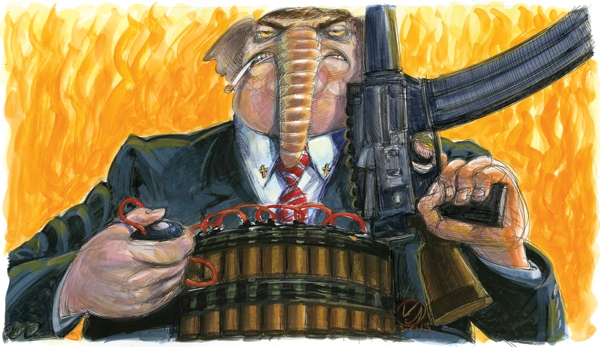
I agree the two parties have become virtually indistinguishable in many respects. But the Republican Party is far more dangerous, in my opinion. And I think Democrats kowtow to big business interests and the Military Industrial Complex mainly because they are more or less forced to if they want to be able to consistently challenge Republican Party dominance. That's no excuse, of course. But I think it's very misleading to portray both parties are essentially opposites sides of the same coin. Anyway, this article points out some important differences between the two parties.
Click on Image to Enlarge

The GOP's Real Agenda

Since last fall, Republicans have pretended to be more moderate – but their politics are harsher and more destructive than ever

After watching voters punish the GOP in the 2012 elections, Republican elites have been talking a brave game about reforms that would make the party less repulsive to Latinos, women and gay-friendly millennials. Florida Sen. Marco Rubio, the GOP's hip-hop-quoting young standard-bearer, is pressing conservatives to back an amnesty for undocumented immigrants. Dozens of party stalwarts, headlined by former Utah Gov. Jon Huntsman, renounced their opposition to gay marriage in a Supreme Court brief. GOP bigwigs have even launched New Republican – a group modeled after Bill Clinton's centrist Democratic Leadership Council – which seeks to rebrand the party as “colorblind,” “not anti-government” and dedicated to “ending corporate welfare.”

How the GOP Became the Party of the Rich

Don't be fooled. On the ground, a very different reality is unfolding: In the Republican-led Congress, GOP-dominated statehouses and even before the nation's highest court, the reactionary impulses of the Republican Party appear unbowed. Across the nation, the GOP's severely conservative agenda – which seeks to impose job-killing austerity, to roll back voting and reproductive rights, to deprive the working poor of health care, and to destroy agencies that protect the environment from industry and consumers from predatory banks – is moving forward under full steam.

Paul Craig Roberts: When Truth is Suppressed Countries Die

03 Economy, 11 Society, Commerce, Corruption, Government
Paul Craig Roberts
Paul Craig Roberts

Over a decade during which the US economy was decimated by jobs offshoring, economists and other PR shills for offshoring corporations said that the US did not need the millions of lost manufacturing jobs and should be glad that the “dirty fingernail” jobs were gone.

America, we were told, was moving upscale. Our new role in the world economy was to innovate and develop the new products that the dirty fingernail economies would produce. The money was in the innovation, they said, not in the simple task of production.

As I consistently warned, the “high-wage service economy based on imagination and ingenuity” that Harvard professor and offshoring advocate Michael Porter promised us as our reward for giving up dirty fingernail jobs was a figment of Porter’s imagination.

Over the decade I repeated myself many times: “Innovation takes place where things are made. Innovation will move abroad with the manufacturing.”

This is not what corporations or their shills such as Porter wanted to hear. Corporations were boosting their profits by getting rid of their American employees and replacing them with lowly paid foreigners. Porter’s job was to reassure the sheeple so that no outcry would materialize against the greed that was hollowing out the US economy.

Now comes a study conducted by 20 MIT professors and their graduate students that concludes on the basis of the facts that “the loss of companies that can make things will end up in the loss of research than can invent them.”

Read full article.

noble gold