Asset-Based Community Development (ABCD)
citizen consensus councils (CCCs)
citizen deliberative councils (CDCs)
citizen panels [By Popular Demand]
Community-Based Watershed Management Councils
community quality of life indicators

The truth at any cost lowers all other costs — curated by former US spy Robert David Steele.
Asset-Based Community Development (ABCD)
citizen consensus councils (CCCs)
citizen deliberative councils (CDCs)
citizen panels [By Popular Demand]
Community-Based Watershed Management Councils
community quality of life indicators
* Titles marked with an asterisk are particularly important to this topic.
Baldwin, Christina, Calling the Circle: The First and Future Culture (Bantam, 1998)
Briggs, John and F. David Peat, Seven Life Lessons of Chaos: Spiritual Wisdom from the Science of Change (Harper Perennial, 2000)
Briskin, Alan, Sheryl Erickson, Tom Callanan, and John Ott, The Power of Collective Wisdom: And the Trap of Collective Folly (Berrett-Koehler Publishers, 2009)
*Brown, Juanita with David Isaacs and The World Cafe, The World Cafe: Shaping Our Futures Through Conversations That Matter (Berrett-Koehler Publishers, 2005)
*Callenbach, Ernest, and Michael Phillips, A Citizen Legislature (Bookpeople, 1985)
Capra, Fritjof, The Web of Life: A New Scientific Understanding of Living Systems (Anchor, 1997)
*Chickering, A. Lawrence and James S. Turner, Voice of the People: The Transpartisan Imperative in American Life (Da Vinci Press, 2008)
*Crosby, Ned, Healthy Democracy: Bringing Trustworthy Information to the Voters of America (Beaver's Pond Press, 2003)
Dahl, Robert A., Democracy and Its Critics (Yale University Press, 1991)
Dowd, Michael, Thank God for Evolution: How the Marriage of Science and Religion Will Transform Your Life and Our World (Plume, 2009)
Ellinor, Linda and Glenna Gerard, Dialogue: Rediscover the Transforming Power of Conversation (Wiley, 1998)
*Fisher, Roger, William L. Ury, and Bruce Patton, Getting to Yes: Negotiating Agreement Without Giving In (Penguin Books, 2011)
*Fishkin, James S., When the People Speak: Deliberative Democracy and Public Consultation (Oxford University Press, 2011)
Continue reading “Tom Atlee: Public Wisdom Suggested Reading”
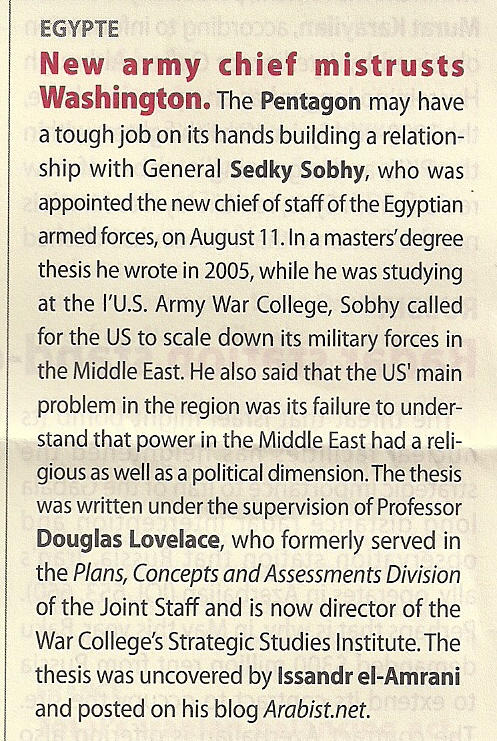
Sedky Sobhy's thesis makes the rounds
Glad to see that a bunch of news outlets picked up the thesis by Chief of Staff of the Egyptian Armed Forces Sedky Sobhy I highlighted a few days ago. Some wanted to interview me but unfortunately I was not available, but here's a couple of links.
Research paper offers insight into Egypt's new armed forces chief (McClatchy)
Professor Douglas Lovelace, the director of the Army War College's Strategic Studies Institute and Sobhy's adviser, remembered him as a “bold thinker,” charming and a “very impressive officer” who often offered thoughts counter to the conventional thinking at the time.
“I do recall he was provocative and an original thinker,” Lovelace said. “It was not surprising that he would either fail completely or rise to the top.”
Egypt general's paper offers insight into thinking (Reuters)
This workshop will bring together an interdisciplinary research team from across Europe to consider the lottery as a democratic institution. The event is being jointly organised by Gil Delannoi (Science Po), Oliver Dowlen (UCL) and Peter Stone (Trinity College Dublin).
Continue reading “Event: 11 Oct Dublin – Drawing Lots for Democracy”

National Insecurity Questions That Won’t Be Asked in the Presidential Debates
How Bad Will Things Get in Afghanistan?
by FRANKLIN C. SPINNEY.
Counterpunch, October 08, 2012
For reasons that were quite clear well before the Afghan “surge” began (see here and here), America’s Afghan adventure is now ending without achieving its goals. The prospects for a civil life in Afghanistan are likely to become even more remote than they were before we intervened. Indeed, some experts think the ground work has been laid for an even more destructive civil war than that which occurred after the Soviets left Afghanistan with their tail between their legs in 1989. Only time will tell how bad things will be, but it is a virtual certainty that events will be ugly and murderous.
One would expect a healthy accountable democratic government, intent on learning from its errors, would be inclined to seek an understanding of how it got itself into such a mess.
For example, will there be soul searching lessons-learned exercise by a military that repeated most of the strategic and tactical blunders it made in Vietnam? To wit: it dumbed down strategy into a mindless attrition strategy driven by body counts and assassinations in the name of winning hearts and minds. It substituted high-cost contractor-intensive technologies for low-cost tactical smarts in a guerrilla war. It over-relied on air power and killing from a safe distance. It allowed its reactive obsessions with force protection to the displace tactical initiative of small unit commanders. And perhaps most decisively, it relied on a fatally flawed grand strategy to quickly create a huge, materiel-intensive, indigenous army out of whole cloth, trained and equipped in the US military’s image. Don’t expect to hear any questions about these issues in the Presidential debates. And don’t expect to see any serious introspection by a military – industrial – congressional complex (MICC) intent on perpetuating its lucrative business-as-usual.
Continue reading “Chuck Spinney: Questions Not Asked in Presidential Debates”
The below BBC report, Afghanistan's ‘green on blue' collapse of trust, places the fatal flaw in the McChrystal plan used by Mr. Obama to justify the Afghan surge in 2010 — namely General McChrystal's failure to examine the strengths and weaknesses of the plan to rapidly build up the Afghan Army/police — into sharp relief.

Good news this is.
Philippines, Muslim rebels agree on peace pact
EILEEN NG, Associated Press, JIM GOMEZ, Associated Press | Sunday, October 7, 2012 | Updated: Sunday, October 7, 2012 8:44pm
MANILA, Philippines (AP) — The Philippine government and the country's largest Muslim rebel group have reached a preliminary peace deal that is a major breakthrough toward ending a decades-long insurgency that killed tens of thousands and held back development in the south.
Philippine President Benigno Aquino III said the “framework agreement” calling for an autonomous region for minority Muslims in the predominantly Roman Catholic nation was an assurance the Moro Islamic Liberation Front insurgents will no longer aim to secede.
The agreement, announced Sunday and to be signed Oct. 15 in Manila, spells out principles on major issues, including the extent of power, revenues and territory of the Muslim region. If all goes well, a final peace deal could be reached by 2016, when Aquino's six-year term ends, officials said.
“This framework agreement paves the way for final and enduring peace in Mindanao,” Aquino said, referring to the southern Philippine region and homeland of the country's Muslims. “This means that the hands that once held rifles will be put to use tilling land, selling produce, manning work stations and opening doorways of opportunity.”
He cautioned that “the work does not end here” and that details of the accord still need to be worked out. Those talks are expected to be tough but doable, officials and rebels said.
Rebel vice chairman Ghadzali Jaafar said the agreement provides a huge relief to people who have long suffered from war and are “now hoping the day would come when there will be no need to bear arms.”
Continue reading “Yoda: Muslim Rebels and Philippine Government Agree on Peace”

 Issandr El Amrani