EDIT of 21 January 2013: I have gotten both sharp criticism from folks I revere, and complements. I am more than willing to delete this, but I am more interested in having people think outside the lines. I've made some revisions, adding issues and readings in each section. Email me as you please, robert.david.steele.vivas [at] gmail [dot] com. I'm doing this to raise some ethical nuances, not to deny or revise history. Relevance to today: the “government” rarely tells the truth, and the “reasons” it gives for doing things that ultimately benefit the few at the expense of the many are generally, at best, “flimsy” and at worst, “calculated lies.” All institutions are lacking in both intelligence (decision-support) and integrity (holistic transparent analytics). Wars are a form a global crime, they are not fought for the reasons given, and the public ALWAYS loses while bankers ALWAYS gain. We need to change that. Thomas Jefferson had it right — we need to be better armed than the government — not just guns, but intelligence with integrity. That's what I think about.
– – – – – – – –
A colleague I respect very much suggested I watch Lincoln, the new movie, for an understanding of a leadership style that worked. Having dismissed the movie because of its erroneous depiction of the Civil War as being about slavery (it was actually a war for and against secession, and a war of conquest from the north of the south), I demurred. Today I read the following from Bill Clinton speaking to an adoring crowd in Hollywood, and it put me to thinking about the point my colleague was trying to make:
“A tough fight to push a bill through a bitterly divided House of Representatives: Winning it required the president to make a lot of unsavory deals that had nothing to do with the big issue.” A little shrug. “I wouldn't know anything about that,” Clinton said. His audience laughed.
Abraham Lincoln
President Abraham Lincoln's struggle to abolish slavery “reminds us that enduring progress is forged in a cauldron of both principle and compromise,” Clinton went on. This film “shows us how he did it, and gives us hope that we can do it again.”
I have known for some time that I am viewed as uncompromising, perhaps even arrogant, in my insistence on intelligence with integrity, and my intolerance of the civil service and uniformed leaders who pander to politicians who shake down corporations and banks for campaign contributions, and then discount the public treasury by 95% solely for the purpose of getting their 5% kick-back, without any deep thought of the public interest, and certainly without considering any ethical evidence-based decision-support. Those same civil service and uniformed leaders are never held accountable for failure and roll over into retirement jobs with the industries they have not been holding accountable themselves. At the end of the day, 50 percent of every federal dollar is waste, and the other 50 percent is primarily beneficial to the recipient of the taxpayer revenue, not to the taxpayer.
A mass murder and an alleged suicide are very much on my mind these days. The mass murder is that of Sandy Hook, and the alleged suicide is that of Adam Swartz. I am quite certain that the government is covering up the facts on Sandy Hook, and not investigating the death ostensibly by hanging, of Aaron Swartz. I will return to these in my conclusion.
First I will touch on The War, Principle, on Compromise, and then on Citizen Intelligence / Counterintelligence and finally on Autonomous Internet.
Unusually interesting article. Some aspects of problem I was aware. Disagree with several of proposed fixes. Understand Air Force has had some success with running an open bid system on upcoming assignments.
Why the Pentagon is failing to keep its best and brightest.
Tim Kane
ForeignPolicy.com, January 10, 2013
As the war in Iraq wore into its most corrosive years, a problem began to emerge — the military, and especially the U.S. Army, was losing its young officers. Editorials were published and examples cited, and by early 2011, the crisis had been recognized at the military's highest levels. But the young captains and lieutenants whose departures at the height of the Iraq war caused this soul-searching at the Pentagon are only half of the story, the superficial half; these are young warriors in harm's way with young spouses and toddlers back home. The military's retention crisis cuts deeper into the heart of the Army. The more complicated and more important half of the story is about the colonels.
Getting a great first assignment after commissioning is essential in climbing the professional military ladder, especially given the nature of Army promotions. Soldiers need to check exactly the right boxes — get the right jobs, go to the right professional schools on time, earn “distinguished graduate” from those schools — to prove themselves. And getting into the infantry, armor, or other combat-arms branches is considered important. If one is “going infantry,” the ideal path is to get light but not too light. Specialized units such as the Navy SEALs or the Army's Delta Force might be too light, whereas mechanized infantry might be a shade too heavy.
Dick Hewitt graduated near the top of the class from West Point. His first assignment was with the legendary 82nd Airborne Division at Fort Bragg, North Carolina. Hewitt, like many of the young officers that received so much attention at the height of the Iraq war, also decided to leave the Army a few years after the 9/11 attacks. But here's the difference: Hewitt had served a full 20-year career. He had checked all the right boxes, even getting tapped to command a battalion when he was just a major. So when Hewitt decided to leave, it was not because the Army had a minor morale problem causing retention heartburn, but rather it was because of a deeper and more nuanced institutional dysfunction.
Obama may want out of Afghanistan, but he is under to pressure to stay, and the Military – Industrial – Congressional Complex (MICC) still has a budgetary interest in maintaining perpetual war, be it cold or hot ( for reasons I explained here).
The bloom is off the Karzai rose (as Amy Davidson explained in her 11 Jan New Yorker blog), but when one combines
(1) the not-so-zero option explained by Kate Clark in the very important report attached below, with
(2) the no-so-different high-cost plan for waging the American style of high-tech war described by General Barno in Ms. Clark's report (note: contrary to Barno's claim, his is hardly a new idea; in fact, the Pentagon has been flogging this this idea since McNamara's Electronic Line failed so disastrously in Vietnam), and
(3) the possibilities of a new cold war implied by Obama's (really the MICC's) “pivot” to China,
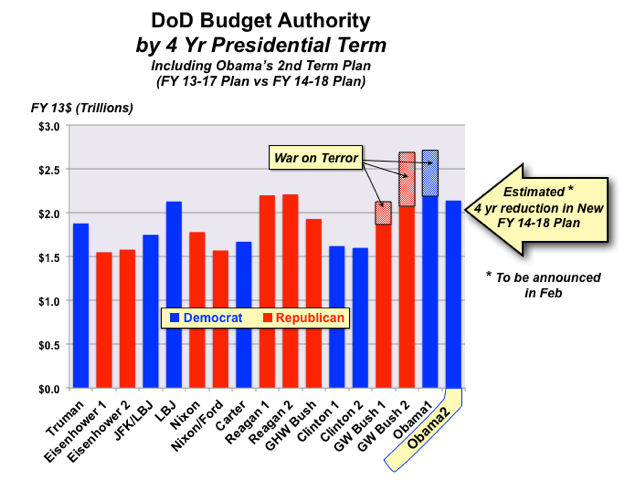
Click on Image to Enlarge $2 T
The sum 1+2+3 makes it easy to understand why Obama's new (albeit still unauditable*) budget plan, if executed perfectly, will result in the biggest eight year boom to the defense industry (including foreign military sales) since since the golden years of Ronald Reagan.
And … as indicated this chart (which I explained in latter part of this essay), this measure of the MICC's golden cornucopia would be true out to 2017,* even if a real zero option for the Afghan war and the war on terror, took place tomorrow!
Presidents Obama and Karzai are due to start the wrangling over their countries’ post-2014 military relationship during the Afghan president’s current visit to Washington. US soldiers, bases, training, equipment, money, immunity all need to be hammered out, although no-one is expecting results just yet. Figures floated in recent days by US government and military officials speak of plans for anything from 20,000 to zero US troops to be left behind after 2014. Talk of the ‘zero option’ on troops might just be a bargaining ploy to put pressure on President Karzai, although as AAN senior analyst, Kate Clark, reports, it needs taking seriously, as does the possibility of a ‘zero plus’ option, ie a full withdrawal of troops which would still leave intelligence agents and military contractors fighting the Taleban.
Phi Beta Iota: It has come to Phi Beta Iota's attention that too many people are searching for Mini-Me daily, rather than reading that day's postings.
Mini-Me is just one of over 25 contributing editors, each committed to the truth — public intelligence in the public interest.
Below are a couple of posts not by Mini-Mi that are Mini-Me-esque in nature. Bottom line: Mini-Me is one of many important contributors, do not neglect the others, please. We will no longer use Mini-Me to improve dissemination of Mongoose, Owl, or others, they are each a “brand” in their own right.
Afghanistan: US Defense Secretary Panetta had talks with Afghan President Hamid Karzai at the Pentagon on Thursday. Panetta told the media the two countries were “at the last chapter” in their effort to rebuild Afghanistan's institutions and security. Panetta said, “We've come a long way towards a shared goal of establishing a nation that you and we can be proud of, one that never again becomes a safe haven for terrorism.”
Comment: Panetta was playing to the gallery… or the mainstream American media. The situation in Afghanistan is not so rosy that anyone should be proud or thumping his or her chest or doing a victory lap.
Unless Congress achieves a deal to head off the revised schedule for across-the-board spending cuts, the Defense Department in March will be forced to begin rotating monthly furloughs of all 791,000 of its civilian employees, a prominent budget analyst said on Wednesday.
“This would be a contracting nightmare for DoD because civilian contracting officers would be furloughed for a month,” Todd Harrison, senior fellow at the Center for Strategic and Budgetary Assessments, told reporters.
Using “back of the envelope” calculations interpreting the new American Taxpayer Relief Act, he said the roughly 8.8 percent cut that would kick in under the sequestration penalties would have “a real impact” on the $70 billion a year spent on the civilian workforce — the equivalent of a 15 percent cut over the remaining seven months of the fiscal year.
“There’s no way to avoid it unless Congress changes the law,” Harrison said in releasing a new paper on the impact of the so-called fiscal cliff that projects revised cuts aimed at the Pentagon of about $48 billion in fiscal 2013. “Not all the furloughs would happen at the same time,” he said, but planners should decide soon who would be furloughed in what month and make it public “to help inform public debate so we could make a good decision as a nation on what we are going to do.”
IF YOU'VE ever suspected politics is increasingly being run in the interests of big business, I have news: Jeffrey Sachs, a highly respected economist from Columbia University, agrees with you – at least in respect of the United States.
In his book, The Price of Civilisation, he says the US economy is caught in a feedback loop. ”Corporate wealth translates into political power through campaign financing, corporate lobbying and the revolving door of jobs between government and industry; and political power translates into further wealth through tax cuts, deregulation and sweetheart contracts between government and industry. Wealth begets power, and power begets wealth,” he says.
Sachs says four key sectors of US business exemplify this feedback loop and the takeover of political power in America by the ”corporatocracy”.
First is the well-known military-industrial complex. ”As [President] Eisenhower famously warned in his farewell address in January 1961, the linkage of the military and private industry created a political power so pervasive that America has been condemned to militarisation, useless wars and fiscal waste on a scale of many tens of trillions of dollars since then,” he says.
Second is the Wall Street-Washington complex, which has steered the financial system towards control by a few politically powerful Wall Street firms, notably Goldman Sachs, JPMorgan Chase, Citigroup, Morgan Stanley and a handful of other financial firms.