In 1989, the Department of State published a notorious volume that purported to document U.S. foreign policy towards Iran in the early Eisenhower Administration. The volume triggered an avalanche of criticism because it omitted any mention of the CIA's role in a 1953 covert action that helped overthrow the government of Iran.
Later this year, after the passage of more than two decades, the State Department will rectify that error by publishing a supplemental volume of declassified documents in its Foreign Relations of the United States (FRUS) series that is expected to fill in the missing pieces of the documentary record of the 1953 coup against the Mossadeq government of Iran.
The publication of the 1989 Iran volume was a milestone in the history of U.S. government secrecy that prompted widespread outrage and ridicule, but it also inspired remedial efforts that had some lasting impact.
In the 19th century, the counter-hegemonic forces of labour focused on the democratisation of the state as well as focusing on the redistribution of the surplus value created by labour. Both tasks are by no means obsolete given the evolution towards market state models which have hollowed out popular democracy, as well ans the increased role of debt in human exploitation1. However, what is now needed in addition, for and by 21st century social movements, is the democratisation of the means of monetization. In a contributive economy, use value becomes key, and undermines mechanisms based on labor value alone; value must therefore become pluralistic and diverse, and so must monetary means; while undoubtedly, demonetization will be a good thing in many sectors under a regime of civic domination, we will also need new forms of monetization, and restore the feedback loop between value creation and value capture. As we will argue, the current value regime, which we call ‘cognitive capitalism under the emergence of netarchical capitalism’ (see infra), is unable to redistribute value in a fair way, and is creating not just a crisis of social reproduction for working people, but also a crisis of accumulation of capital. In our article, value and money regimes are placed in the context of the evolution of the overall political economy toward an increasing importance of models based on peer production. We will look at what kind of social system and policy transition, that can solve this crisis of value.
An Inadequate Defense Budget? Compared to Whom? Compared to When?
Many Republicans and numerous Democrats, especially on the House and Senate Armed Services Committees, have been characterizing the US defense budget as inadequate. They propose to release the Pentagon from the statutory spending caps set by the Budget Control Act of 2011 and its “sequestration,” which would keep some, but not all, Pentagon spending in the neighborhood of $500 billion, annually, for several years. The Joint Chiefs of Staff, the Secretary of Defense and any other Pentagon official near a microphone have been cheering them on.
Absent from all their talking points are three salient facts:
President Obama's 2015 request for all national security related programs would exceed $1 Trillion;
the US outspends any other nation, especially presumed threat nations, by a huge amount, and
under the dreaded sequestration, the Pentagon portion of national security spending would remain at historically high levels.
There is a major mismatch between the actual size of the US defense budget and the characterization of inadequacy given to it. The enormity of the US defense budget, even under sequestration, is readily apparent in both relative and absolute terms.
If you read either the daily SR or the monthly version you know my thinking on why I believe that there will be two major migrations, one away from the coasts, the other out of the Southwest and Great Plains. The first because of too much water, the second because of too little. Here is a good representation of the reasons why I think this.
Phi Beta Iota: The federal government — which should not own any land at all — owns most of the west. States should be giving serious thought to ending federal ownership of land at the same time that they begin nullifying insane federal policies that are clearly inimical to society. What the west needs is a Manhattan Project to desalinate massive amounts of water and bring them from the sea inland using solar power, while creating hydroponics industries and ending all fracking and all contamination of groundwater from any source including mega-agricultural fertilizers and toxins.
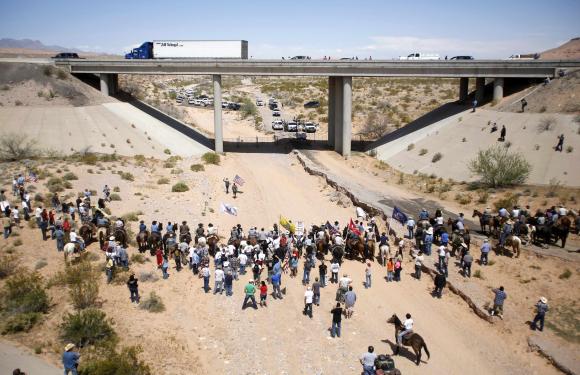
Fearing for their safety as armed protesters gathered in the Nevada back country, federal officials on Saturday suddenly ended a controversial effort to seize hundreds of cattle that a rancher has kept illegally on public land.
The cattle ranch’s owner, Cliven Bundy, and hundreds of armed supporters had threatened to forcefully keep Bureau of Land Management employees from rounding up the approximately 900 cattle. Nearly 400 of the cattle had been seized during the past week. They were being held nearby and could be sent to Utah, authorities said.
The real reason they are going after Bundy, making way for the frackers? Mike Adams lays out the case in detail for frackers behind federal persecution of Bundy:
“This document from the Nevada Bureau of Mines and Geology(1) shows significant exploratory drilling being conducted in precisely the same area where the Bundy family has been running cattle since the 1870's. The “Gold Butte” area is indicated on the lower right corner of the document (see below), and it clearly shows numerous exploratory drilling operations have been conducted there. What's also clear is that oil has been found in nearby areas and possibly even within the Gold Butte area itself.
Or maybe THIS is the real reason they are after Bundy: Senator Harry Reid & son will make a bundle:
“Back in 2012, the New American reported that Harry Reid’s son, Rory Reid, was the chief representative for a Chinese energy firm planning to build a $5-billion solar plant on public land in Laughlin, Nevada. And journalist Marcus Stern with Reuters also reported that Sen. Reid was heavily involved in the deal as well. [Reid] and his oldest son, Rory, are both involved in an effort by a Chinese energy giant, ENN Energy Group, to build a $5 billion solar farm and panel manufacturing plant in the southern Nevada desert,” he wrote. “Reid has been one of the project’s most prominent advocates, helping recruit the company during a 2011 trip to China and applying his political muscle on behalf of the project in Nevada.” “His son, a lawyer with a prominent Las Vegas firm that is representing ENN, helped it locate a 9,000-acre (3,600-hectare) desert site that it is buying well below appraised value from Clark County, where Rory Reid formerly chaired the county commission.” Although these reports are in plain view, the mainstream media has so far ignored this link.”