Leaving Afghanistan: Not With a Bang, But a Whimper
Stephen M. Walt, Foreign Policy, 28/10/13

Leaving Afghanistan: Not With a Bang, But a Whimper
Stephen M. Walt, Foreign Policy, 28/10/13

PDF (1 Page): (U) CSA Interview (Defense News, 28Oct13)-1
Interview
GEN. RAY ODIERNO
US Army Chief of Staff
Defense News 10/28/2013

At last week’s Association of the United States Army annual meeting and exposition in Washington, thousands gathered to hear senior leaders explain where the service is headed in this era of austerity. And the message from Gen. Ray Odierno, Army chief of staff, was one of frustration with uncertain budgets and automatic and inflexible defense cuts that are gutting readiness, with only two of his brigades ready for combat. The Army has been cutting personnel at a breakneck pace to save as much money as possible, given additional budget cuts are likely.
The Army is headed from a force of 570,000 soldiers, just a few years ago, down to 490,000. That number could get smaller, given sequestration is likely to continue and deeper reductions are expected over the coming months as part of a broader debt and spending deal.
Q. What is the real impact of past and future budget cuts on the force? Why are you so alarmed? And what is the way out of it?
This is the latest on Fukushima and the impact it is making on the U.S. West Coast. This directly affects me, as well as tens of millions of other Americans, and there doesn't seem to be a thing we can do about it.
28 Signs That The West Coast Is Being Absolutely Fried With Nuclear Radiation From Fukushima
MICHAEL SNYDER – Global Research – Centre for Research and Globilization
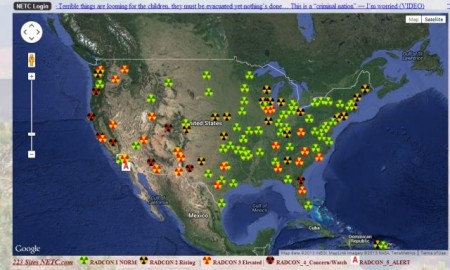
The map below comes from the Nuclear Emergency Tracking Center. It shows that radiation levels at radiation monitoring stations all over the country are elevated. As you will notice, this is particularly true along the west coast of the United States.

Every single day, 300 tons of radioactive water from Fukushima enters the Pacific Ocean. That means that the total amouont of radioactive material released from Fukushima is constantly increasing, and it is steadily building up in our food chain. Ultimately, all of this nuclear radiation will outlive all of us by a very wide margin. They are saying that it could take up to 40 years to clean up the Fukushima disaster, and meanwhile countless innocent people will develop cancer and other health problems as a result of exposure to high levels of nuclear radiation. We are talking about a nuclear disaster that is absolutely unprecedented, and it is constantly getting worse. The following are 28 signs that the west coast of North America is being absolutely fried with nuclear radiation from Fukushima.
America’s Threat-Centric [Lie-Based] Education System: Out of Date and Out of Time
“History is a story. That’s why we fight over history. We make sense of ourselves, the world and ourselves in the world through the struggle to tell the truth through stories. Facts have to be contextualised to become the truth. And that truth is a struggle that is constantly fought over. It is not given. And telling stories helps to create debate about that truth. That is why working people should tell their stories. Truth is a class issue. I would appeal to all your readers, especially to young ones, to make their own political films; shoot interviews, especially with older comrades, and dare to express themselves on the screen. Film making is for everybody. I would be looking at the new technologies. They are disruptive and a problem in capitalist society…That’s why they want to close down the Internet if they can. Politicians don’t like allowing people to communicate anonymously with each other. They want to restrain freedom … But still for a while there is a window of opportunity and freedom. They monitor you, but don’t yet stop you. That will come, of course…[But] it’s where people ought to be, where creative people and political people ought to be.” Tony Garnett interviewed by the editors of WSWS
How can young people be encouraged and coached to narrate a “true” history of their lives and times in the world—and the events, people and geography that influence them—for the bulk of their literate existence (i.e., 21st Century literate to include visual and technological literacy)?

Professor Brenner gave me permission to distribute and post the attached essay. Without saying so, he describes a way that seems tailor-made to systematically violate just about all the criteria for a sensible grand strategy.
For someone of my age who grew up at a time when America was viewed by the world as a society to be emulated, the last 30 years have been very painful. So painful, I think, that rather than face the truth we tell ourselves lies. Politicians, from the President on down engage in systematic lying about the truth of American society today. Here's some truth.
Can You Guess the 10 Best Countries For Women? Hint: the U.S. Isn't One of Them
JODIE GUMMOW – AlterNet (U.S.)The report, which ranks 136 countries, determines its findings across four primary areas including economic participation and opportunity, educational attainment, political empowerment and health and survival, ranking the United States 23 rd on the list for 2013, HuffPost reported.
We are metaphorically eating our young. This report about homeless students is the kind of thing one expects to read about a third world country.
The Number Of Homeless Students In The United States Hits A Record
SCOTT KEYES – Think ProgressDuring the 2011-12 school year, there were 1,168,354 homeless students enrolled in preschool or K-12, a 10 percent increase over the previous year. A total of 55.5 million students were enrolled in preschool or K-12 that year, meaning nearly 2 percent of all students were homeless.
This brain drain trend started about 18 months ago and, as this report describes, is gaining momentum. This is the other end that begins with homeless students.
Brain Drain: Funding and Industry Leave America, Followed by Top Minds
PATRICK HENNINGSEN, Investigative Journalist – RT (Russia)Two fundamental building blocks for any modern technological, progressive economy are discovery research and scientific investigation. By their nature, these two pursuits carry a much slower return on the investment. In the past, the US could afford to be patient because its thriving industrial sector was a magnet for the word’s talent and investment – which is why successive governments have routinely placed their dollars there. That engine which used to power the US juggernaut has been disassembled and shipped overseas.
I have more and more readers writing me to tell me about poverty that they are observing or, sometimes, experiencing.
Billionaires’ Row and Welfare Lines
CHARLES M. BLOW – The New York TimesThis disconnecting is particularly acute among young people. Measure of America, a project of the Social Science Research Council, recently released a study finding that a staggering 5.8 million young people nationwide – one in seven of those ages 16 to 24 – are disconnected, meaning not employed or in school, ‘adrift at society’s margins,” as the group put it.

It's the second time that I go back to this insightful article by Jonathan Stray, dating back to 2011, but which was visionary and rightful then as it is still now. The first time I did, right after it came out, I didn't actually realize in full how relevant and important was the idea being communicated through it. On the surface the article talks about an hypotethical Editorial Search Engine as a desirable news app. But if you look just beyond the surface, which is by itself fascinating, in essence, Mr. Stray indicates how useful and effective it would be if news publishers moved on from reporting and and into 100% curated coverage of a certain topic, issue or story, opening a fascinating discovery gateway around each story and allowing in time for these streams to intersect and interconnect with each other. By doing this, we can not only make the news much more interesting and relevant, but we can transform them into instruments for in-depth learning about anything we are interested in. In this light the future of news could be very much about Comprehensively Informing an Audience on a Specific Topic. And if you stop enough time to re-read it and think about it, this is a pretty powerful and revolutionary concept by itself. He specifically writes: “Rather than (always, only) writing stories, we should be trying to solve the problem of comprehensively informing the user on a particular topic.” “Choose a topic and start with traditional reporting, content creation, in-house explainers and multimedia stories. Then integrate a story-specific search engine that gathers together absolutely everything else that can be gathered on that topic, and applies whatever niche filtering, social curation, visualization, interaction and communication techniques are most appropriate.” Jonathan Stray makes also a very inspiring connection to Jay Rosen of NYU and his idea of covering 100% of a story which in my view correctly anticipated the niche content curation trend while going beyond it in its effort to explore gateways to innovation. . . . Insightful. Visionary. Inspiring. 9/10 . .Original article (2011): http://jonathanstray.com/the-