I’ve written several articles on this subject. As vaccine supporters, enthusiasts, liars, and poisoners keep showing up, I’m sure I’ll write several more.
Here’s the drill. If a parent believes her child has developed autism as the result of a vaccine(s), she must enter the maze of the US government compensation system. Why? Because she can no longer go to court and sue the vaccine manufacturer directly. That’s out.
The manufacturers and the federal government have conspired to erect a wall against those lawsuits, to protect the manufacturers from high-priced judgments.
Google is always striving to improve their flagship search engine. Well, improve its profitability, anyway. Ars Technica reports that “New Banner Ads Push Actual Google Results to Bottom 12% of the Screen.” These new adds do not unobtrusively hug the top of the page; for thirty companies lucky enough to be part of this “experiment,” their ads can dominate the results page. Reporter Casey Johnston reminds us this is a tactic Google pledged eight years ago never to employ. Have dollar signs have weakened the company’s resolve? The article observes:
“The rollout of banner ads comes only days after Google’s most recent earnings call, where financial results showed that Google is struggling with falling mobile ad sales prices. As The New York Times reported, Google sells mobile ads for half to two-thirds as much as desktop ads, but the mobile ads are only a third to a quarter as effective. It bears mentioning that before scrolling, real search results on mobile don’t get much real estate, either.
“Google will not publicly address any aspect of the banner ad experiment beyond saying that it is a ‘very limited, US-only test, in which advertisers can include an image as part of the search ads that show in response to certain branded queries.’”
It is worth noting that last bit—”. . . in response to certain branded queries.” In other words, if you search for “Southwest Airlines,” you might get a really big ad about Southwest Airlines. That’s much more reasonable than getting such advertising if you just searched for “airplanes” or “air travel.” (I would not put that evolution past them, though. Stay tuned.) Still, the tactic is bound to rub many searchers the wrong way. Johnston delves into specifics, augmenting her analysis with several screenshots. She concludes with a prediction—she will not be surprised if this experiment turns into a fixture. Neither will I.
From: Kevin Kelley <kwk@thehomegalaxy.com> Date: Sat, 2 Nov 2013 10:31:11 -0700 Subject: NSA Files: Decoded – Truly Stunning! & ESSENTIAL! (From The Guardian)
This is truly stunning in many ways! Not in order:
It's stunningly beautiful as a graphic piece and typography
It's a stunning cutting edge of digital reporting converging interactive media
It stunning in it's brilliant and cogent making of it's case
It's stunning in the story it tells and conveys and in it's impact.
A collection of videos, text snap-shots, and images, across many authoritative personalities. This is a MAJOR contribution to the public dialog about mass surveillance and out of control government agencies.
Baker, Stewart (former NSA general counsel)
Drake, Thomas (former senior executive, NSA)
Greenwald, Glenn (Journalist)
Jaffer, Jameel (Deputy legal director, ACLU)
Levison, Ladar (Founder of Lavabit)
Lofgren, Zoe (US congresswoman)
Scalhill, Jeremy (National security journalist)
Soghoian, Chris (Principal technologies, ACLU)
Stepanovich, Amie (Lawyer, Electronic Privacy Information Center)
Wyden, Ron (US senator)
Below is a full text reproduction of the above letter from Gary Hart. The above also contains a letter to John Kerry from Art Goodtimes then of the Telleride Times-Journal. The Hart letter was written a year and a month after Col James Sabow, USMC (Aviation) was murdered, possibly by Marines acting on the orders of General Al Gray, then Commandant of the Marine Corps and long-timer special operations and counter-terrorism enabler for CIA operations outside the legal channels established by Congress. (For more information see Col James Sabow USMC Murder Book).
GARY HART
Davis, Graham & Stubbs
Suite 4700
370 Seventeenth Street
Post Office Box 185
Denver, Colorado 80201-0185
February 14, 1991
The Honorable John Kerry
Chairman
Subcommittee on Terrorism, Narcotics and International Communications
222 R.S.O.B.
Washington, D.C. 201510
Hon Gary Hart
Dear Senator Kerry,
The following information is provided at the request of Mr. Tosh Plumlee and is to document specific contacts he made with my Senate Office during the years of 1983-1985.
In March of 1983, Plumlee contacts my Denver Senate Office and met with Mr. Bill Holen of my Senate Staff. During the initial meeting, Mr. Plumlee raised certain allegation concerning U.S. foreign and military policy toward Nicaragua and the use of covert activities by U.S. intelligence agencies. He indicated that he was personally involved in covert military intelligence activities in Central and South America beginning in Feburary 1978. He stated that he had grave concerns that certain intelligence information about illegal arms and narcotic shipments were not being appropriately acted upon by U.S. intelligence and law enforcement agencies. Mr. Plumlee's stated purpose in contacting my office was to attempt to initiate a congressional investigation of these allegations. Mr. Plumlee stated that he had personally flown U.S.-sponsored covert missions into Nicaragua. He stated that Nicaragua was receiving assistance from Cuba with nearly 6,000 Cuban military advisors and large quantities of military supplies were being stockpiled at various staging areas inside Nicaragua and the Costa Rica border.
Mr. Plumlee also stated that Mexico, Costa Rica, Guatemala and El Salvador were providing U.S. military personnel access to secret landing field (sic) and various staging areas scattered throughout Central America.
The Honorable John Kerry
Washington, D.C.
February 14, 1991
Page 2
He specifically states the Mexican government's direct knowledge of illegal arms shipments and narcotic smuggling activities that were taking place out of a civilian ranch in the Veracruz area which were under the control and sponsorship of the Rafael Car-Quintero and the Luis Jorge Ochoa branch of the Medellin Escobar Cartel.
Mr. Plumlee states that the U.S. military and intelligence agencies had been otified through proper channels of these allegations.
During the next three months, Mr. Bill Holen of my staff met with Mr. Plumlee on several occasions allowing him to further elaborate on his experiences and concerns with U.S military operations in the region. In those later meetings, Mr. Plumlee raised several issues including that covert U.S. intelligence agencies were directly involved in the smuggling and distribution of drugs to raise funds for covert military operations against the government of Nicaragua. He provided my staff with detailed maps and names of alleged covert landing strips in Mexico, Costa Rica, Louisiana, Arizona, Florida, and California where he alleged aircraft cargoes of drugs were off-loaded and replaced with Contra military supplies. He also tates that these operations were not CIA operations but rather under the direction of the White House, Pentagon, and NSC personnel.
My staff brought these allegations to the attention of the Senate Armed Services Committee and the Senate Intelligence Committee at the time but no action was initiated by either committee.
In 1973, the Director of Central Intelligence ordered CIA officials to prepare a descriptive account of all CIA activities that were “outside the legislative charter of this Agency,” which is to say unauthorized or illegal. The purpose of the exercise was to identify operations that had “flap potential,” meaning that they could embarrass the Agency or embroil it in controversy.
The resulting 700-page CIA compendium of unlawful domestic surveillance, wiretapping, mail opening and detention actions became known as “the family jewels.” It helped to inform and to substantiate the investigations of intelligence in the 1970s. The document was finally declassified (with some redactions) in 2007 and was released to the National Security Archive, which has posted it here.
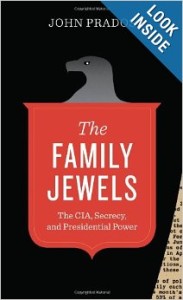
Amazon Page
In a new book entitled The Family Jewels: The CIA, Secrecy, and Presidential Power (University of Texas Press, 2013), historian John Prados reviews the origins and consequences of the family jewels document and the operations described in it.
The thrust of Prados’ book is that the CIA family jewels are not simply relics of a discrete historical period, but rather that they are exemplars of a recurring pattern of intelligence misconduct. Many of the specific abuses of the 1970s, he argues, can be understood as archetypes that have been manifested repeatedly, up to the present day.
As DNI James Clapper said at a hearing of the House Intelligence Committee last week, “there are many things we do in intelligence that, if revealed, would have the potential for all kinds of blowback…. the conduct of intelligence is premised on the notion that we can do it secretly and we don’t count on it being revealed in the newspaper.”
“The intelligence community must acknowledge how difficult it is to keep secrets today,” said ODNI General Counsel Robert Litt in a speech last week.
The notion of creating and incrementally expanding “no spy” zones has some history. In a 1996 op-ed, for example, former U.S. Ambassador Robert E. White proposed that the U.S. explore the possibility on a trial basis:
“One reform might be to select a specific region of the world — for example, Central America — as a testing place. Withdraw all CIA staff from these countries. Let the National Security Council charge our career diplomats with fulfilling Washington’s intelligence requirements. Should Foreign Service officers prove capable of meeting all intelligence needs, then gradually extend this beneficial practice to other countries through pacts of reciprocal restraint by which signatories agree not to spy on or engage in covert action against the other. In order to be eligible to sign such a pact with the United States, the other nation would have to meet minimal standards of openness.” (“Call Off The Spies,” Washington Post, February 7, 1996).
This article focuses on high-level pederasts in the UK. But if judges, politicians, Cabinet ministers, corporate executives and other “respectable” people are frequently found to be child molesters, surely their counterparts in other first world countries, such as the US, Germany, France, etc., must have similar numbers representative of high-level pedos? So much rot at the top must stink very badly, but unlike garbagemen dealing with garbage cans on the street, the police – a specialized sort of garbageman – is blocked from doing their job when the trash is high-level.
“POLICE chiefs are turning a blind eye to members of the Establishment abusing children in care, a former child protection officer claimed last night. The whistleblower said he was warned by his superiors not to investigate suspected paedophiles, including a senior politician and a judge. He said the justice system was “corrupt” and “rotten to the core” and told how vulnerable boys and girls as young as nine were plied with heroin and raped by rich and powerful men. Agreeing to speak anonymously, the police insider warned: “There is a massive cover-up going on and those who are abusing children are being protected by the powers that be. “When I was investigating abuse at low levels, street prostitution, everything was fine but as soon as the evidence started taking me to a higher level, I was told to wind my neck in and not go any further.
“Among the names given to me by abuse victims were a former Cabinet minister and a judge who had been handing paedophiles soft sentences. I was warned by a senior officer to back off and it has to be because the clients of these children were very well-connected people.” Our source has more than 20 years’ experience working with abused children. During his investigations for one of the country’s biggest police forces, victims mentioned a number of prominent names.”
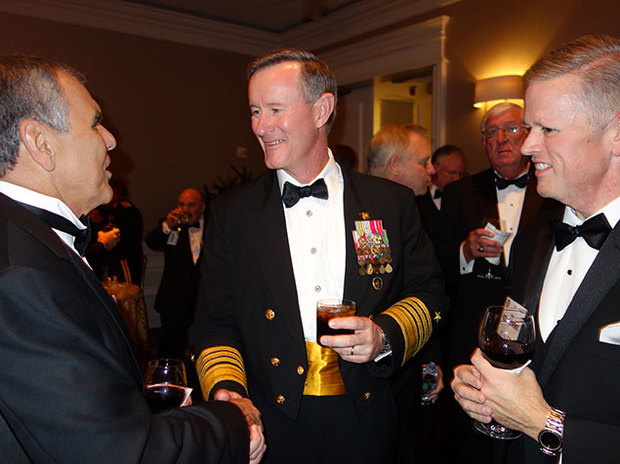
No one in the ballroom came right out and shouted, “William McRaven for elected office!” but the idea hovered like a thought bubble over the OSS Society’s William J. Donovan Award Dinner Saturday night, where the commander of US Special Operations was honored—including by President Obama—and even sounded himself a bit like a candidate.
US special operations commander, Adm. William H. McRaven, greets guests at the annual OSS Society dinner, where he was honored with the William J. Donovan Award. Photograph by Carol Ross Joynt.
The annual celebration commemorating the World War II spy agency and predecessor of the CIA—for the intelligence and special operations communities, it’s the prom and the Oscars wrapped in one—is a time for reminiscing and gossiping for both the smooth-skinned, ramrod-spined young operatives and the retired spies and warriors with more medals than hair or teeth. But McRaven, the Navy admiral who oversaw the 2011 Navy SEAL mission that resulted in the death of Osama bin Laden and who received the Donovan award, gave this year’s gathering a political edge.
President Obama addressed the audience and the honoree via taped video, his image filling three ceiling-high screens. He called McRaven “one of the finest special operators our nation has ever produced. Few Americans will ever see what you do, but every American is safer because of your service.” Also lauding him in taped messages were two other individuals who were directly involved in the bin Laden mission, former CIA director Leon Panetta and Defense Secretary Robert Gates.
A third official who was a player in that historic episode, John Brennan, now director of Central Intelligence, relived the experience in his remarks. He said the deliberations to undertake the mission were “difficult and fraught with uncertainty.” He said there was “a key moment in those deliberations when President Obama seemed to move a step closer to his final decision. It was when Adm. McRaven looked at the President and said, ‘Sir, we can get this job done.’ You could hear a pin drop. It was at that time that everyone in that room knew the decision was made and we were going forward.”