Hoax exposed: Gen. Dempsey rebuffs speculations he called for Syria raids
“In truth, the calls for ‘kinetic strikes’ on Syria came from Senator John McCain of Arizona, a member of the Israeli lobby who met with Al Qaeda leaders in the Arab country in late May, 2013.”
Seated on a stool before an audience packed with spooks, lawmakers, lawyers and mercenaries, CNN’s Wolf Blitzer introduced recently retired CENTCOM chief General James Mattis. “I’ve worked with him and I’ve worked with his predecessors,” Blitzer said of Mattis. “I know how hard it is to run an operation like this.”
Reminding the crowd that CENTCOM is “really, really important,” Blitzer urged them to celebrate Mattis: “Let’s give the general a round of applause.”
Following the gales of cheering that resounded from the room, Mattis, the gruff 40-year Marine veteran who once volunteered his opinion that “it’s fun to shoot some people,” outlined the challenge ahead. The “war on terror” that began on 9/11 has no discernable end, he said, likening it to the “the constant skirmishing between [the US cavalry] and the Indians” during the genocidal Indian Wars of the 19th century.
“The skirmishing will go on likely for a generation,” Mattis declared.
Mattis’ remarks, made beside a cable news personality who acted more like a sidekick than a journalist, set the tone for the entire 2013 Aspen Security Forum this July. A project of the Aspen Institute, the Security Forum brought together the key figures behind America’s vast national security state, from military chieftains like Mattis to embattled National Security Agency Chief General Keith Alexander to top FBI and CIA officials, along with the bookish functionaries attempting to establish legal groundwork for expanding the war on terror.
Partisan lines and ideological disagreements faded away inside the darkened conference hall, as a parade of American securitocrats from administrations both past and present appeared on stage to defend endless global warfare and total information awareness while uniting in a single voice of condemnation against a single whistleblower bunkered inside the waiting room of Moscow International Airport: Edward Snowden.
For those who have not seen from one of the Army's premier thinkers. Opposition rebuttal follows from a consistent defense naysayer.The issues can also be framed in a couple of other ways, from the conventional and special operations perspectives:
CONVENTIONAL: “Wars may be fought with weapons, but they are won by men. It is the spirit of the men who follow and the man who leads that gains the victory.”
SPECIAL OPERATIONS: “Humans are more important than hardware. Quality is more important than quantity.”
FORT BENNING, Ga. — ”A GREAT deal of intelligence can be invested in ignorance when the need for illusion is deep,” the novelist Saul Bellow once wrote. We should keep that in mind when we consider the lessons from the wars in Iraq and Afghanistan — lessons of supreme importance as we plan the military of the future.
Our record of learning from previous experience is poor; one reason is that we apply history simplistically, or ignore it altogether, as a result of wishful thinking that makes the future appear easier and fundamentally different from the past.
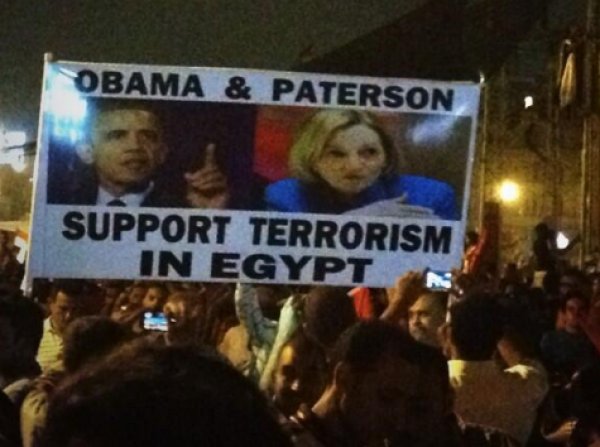
Curiously, a massive wave of anti-Obama sentiment in Egypt has been utterly ignored by vintage media, even though the protests may be the largest in all of human history.
Phi Beta Iota: The many signs, both hung banners and neatly printed hand posters in perfect English, are clearly “organized” but they are also clearly what the protesters want to say. As a general statement, the US Government and Obama and the US Ambassador are considered to be severely hypocritical and not at all supportive of any form of democracy.
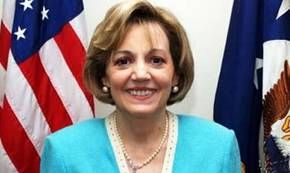
Anne Woods Patterson
Unlike many Ambassadors who bought their position with campaign contributions, Anne Woods Patterson is a professional who took 20 years to go from entry level to Deputy Assistant Secretary of State for Inter-American Affairs and has been an Ambassador to various countries for the past fifteen years. She is considered by Egyptians to be too close to the Muslim Brotherhood.
In the nation's history this is one of the most extraordinary statements ever made by a former President. The fact that it has gone mostly unremarked by corporate media is, itself, a commentary on the country we have become.
Thanks to Michael Feikema and Doug Hendren for inviting me. Like most of you I do not spend my life studying trade agreements, but the Trans-Pacific Partnership (TPP) is disturbing enough to make me devote a little time to it, and I hope you will do the same and get your neighbors to do the same and get them to get their friends to do the same — as soon as possible.
I spend most of my time reading and writing about war and peace. I'm in the middle of writing a book about the possibility and need to abolish war and militarism. I hate to take a break from that. But if we think trade and militarism are separate topics we're fooling ourselves.
New York Timescolumnist Thomas Friedman, a big fan of the supposed wonders of the hidden hand of the market economy says, “The hidden hand of the market will never work without a hidden fist. McDonald's cannot flourish without McDonnell Douglas, the designer of the U.S. Air Force F-15. And the hidden fist that keeps the world safe for Silicon Valley's technologies to flourish is called the U.S. Army, Air Force, Navy and Marine Corps.”