Robert Steele: World Brain / Global Game Update with Concept for School of Future-Oriented Hybrid Governance and Centre for Multinational Multiagency Multidisciplinary Multidomain Information-Sharing and Sense-Making (M4IS2)

Advanced Cyber/IO, Collaboration Zones, Communities of Practice, Key Players, Policies, Serious Games, Threats
Robert David STEELE Vivas

As the global economy collapses and increasing numbers recognize that no one is addressing our common problems with intelligence and integrity, it seems like a good time to quickly survey the state of the World Brain /Global Game. Here are a few headlines with short comments.

2011-07-07 Complex Global Issues Explored in the World Brain Trust’s Annual Reports

The Network of Global Agenda Councils, launched by the World Economic Forum three years ago, comprises more than 1,000 thought leaders who meet at least four times a year – three times in virtual meetings and once during the annual Summit on the Global Agenda in the United Arab Emirates, arguably the biggest intellectual brainstorming in the world.

RS:  This is the World Economic Forum / 1% “front” version of the World Brain.  There is a great deal that can be harvested from this endeavor, but it lacks a strategic analytic model, a commitment to open source data access and other fundamentals of the M4IS2 process.  It is inherently elitist.  Of interest is the fact that all of its community lists have been blanked out
Click on Image to Enlarge

1964-10-06 Towards the World Brain – Eugene Garfield

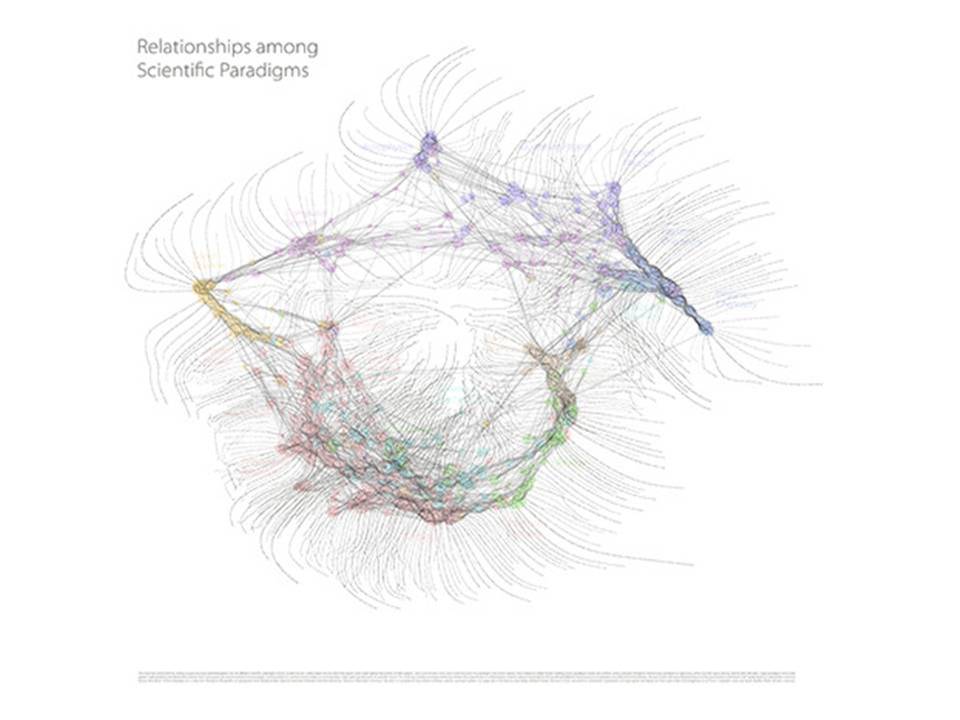
RS:  Eugene Garfield with the Institute of Scientific Information (now Thompson Reuters), and then Dick Klavans with Maps of Science, have done more than any other to actually create a structure for identifying strengths, gaps, and emergent possibilities in the World Brain on the basis of published formal knowledge.  One of my most prized possessions is the internal massive PDF file (shown here as a snapshot) that allows for drilling down all the way to each and every sub-discipline.  Here are two of the seminal works:

2009 Mapping the Backbone of Science – Klavans Boyack

2005 Mapping the Backbone of Science – Boyack Klavans Borner

Click on Image to Enlarge

RS: Using techniques developed by Garfield and Klavans (much of this done prior to computing advances, by hand), Thompson Reuters now offers a service that can show, by country, region, university, or discipline, where the strengths and weaknesses are on the basis of citation analysis.  One example for the USA is shown here to the side.  This remains severely deficient for two reasons: first, the persistence of inbred citation cabals; and second, the extremely poor coverage of languages other than English, French, and German.  There is a third deficiency beyond that of citation analytics, and that has to do with the identification of unpublished experts of various kinds–I am especially interested in the indigenous experts and the oral historical knowledge they have inherited from prior generations.  Finally, there is a fourth deficiency yet to be addressed that will eventually turn citation analytics on its head: most research is isolated from both a strategic analytic model and true cost economics.  When these two are eventually factored in, I believe there will be a revolutionary shift in interest away from Western citation cabals and toward those in Brazil, China, India, Indonesia, Russia, South Africa, and Turkey, among others.

RS:  To the best of my knowledge, and having failed to get Jeff Bezos to think of Amazon as the World Brain is gestation (including reviewers and readers down to the zip code level of specificity), no one, anywhere, is actually putting together a strategic analytic model, global true cost data, and a global grid of published and unpublished experts in all languages.  Some of the Earth Science networks have the right idea, but are missing some big pieces.

2012-03-29 EarthGame

EarthGame™ is a massively multiplayer online strategic design and planning real-world “game.” It is also a set of tools for recognizing, defining and solving global and local problems onboard Spaceship Earth. It combines the vast and growing wealth of global data available on the web with sophisticate data visualization techniques, embeds these within a powerful strategic planning and design methodology, and places all this into a gaming context.

RS: Medard Gabel, co-creator with Buckminster Fuller of the analog World Game, remains the only person I know of (i.e. in the English language) who is serious about creating the Global Game.  Earth Intelligence Network (EIN) funded his definition of the preliminary staffing and cost, as well as the trademarking (in his name) of EarthGame.  I have approached one massive multi-player game firm about joining with Wolfam Alpha and EarthGame, but they were not interested.  Below is the high-level summary he created for EIN.

2012-03-29 EarthGame 1.0 Version 3.3-1

RS:  I am aware of the World Game as managed by the Buckminster Fuller Institute  and commercialized by OSEarth.  Neither of these has the mind-set, depth, or breadth that Medard and I have envisioned together.  The Global Economics Game has some laudable aspects to it, but accepts so many false assumptions about true cost and corruption and the way the world actually works that it would need a considerable make-over–never-the-less, it is a most impressive endeavor and not to be over-looked.
Click on Image to Enlarge

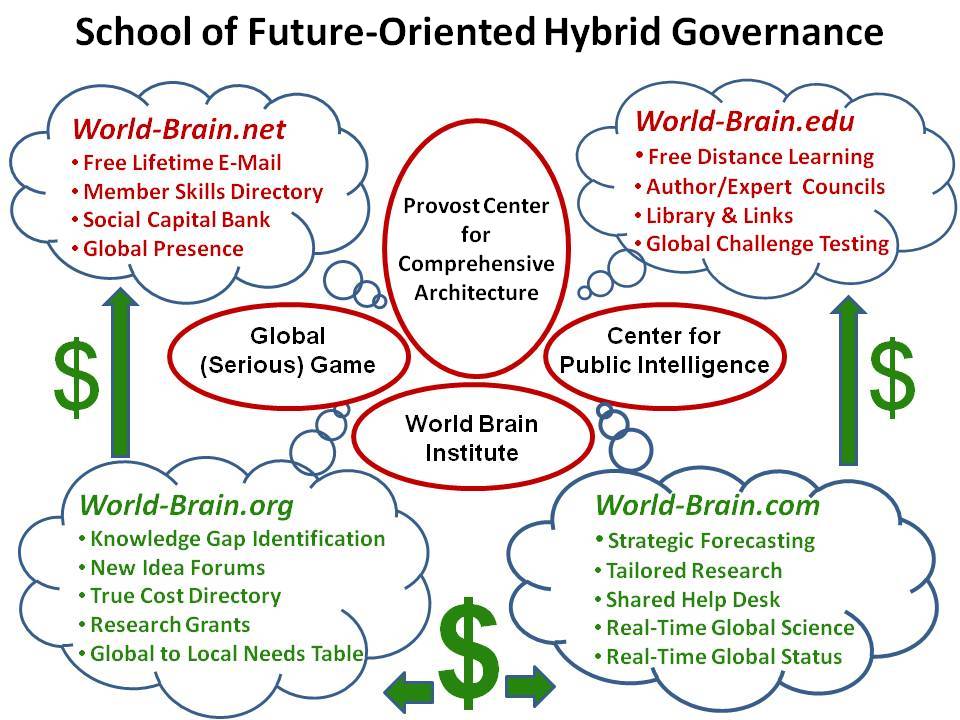
RS:  The whole point of the Global Game is to connect all human minds with all information in all languages — and embedded open source everything tools — so that every person can play themselves, fully informed in a timely fashion, on every issue from local to global.  I myself am actively in search of a major university interested in creating a School of Future-Oriented Hybrid Governance with a Center for M4IS2, a World Brain Institute, the Global Game (with Medard Gabel), and a prototype Center for Public Intelligence — all committed to open source software, hardware, spectrum, and OpenBTS as the hand-held standard.

See Also:

THE OPEN SOURCE EVERYTHING MANIFESTO: Transparency, Truth & Trust (2012)

INTELLIGENCE FOR EARTH: Clarity, Diversity, Integrity, & Sustainability (2010)

COLLECTIVE INTELLIGENCE: Creating a Prosperous World at Peace (2008)

THE SMART NATION ACT: Public Intelligence in the Public Interest (2006)

INFORMATION OPERATIONS:  All Information, All Languages, All the Time (2006)

THE NEW CRAFT OF INTELLIGENCE: Personal, Public, & Political (2002)

ON INTELLIGENCE: Spies and Secrecy in an Open World (2000)

Mini-Me: US Dollar Out, Yuan, System D, and Open Money In + Meta-RECAP

Advanced Cyber/IO, Budgets & Funding, Collaboration Zones, Communities of Practice, Corruption, Ethics, Key Players, Policies, Threats
Who? Mini-Me?

BRICS Move To Replace Dollar With “Super-Sovereign” Global Currency

Alexander Higgins, Contributor

Activist Post, 28 March 2012

As China is expected to rise to the status of a financial superpower within the next 8 years and eclipse the US economy by 2020, Africa becomes center stage in the greatest currency war the world has seen since the 1930s, which is now shifting into overdrive.

Brazil, Russia, India, China and South Africa, collectively known as the BRICS nations, are moving forward with their plan to unseat the US dollar from its throne as the global trade currency and to replace it with a Chinese-denominated “super-sovereign” international currency.

Click on Image to Enlarge

This Geo-political game to establish global monetary dominance is by no means limited to the attack on the US dollar. Instead this is merely the first strike of a concerted campaign of worldwide economic warfare that will soon follow which seeks to bring the United States and its western allies to their knees.

Ultimately the BRICS collective is staging a coup to overthrow the current global financial regime that has been dominated by the World Bank and the International Monetary Fund since the last global currency war was won at the end of World War II.

The attack comes partially in retaliation for the latest round of quantitative easing in which we witnessed the Federal Reserve deliberately printing trillions of dollars in an attempt to jump-start the U.S. economy by forcing investors back into the U.S. stock market by devaluing the US dollar.

Phi Beta Iota:  One third of the global economy is transnational crime, and one third System D or “off the books” entrepreneurial information economics routing around governments.  Now that we know the final third is legalized crime, it becomes much easier to understand why two thirds of the brain power on the planet has opted out of the legalized crime world that favors the 1%.

See Also:

Continue reading “Mini-Me: US Dollar Out, Yuan, System D, and Open Money In + Meta-RECAP”

Patrick Meier: Crisis Mapping Syria – Automated Data Mining and Crowdsourced Human Intelligence

Advanced Cyber/IO, Collective Intelligence, Communities of Practice, Earth Intelligence, Geospatial, Hacking
Patrick Meier

Crisis Mapping Syria: Automated Data Mining and Crowdsourced Human Intelligence

The Syria Tracker Crisis Map is without doubt one of the most impressive crisis mapping projects yet. Launched just a few weeks after the protests began one year ago, the crisis map is spearheaded by a just handful of US-based Syrian activists have meticulously and systematically documented 1,529 reports of human rights violations including a total of 11,147 killings. As recently reported in this NewScientist article, “Mapping the Human Cost of Syria’s Uprising,” the crisis map “could be the most accurate estimate yet of the death toll in Syria’s uprising […].” Their approach? “A combination of automated data mining and crowdsourced human intelligence,” which “could provide a powerful means to assess the human cost of wars and disasters.”

On the data-mining side, Syria Tracker has repurposed the HealthMap platform, which mines thousands of online sources for the purposes of disease detection and then maps the results, “giving public-health officials an easy way to monitor local disease conditions.” The customized version of this platform for Syria Tracker (ST), known as HealthMap Crisis, mines English information sources for evidence of human rights violations, such as killings, torture and detainment. As the ST Team notes, their data mining platform “draws from a broad range of sources to reduce reporting biases.” Between June 2011 and January 2012, for example, the platform collected over 43,o00 news articles and blog posts from almost 2,000 English-based sources from around the world (including some pro-regime sources).

Syria Tracker combines the results of this sophisticated data mining approach with crowdsourced human intelligence, i.e., field-based eye-witness reports shared via webform, email, Twitter, Facebook, YouTube and voicemail. This naturally presents several important security issues, which explains why the main ST website includes an instructions page detailing security precautions that need to be taken while sub-mitting reports from within Syria. They also link to this practical guide on how to protect your identity and security online and when using mobile phones. The guide is available in both English and Arabic.

Eye-witness reports are subsequently translated, geo-referenced, coded and verified by a group of volunteers who triangulate the information with other sources such as those provided by the HealthMap Crisis platform. They also filter the reports and remove dupli-cates. Reports that have a low con-fidence level vis-a-vis veracity are also removed. Volunteers use a dig-up or vote-up/vote-down feature to “score” the veracity of eye-witness reports. Using this approach, the ST Team and their volunteers have been able to verify almost 90% of the documented killings mapped on their platform thanks to video and/or photographic evidence. They have also been able to associate specific names to about 88% of those reported killed by Syrian forces since the uprising began.

Depending on the levels of violence in Syria, the turn-around time for a report to be mapped on Syria Tracker is between 1-3 days. The team also produces weekly situation reports based on the data they’ve collected along with detailed graphical analysis. KML files that can be uploaded and viewed using Google Earth are also made available on a regular basis. These provide “a more precisely geo-located tally of deaths per location.”

In sum, Syria Tracker is very much breaking new ground vis-a-vis crisis mapping. They’re combining automated data mining technology with crowdsourced eye-witness reports from Syria. In addition, they’ve been doing this for a year, which makes the project the longest running crisis maps I’ve seen in a hostile environ-ment. Moreover, they’ve been able to sustain these import efforts with just a small team of volunteers. As for the veracity of the collected information, I know of no other public effort that has taken such a meticulous and rigorous approach to documenting the killings in Syria in near real-time. On February 24th, Al-Jazeera posted the following estimates:

Syrian Revolution Coordination Union: 9,073 deaths
Local Coordination Committees: 8,551 deaths
Syrian Observatory for Human Rights: 5,581 deaths

At the time, Syria Tracker had a total of 7,901 documented killings associated with specific names, dates and locations. While some duplicate reports may remain, the team argues that “missing records are a much bigger source of error.” Indeed, They believe that “the higher estimates are more likely, even if one chooses to disregard those reports that came in on some of the most violent days where names were not always recorded.”

The Syria Crisis Map itself has been viewed by visitors from 136 countries around the world and 2,018 cities—with the top 3 cities being Damascus, Washington DC and, interestingly, Riyadh, Saudia Arabia. The witnessing has thus been truly global and collective. When the Syrian regime falls, “the data may help sub-sequent governments hold him and other senior leaders to account,” writes the New Scientist. This was one of the principle motivations behind the launch of the Ushahidi platform in Kenya over four years ago. Syria Tracker is powered by Ushahidi’s cloud-based platform, Crowdmap. Finally, we know for a fact that the International Criminal Court (ICC) and Amnesty International (AI) closely followed the Libya Crisis Map last year.

Ken Bausch Recommending Henry A. Giroux “Gated Intellectuals and Ignorance in Political Life – Toward a Borderless Pedagogy in the Occupy Movement”

Advanced Cyber/IO, Collaboration Zones, Communities of Practice
Kenneth Bausch

Forwarded message from Jacqueline Wasilewski

I just read Henry A. Giroux's article below when you have time. I provides all sorts of discourse for us to use in promoting SDD/ILIS and making it clear why it is important, i.e., making it intelligible to people who have not yet experienced it …

It is a long, dense article … but absolutely outstanding.

Tuesday 20 March 2012

Henry A. Giroux | Gated Intellectuals and Ignorance in Political Life: Toward a Borderless Pedagogy in the Occupy Movement

Henry A. Giroux, Truthout: “A group of right-wing extremists in the United States would have the American public believe it is easier to imagine the end of the world than it is to imagine the end of a market society. Comprising this group are the Republican Party extremists, religious fundamentalists such as Rick Santorum and a host of conservative anti-public foundations funded by billionaires such as the Koch brothers, whose pernicious influence fosters the political and cultural conditions for creating vast inequalities and massive human hardships throughout the globe.”

Read the Article

Phi Beta Iota:  Selected extract below.

Overlaying the festering corruption is a discourse in which national destiny (coded in biblical scripture) becomes a political theology drawing attention away from the actual structural forces that decide who has access to health insurance, decent jobs, quality schooling and adequate health care. This disappearing act does more than whitewash history, obscure systemic inequalities of power and privatize public issues. It also creates social automatons, isolated individuals who live in gated communities along with their resident intellectuals who excite legions of consumer citizens to engage in a survival-of-the fittest ritual in order to climb heartlessly up the ladder of hyper-capitalism. The gated individual, scholar, artist, media pundit and celebrity – walled off from growing impoverished populations – are also cut loose from any ethical mooring or sense of social responsibility. Such a radical individualism and its shark-like values and practices have become the hallmark of American society. Unfortunately, hyper-capitalism does more than create a market-driven culture in which individuals demonstrate no responsibility for the other and are reduced to zombies worried about their personal safety, on the one hand, and their stock portfolios on the other. It also undermines public values, the centrality of the common good and any political arenas not yet sealed off from an awareness of our collective fate. As democracy succumbs to the instrumental politics of the market economy and the relentless hype of the commercially driven spectacle, it becomes more difficult to preserve those public spheres, dialogues and ideas through which private troubles and social issues can inform each other.

See Also:

Kenneth Bausch at Phi Beta Iota

Stuart Umpleby at Phi Beta Iota

Event: 9-14 April Santa Barbara CA Dr. Don Beck Et Al Cracking the Master Code: Searching for a New Metaphor to Fascilitate Human Emergence

Advanced Cyber/IO, Cultural Intelligence

The Master Code: How to create the functional matrix for dealing with great complexity in the real world

Amid almost overwhelming uncertainty and upheaval all around, when the ground underneath our feet can shift in an instant and our fortunes and futures become an ever-morphing constant, what does practical Integral Leadership in the real world mean? How do you apply the principles and tools to deal with a complexity of variables, demands, necessities, and wildcards simultaneously?

In these treacherous times, how can you and your organization not only keep your head above water but thrive – and help others thrive?

You are invited

Dr. Don Beck and the Adizes Graduate School are pleased to invite you to a highly topical SDi certification seminar in Santa Barbara, California, to explore The Master Code and learn about the core intelligences and deep values that flow beneath what we believe and do in the communal, organizational spheres of our lives.


“Natural Design: Second Tier Leadership, Organizational Elegance and Integral Management”

Santa Barbara, California   April 9-14, 2012

This week offers a splendid learning opportunity in which you can take the basic three-day Level One course supplemented by a vast array of additional resources, and elect to attend the second part, Level Two, that is built around the SDi Natural Design package.


Natural Design
Thriving in times of turbulence 

… Understanding the nature and character of change may be most important to man's future. ~ Clare W. Graves. May 27, 1965

Whether you are a beleaguered company CEO, institutional middle manager, community organizer, or a group member or leader of any kind and wish to make sense of interpersonal and group dynamics in these challenging times, this learning will equip you with radical new ideas, insights, and tools. If you are part of the growing numbers worldwide who are acutely aware that “business as usual” has the world in an awful mess, that the global economy is teetering and companies and financial institutions everywhere struggle to survive, this opportunity is for you. If you live with the reality of knowing the old ways of organizational life no longer suffice, this training is what you need now.

Elza Maalouf and Said Dawlabani, respectively CEO and COO of the Center for Human Emergence Middle East, and Darrell Gooden, large-scale systems specialist and Ph.D. candidate at Adizes Graduate School, will be among the guest presenters on board in beautiful Santa Barbara.
The Natural Design course includes powerful insights into …

*  how to recognize, identify, and define your organization’s “cultural DNA” codes and then elaborate those codes to functions to be performed

*   how everything is impacted whenever core values systems in the organization’s or group’s “cultural DNA” change

* how to design different kinds of organizations, whether educational, religious/spiritual, sports and high performance teams, military systems, entrepreneurial and service-oriented organizations such as airlines, hospitals, etc.

* how to apply the underlying processes,  principles and tools of Natural Design to transcend the old rigid, top-down leadership and management models

* how to synthesize approaches to leadership, organizational theory, and leadership styles

* how to go beyond holism into specific functional designs that morph and shift themselves as times change and new problems appear …

And so much more!


You will also have the opportunity to respond to the Culture-SCAN profiling system and to a series of othermassessments; participate in simulations and be exposed to case-studies that move beyond theory into real-world applications; and you will be challenged! The experience is fast moving – insightful and provocative – with day and evening sessions of high energy, and with very unique tools. You will make new friends and be inspired to be and do your best.
Register now for this outstanding event

As always in Santa Barbara, the SDi Level One certification will be offered immediately prior to the Natural Design course:

*   SDi Level One Foundations: April 9-11
*   SDi Level Two Natural Design: April 12-14

Read more about the training and what others say about it.
Visit the event website for registration and more.

Contact Stephanie Galindo at Edu@Adizes.com to ask about small group, educator, student and senior discounts, or if you have other questions.

Michel Bauwens: Open Sourcing Digital Medical Devices

Advanced Cyber/IO, Collaboration Zones, Communities of Practice, Ethics, Hacking, Mobile, Policies, Real Time, Threats
Michel Bauwens

Essay of the Day: From Open Source to Open Sourcing Digital Medical Devices

Excerpted from Glyn Moody:

“It is not just an issue for life-saving medical devices that can kill as well as save: it is about our increasing reliance on embedded software in everyday life, in developed countries at least.

Clearly, we can’t. If the code is not available, then it necessarily limits the number of people who have looked at it. And as Linus’ Law reminds us, given enough eyeballs, all bugs are shallow. That doesn’t mean opening up the code guarantees that all bugs will be found, but it certainly increases the probability. The corollary is that keeping it closed decreases the chance of someone finding such bugs.

But there’s a problem here. As we move from the realm of “pure” software – that is, programs running on generalised computers producing essentially digital output (even if that is converted into analogue formats like sounds, images or printouts) – to that of “applied” software, there is a new element: the device itself.

For example, in the case of the pacemakers, having the software that drives the computational side of things is only part of the story: just as important is knowing what the software does in the real world, and that depends critically on the design of the hardware. Knowing that a particular sub-routine controls a particular aspect of the pacemaker tells us little unless we also know how the sub-routine’s output is implemented in the device.

What that means is that not only do we need the source code for the programs that run the devices, we also need details about the hardware – its design, its mechanical properties etc. That takes us into the area of open hardware, and here things start to get tricky.

Read rest of article.

Phi Beta Iota:  Governments have all failed to be responsible about understanding complexity and understanding the role of integrity as a foundation for sustainable properity.  Proprietary does not scale.  Closed kills.  It's time now for open everything and no compromises with respect to intelligence and integrity.

See Also:

2012 (Book) THE OPEN SOURCE EVERYTHING MANIFESTO: Transparency, Truth & Trust 

2012 (Slides) THE OPEN SOURCE EVERYTHING MANIFESTO: Transparency, Truth & Trust

noble gold