
Jim Channon explains some of the good news hidden beneath promoted kaos
GO PLANET (YouTube 7:37)
E-Book GO PLANET ($14.95)
Tip of the Hat to Sumner Carter at Facebook

The truth at any cost lowers all other costs — curated by former US spy Robert David Steele.
Jim Channon explains some of the good news hidden beneath promoted kaos
GO PLANET (YouTube 7:37)
E-Book GO PLANET ($14.95)
Tip of the Hat to Sumner Carter at Facebook

01 Beyond The First Five Links (Tasha Bergson-Michelson–January 12/13, 2011–1 hour 9 minutes)
02 Tools for Assessing Authority on the Web (Julian Prentice–March 15/16, 2011–50 minutes)
03 Introduction to Maps for Research (Trent Maverick–April 12/13, 2011–1 hour 7 minutes)
04 Writing Successful Queries with Predictive Searching (Tasha Bergson-Michelson–May 4, 2011–57 minutes)
Gathering and Filtering Relevant Content: Introduction to Attensa & the StreamServer
Use Dapper To Create RSS Feeds From Any Page, Including Google Plus Posts
Phi Beta Iota: Google is “thin web” not deep web. For deep web other tools are required, such as Deep Web Technologies, and human networks that do pro-active sharing at the C drive level.

Featured Article
Noetic Now, Issue Fourteen, September 2011
by Tiffany Shlain
Fifteen years ago I founded the Webby Awards. I was fascinated by how the Internet was connecting people all over the world in new and unexpected ways. I have also been struck by the many conversations about the problems of our day that view them as separate challenges—whether the environment, women’s rights, poverty, or social justice. It has become increasingly apparent to me that when you perceive everything as connected, it radically shapes your perspective.
The concept of interdependence isn’t new; it’s been around since the dawn of humanity. For two-hundred-thousand years, we’ve been connecting through networks both natural and technological. Interdependence has long been a tenet of Eastern philosophy and indigenous cosmologies. But the recent addition of the Internet has added a new layer, which connects us in a fresh way, giving the world a new type of central nervous system. Something happens in one place, and we can see it, feel it, and do something about it almost instantaneously.
Safety copy below the line (original URL is inconsistent)
Kalev Leetaru
First Monday, Volume 16, Number 9 – 5 September 2011
Abstract
News is increasingly being produced and consumed online, supplanting print and broadcast to represent nearly half of the news monitored across the world today by Western intelligence agencies. Recent literature has suggested that computational analysis of large text archives can yield novel insights to the functioning of society, including predicting future economic events. Applying tone and geographic analysis to a 30–year worldwide news archive, global news tone is found to have forecasted the revolutions in Tunisia, Egypt, and Libya, including the removal of Egyptian President Mubarak, predicted the stability of Saudi Arabia (at least through May 2011), estimated Osama Bin Laden’s likely hiding place as a 200–kilometer radius in Northern Pakistan that includes Abbotabad, and offered a new look at the world’s cultural affiliations. Along the way, common assertions about the news, such as “news is becoming more negative” and “American news portrays a U.S.–centric view of the world” are found to have merit.
Contents
Introduction
Data sources
Method
Forecasting unrest: Conflict early warning
The spatial dimension of news
Mapping the “civilizations” of the world’s press
Conclusions
Phi Beta Iota: Interesting, and no doubt to be presented to IARPA as a proposed project. However, there are four major flaws in this approach:
1) it does not recognize the difference between preconditions of revolution and precipitants;
2) is has no underlying analytic model for understanding true costs and severe imbalances between the few and the many;
3) it relies on English-language second and third hand depictions of the indigenous press in a handful of languages (there are actually 183 that need to be studied as indigenous populations strive to overturn the Treaty of Westphalia and its artificial boundaries); and
4) it assumes that published media interpretations are a reliable representation of the public mood–in our experience, not only are all media generally biased as they are owned by the “establishment” in one form or another, but they also fail to capture the 80% that is “unpublished” or “unarticulated” but simmering and very reality-based.
Managing The Psychological Bias Against Creativity
You come up with a great new idea at work, or at home. Or a political leader actually tries something “new and different” when faced with a previously intractable problem. But then, rather than grateful acceptance, or even a fair hearing, the idea is squashed, ridiculed, or otherwise ignored.
Sound familiar? It should. As anyone who has ever suggested a creative solution knows, people often avoid the uncomfortable uncertainty of novel solutions regardless of potential benefit. Creativity, no matter how much we say we like it, frequently elicits what my grandmother used to warn about, “too smart is half stupid” (for a current illustration look no further than the Obama administration).
Now, new research, soon to appear in Psychological Science, titled “The Bias Against Creativity: Why People Desire But Reject Creative Ideas” empirically documents how our resistance to uncertainty makes the “old ways” far stickier than they should be given the practical benefits of creative, new solutions. Once again, the biases built into our minds leave us simultaneously moving in opposite directions; we like creativity but avoid creative ideas because creative ideas are too, in a word, creative.
Our results show that regardless of how open minded people are, when they feel motivated to reduce uncertainty either because they have an immediate goal of reducing uncertainty, or feel uncertain generally, this may bring negative associations with creativity to mind which result in lower evaluations of a creative idea. Our findings imply a deep irony. Prior research shows that uncertainty spurs the search for and generation of creative ideas …, yet our findings reveal that uncertainty also makes us less able to recognize creativity, perhaps when we need it most.
Tip of the Hat to Anthony Tang at LinkedIn.
See Also:
Paul Fernhout: Open Letter to the Intelligence Advanced Programs Research Agency (IARPA)

Osama bin Laden repeatedly said that his strategy for defeating the US and driving it out of the Middle East was to bankrupt the US by suckering it into a string expensive of never ending small wars. Osama may be dead, but the US remains locked in a state of perpetual wars abroad and shrinking civil liberties at home.
So was Osama right?
The dismaying debt ceiling spectacle in Congress is revealing in one psychological sense: A clear majority of US politicians now believe (I think incorrectly [1]) that the US federal government is bankrupt.
On this anniversary of 9-11, in addition to remembering the dead and the sacrifices of the living, we ought to look in the mirror and ask ourselves if America was taken to the cleaners by a Saudi whack job of Yemeni extraction. One way to start is by trying to figure out what kind of cash hemorrhage was triggered by our reaction to Osama's attack. My good friend Winslow Wheeler has been grappling with this problem, and his answer below is not pretty.
Chuck Spinney
Sanary sur Mer, France
SEPTEMBER 7, 2011
Five Trillion and Counting
What Has Been the Real Costs of the Post-9/11 Wars?
by WINSLOW T. WHEELER, Counterpunch
Continue reading “Chuck Spinney: Bin Laden, Perpetual War, Total Cost + Perpetual War RECAP”

True cyborgs: “disabled patients mind-meld with robots”
Disabled patients are learning to use robot extensions directed by brain activity, currently in a limited way – but tests are promising. One hope is that “locked-in” patients, those unable to communicate with the outside world, can use robots to communicate and interact. Researchers set up a modified Robotino robot with an interface that translates EEG signals into realtime navigation instructions. Initial tests were with healthy subjects, then with disabled subjects who had been confined to bed for 6-7 years.
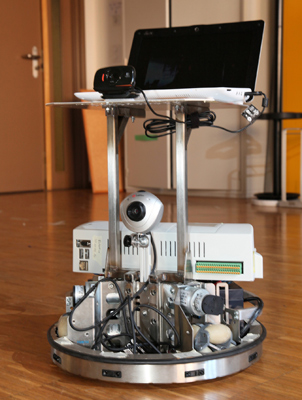
Researchers set up a modified Robotino robot with an interface that translates EEG signals into realtime navigation instructions. Initial tests were with healthy subjects, then with disabled subjects who had been confined to bed for 6-7 years.
Researcher José del R. Millán, a biomedical engineer at the École Polytechnique Fédérale de Lausanne (EPFL) in Switzerland, says “says he wasn’t terribly surprised that disabled people could control the robot.” However
he was surprised how fast they learned. He is now hoping to involve more bed-bound patients, including locked-in patients in the study. He also sees future applications for the shared control brain-machine interface, such as modifying it to let a user control a prosthetic limb or a wheelchair. And the researchers may eventually add an arm to the current telepresent robot to allow it to grasp objects.
