Berto Jongman: Saudi Arabia’s Efforts to Expand Radical Islam and Support Terrorism

04 Inter-State Conflict, 05 Civil War, 07 Other Atrocities, 08 Wild Cards, 09 Terrorism, Corruption, Government, IO Deeds of War, Peace Intelligence
Berto Jongman
Berto Jongman

Saudi Arabia's Efforts to Expand Radical Islam and Support Terrorism

Rachel Ehrenfeld and Ken Jensen

American Center for Democracy, 23 February 2013

On the eve of the Arab Spring, Rachel Ehrenfeld published a lengthy and important study titled, “Their Oil Is Thicker Than Our Blood“*on Saudi support for Islamist terrorism and the global expansion of the radical Islamic base, as well as the inadequacies of the Kingdom’s purported anti-terrorist efforts. While much has happened since, very little has changed regarding the patterns of Saudi behavior in this regard.

Despite continued public statements of support for U.S. and Western counterterrorism efforts, sporadic enforcement of new laws in the Kingdom regarding such things as money laundering, money transfers to dubious foreign recipients, and the occasional rousting of terrorist cells (al Qaeda- and Iran-affiliated), Saudi Arabia remains one of the most important sources of terrorist funding worldwide-if not THE most important source.

The U.S., while knowing this full well, has for many years doled out nothing but praise for the Saudis when it comes to fighting Islamist terrorism. This is as true now as it was after September 11. In this, the U.S. government has seemingly accepted the principal underpinning of the Saudi regime: buying off its would-be Islamist adversaries at home. The leading principle has been all along – not in our backyard. Thus the Kingdom’s support of Osama bin-Laden and al Qaeda in Afghanistan.

But Saudi funding to globally spread their Sunni radical version of Islam-Wahhabism–began in earnest in 1962 with the establishment of the Muslim World League (MWL), which expanded into at least to one hundred branches in more than thirty countries, and served as the main body for other international Saudi charities. Since then, the Kingdom’s charities have been estimated to spend between $1.5 and $2 trillion to build many thousand of mosques, madrassas and Islamic centers equipped with Saudi books and Imams, preaching the Wahhabi doctrine.

Continue reading “Berto Jongman: Saudi Arabia's Efforts to Expand Radical Islam and Support Terrorism”

Jean Lievens: NSA Has Destroyed Cyber-Trust

Corruption, Cultural Intelligence, Government, IO Deeds of War, IO Impotency, Military
Jean Lievens
Jean Lievens

Trusted Computing Must Repudiate The NSA – Forbes

Trust is fragile and the decade long effort on the part of the NSA to compromise all security models has destroyed trust. From its inception the coalition of industry giants who have backed the concept of hardware-based security, the Trusted Computing Group (TCG), have been at odds with the “information should be free” crowd. The problem these giants (Microsoft, Intel, AMD, IBM, HP) faced a decade ago was software and media piracy. As the biggest backer, Microsoft, was the most suspect. In recent weeks that suspicion of Microsoft has exploded into bald-face claims from the German BSI that the Trusted Platform Module, the hardware component of Trusted Computing is an NSA backdoor. And who knows what further releases of the Snowden files will unveil about the NSA’s involvement with the Trusted Computing Group?

Read full article.

Continue reading “Jean Lievens: NSA Has Destroyed Cyber-Trust”

Berto Jongman: Bits, Bytes, & Stuff

Cultural Intelligence, IO Impotency
Berto Jongman
Berto Jongman

Analysis of Al Qaeda — loose pack listening for one howl

Phi Beta Iota: This is one of the most interesting Information Operations (IO) relevant pieces we have read recently.

Avaaz Online Activism (The Guardian)

Phi Beta Iota: Now imagine Avaaz joining with Amazon and Crisis Mappers.

Brain Filtering Process

CIA's Domestic Collection Division

Phi Beta Iota: They provide more intelligence at less cost than the clandestine service. They also know almost nothing about holistic analytics or full spectrum human open source intelligence.

Click on Image to Enlarge

Doctor's Protocol Field Manual (Survivalist Literature)

INTERVIEW: Citizen's Tools via Sunlight Foundation

Mafia Targeting Pope?

Phi Beta Iota: Much more likely to target the pope is the mix of banking, pedophiles, and neo-Nazi militarists.

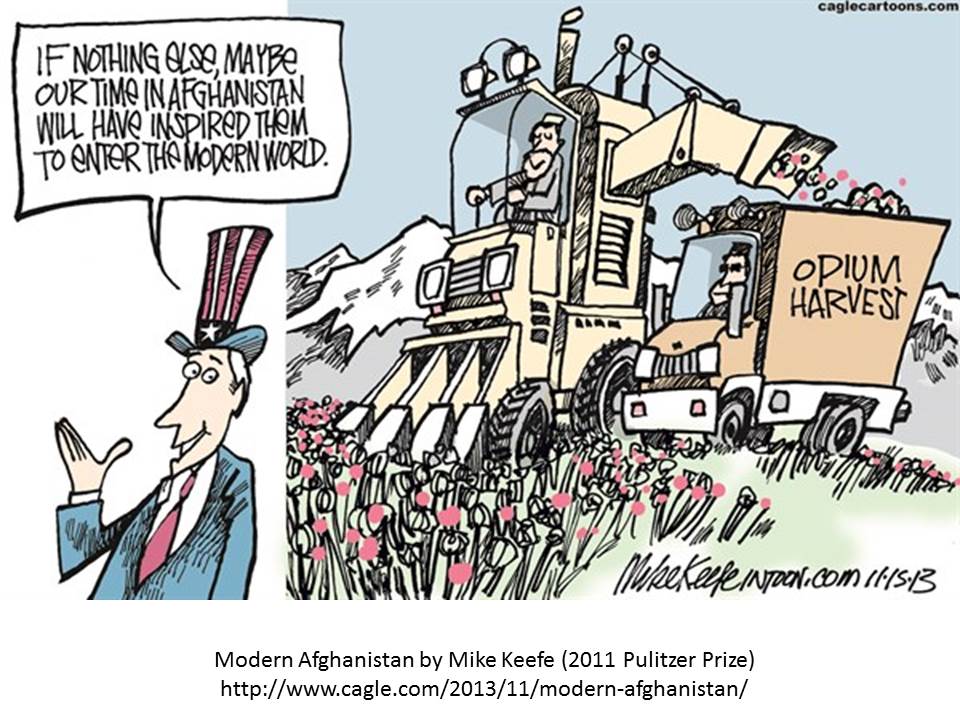
Modern Afghanistan (Cartoon)


Stephen E. Arnold: Social Media and News – Amazing Graphic + Comment on Amazon & Wikipedia

Civil Society, Collective Intelligence, Cultural Intelligence, IO Impotency, IO Sense-Making
Stephen E. Arnold
Stephen E. Arnold

Social Media and News: Amazing Graphic

News Use across Social Media Platforms” confirms what I have suspected for a while. The mobile generation has some interesting behavior patterns with regard to news. Among the factoids that the Pew outfit has boiled down to numbers are:

ITEM: YouTube viewers are not using the service to get news. Maybe that explains why experiments with Thomson Reuters proved to be somewhat disappointing.

ITEM: Google Plus is less popular than Reddit, Twitter, and Facebook as a source of news. The push back about Google Plus as a prerequisite for YouTube comments may have more importance than some realize.

ITEM: Facebook is an important source of news. As the demographics of Facebook shift, the importance of news may suggest that Facebook has morphed into a more mature service.

The most interesting “fact” in the report is the apparent importance of Reddit, a service which points to public posts on a range of issues. The Reddit service offers a search function, but I find consistently disappointing. In fact, most of the unusual collections of links and comments are essentially unfindable.

Continue reading “Stephen E. Arnold: Social Media and News – Amazing Graphic + Comment on Amazon & Wikipedia”

Berto Jongman: Bits, Bytes, & Stuff

Commercial Intelligence, Cultural Intelligence, IO Impotency
Berto Jongman
Berto Jongman

2014 Cyber-Security Predictions [8 certain mistakes]

FBI's Threat Statement to Congress

Phi Beta Iota: Nothing on financial crime (Wall Street), crimes against humanity (pedophilia), or traitors among us.  FBI continues to serve as the protective agency for those committing high crimes and misdemeanors against the public interest.

GAO: TSA Program Not Effective

HAMR: Increasing Disk Capacity Five Fold

Microsoft Cyber-Crime Center

Singularity 1 on 1: We Are in the Cyborg State! [Godfrey Reggio]

Dr. Laura DeNardis & Dr. Mark Raymond: Thinking Clearly About Multistakeholder Internet Governance

Advanced Cyber/IO
Dr. Laura DeNardis
Dr. Laura DeNardis

Thinking Clearly About Multistakeholder Internet Governance

Dr. Laura DeNardis
American University; Yale Information Society Project

Mark Raymond

Centre for International Governance Innovation

November 14, 2013

Dr. Mark Raymond

Abstract:

Efforts to study and practice Internet governance start, virtually without exception, from the premise that the Internet is governed by an innovative, unusual (perhaps unique) ‘multistakeholder’ model. Preserving that model is a primary goal for the broader Internet community as well as for many governments, though not for all. Viewing multistakeholderism as a teleological goal for Internet governance creates several problems. First, multistakeholderism is often elevated as a value in itself rather than as a possible approach to meeting more salient public interest objectives such as preserving Internet interoperability, stability, security, and openness. Second, multistakeholder governance may not be appropriate in every functional area of Internet governance. Internet coordination is not a monolithic practice but rather a multilayered series of tasks of which some are appropriately relegated to the private sector, some the purview of traditional nation-state governance or international treaty negotiations, and some more appropriately multistakeholder. It is a misnomer to speak not only of multistakeholder governance but also of Internet governance as a single thing.The concept of multistakeholderism can also serve as a proxy for broader political struggles or be deployed as an impediment to the types of Internet coordination necessary to promote conditions of responsible governance. For example, governments with repressive information policies can advocate for top-down and formalized multistakeholderism to gain additional power in areas in which they have traditionally not had jurisdiction. These types of efforts can result in multilateral rather than multistakeholder approaches with non-governmental actors limited from participating in formal deliberations and lacking any meaningful voting power. Alternatively, companies and other actors with vested interests in current governance arrangements can deploy multistakeholderism in a manner either meant to exclude new entrants (whether public or private) with incommensurate interests and values or to preserve incumbent market advantage.

This paper suggests that multistakeholderism should not be viewed as a value in itself applied homogenously to all Internet governance functions. Rather, the appropriate approach to responsible Internet governance requires determining what types of administration are optimal for promoting a balance of interoperability, innovation, free expression and operational stability in any particular functional and political context. Doing so requires conceptual and theoretical tools that have not yet been developed. Accordingly, the paper proceeds in three parts. First, it presents a more granular taxonomy and understanding of Internet governance functions – differentiating between, for example, cybersecurity governance, Internet standards setting, and the policymaking function of private information intermediaries. Second, it performs the same task of disaggregation with respect to multistakeholderism. It presents distinct varieties of multistakeholder Internet governance (which differ according to the varieties of actors involved and the nature of authority relations between them) and sets these arrangements in a broader context of modalities for accomplishing global governance in other issue areas. Such an approach contributes both to the study and practice of Internet governance, and to scholarship in International Relations and global governance.

PDF (18 Pages): Multistakeholder Internet Governance

Keywords: Internet governance, multistakeholder governance, international relations, Internet policy, ICANN, ITU, IETF, cybersecurity, Internet standards, information intermediaries, critical Internet resources


noble gold