This week, one typhoon and one tropical storm simply vanished while heading toward Japan. They were abruptly turned northward, sparing Japan and then simply vanished.
Days before, the events were predicted in an article on Veterans Today, citing plans by a defense group to use a Tesla based energy system to disrupt the storms.
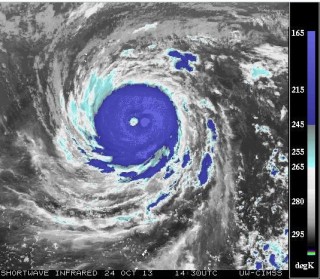
Majestic Super Typhoon LEKIMA. SW-IR satellite image recorded at 14:30UTC on October 24, 2013. Temperature of the patch located to the right of the typhoons eye measures about 150ºK (< minus 123ºC) making it the coldest place on or near planet Earth. Image sourced from: CIMSS/SSEC/WISC.
The website announced in advance when they were beginning operations and reported results as things transpired.
As to whether they were successful or that the two storms mysteriously disappeared, a freak of nature, will never be proven.
The group announced they are willing and able to cause another mysterious freak of nature when needed.
The idea is that open source Android is working like a Petri dish. Instead of growing little Googles, the Petri dish harbors a big Amazon and may soon give birth to a bigger Samsung. Here’s the point I noted:
As much as Google likes and touts that Android is open, that freedom may come with the cost of some control over the platform. Amazon may have started the first truly successful “fork” of Android, but Samsung is going after the whole place setting. Samsung kicked off its first Developers Conference on Monday and based on the keynote message, I wouldn’t be too happy if I were Google.
The point is that Android is supposed to be Google’s open source mobile platform. Others can use it, but Android is Google’s idea.
With iPhones too expensive for most mobile users and Microsoft mobile not getting the buzz Redmond hoped, Android is the mobile platform with legs it seems. Amazon and Samsung have figured this out. The companies have been moving forward with Android that has been reworked to make it less Googlely than Google may have hoped.
Amazon is a lesser problem for Google. Samsung, however, seems to be a bigger potential problem.
But my view is that the larger challenge will be from innovators in other countries who surf on Android. When I was in China, I learned about a number of mobile phones running Android that performed some interesting tricks. One taxi driver had a line of four mobile devices in his taxi. Each mobile had four SIMs. Each SIM connected to a different service providing information about pick ups.
I asked the taxi driver if the phones were running Google Android. The answer was, “I don’t know. There are cheap and do more than a high dollar, upper class phone. These are the future, not Apple or Google.”
Is the taxi driver correct? My view is that Google’s Android is not just fragmented. Android is enabling innovators to go in directions that may prove difficult for Google to control. Samsung may be the near term challenge for Google. Looking out over a longer time line, there may be a different set of challenges created by an open source mobile operating system, new manufacturing options, and a burgeoning demand for mobile devices that are delivering fresh, high-value functionality.
Sure the four phones put on a light show when orders came in. My smart phone has one SIM and was woefully out of step with the Chinese taxi driver’s needs. Google has to think about Android as free and open source software that may spawn some antibiotic resistant competitors.
To inform people is hard slugging. Everything is lined up against the public being informed, or the policymakers for that matter. News is contaminated by its service to special interests and hidden agendas. Many scientists or their employers are dependent on federal money. Even psychologists and anthropologists were roped into the government’s torture and occupation programs. Economists tell lies for corporations and Wall Street. Plant and soil scientists tell lies for agribusiness and Monsanto. Truth tellers are slandered and persecuted. However, persistence can eventually win out. In the long-run, truth sometimes emerges. But not always. And not always in time.
I have been trying to inform the American people, economists, and policymakers for more than a decade about the adverse impacts of jobs offshoring on the US economy. The word has eventually gotten out. Last week I was contacted by 8th grade students competing for their school in CSPAN’s StudentCam Documentary Contest. They want to interview me on the subject of jobs offshoring for their documentary film.
America is a strange place. Here are eighth graders far ahead of the economics profession, the President, the Congress, the Federal Reserve, Wall Street, and the financial press in their understanding of one of the fundamental problems of the US economy. Yet, people say the public schools are failing. Obviously, not the one whose students contacted me.
According to Harold Jarche, knowledge is an emergent property of all sense-making activities.
Curation and PKM (personal knowledge management) have the same objective: helping oneself and others gain more understanding about whatever we are interested in. The only difference between the two is that curation devotes itself to satisfy the knowledge needs of an audience while the second addresses these at a personal level.
It is indeed around identifying and becoming aware of these specific aspects of our sense-making activities that we can improve and augment our capability to learn and to effectively curate information for others.
America’s Threat-Centric [Lie-Based] Education System: Out of Date and Out of Time
“History is a story. That’s why we fight over history. We make sense of ourselves, the world and ourselves in the world through the struggle to tell the truth through stories. Facts have to be contextualised to become the truth. And that truth is a struggle that is constantly fought over. It is not given. And telling stories helps to create debate about that truth. That is why working people should tell their stories. Truth is a class issue. I would appeal to all your readers, especially to young ones, to make their own political films; shoot interviews, especially with older comrades, and dare to express themselves on the screen. Film making is for everybody. I would be looking at the new technologies. They are disruptive and a problem in capitalist society…That’s why they want to close down the Internet if they can. Politicians don’t like allowing people to communicate anonymously with each other. They want to restrain freedom … But still for a while there is a window of opportunity and freedom. They monitor you, but don’t yet stop you. That will come, of course…[But] it’s where people ought to be, where creative people and political people ought to be.” Tony Garnett interviewed by the editors of WSWS
How can young people be encouraged and coached to narrate a “true” history of their lives and times in the world—and the events, people and geography that influence them—for the bulk of their literate existence (i.e., 21st Century literate to include visual and technological literacy)?
Semantria focuses on a class of problems that a few years ago would have been outside the reach of many firms. He said:
We make it simple for our clients to solve the following problems: First, some organizations have too much text to read. For example, a Twitter stream or surveys with many responses. Also, there is the need to move quickly and reduce the time to get to market. Many survey results come with an expiry date before they’re irrelevant. Then there is reporting the information. Anyone can use their Excel smarts to build simple/interesting reports and visuals out of unstructured data. But that can take some time, and Semantria accelerates this step. Finally, users need to analyze text with the same impartiality each time. A human might see a glass as half full or half empty, but Semantria will always see a glass with water.
The former employee then offers this observation or is it a threat?
If I were an Amazon competitor, I’d actually regard Amazon’s current run of quarterly losses as a terrifying signal. It means Amazon is arming itself to take the contest to higher ground. The retail game is about to become more, not less, punishing.
All three articles in full text with links below the line.
It's the second time that I go back to this insightful article by Jonathan Stray, dating back to 2011, but which was visionary and rightful then as it is still now. The first time I did, right after it came out, I didn't actually realize in full how relevant and important was the idea being communicated through it. On the surface the article talks about an hypotethical Editorial Search Engine as a desirable news app. But if you look just beyond the surface, which is by itself fascinating, in essence, Mr. Stray indicates how useful and effective it would be if news publishers moved on from reporting and and into 100% curated coverage of a certain topic, issue or story, opening a fascinating discovery gateway around each story and allowing in time for these streams to intersect and interconnect with each other. By doing this, we can not only make the news much more interesting and relevant, but we can transform them into instruments for in-depth learning about anything we are interested in. In this light the future of news could be very much about Comprehensively Informing an Audience on a Specific Topic. And if you stop enough time to re-read it and think about it, this is a pretty powerful and revolutionary concept by itself. He specifically writes: “Rather than (always, only) writing stories, we should be trying to solve the problem of comprehensively informing the user on a particular topic.” “Choose a topic and start with traditional reporting, content creation, in-house explainers and multimedia stories. Then integrate a story-specific search engine that gathers together absolutely everything else that can be gathered on that topic, and applies whatever niche filtering, social curation, visualization, interaction and communication techniques are most appropriate.” Jonathan Stray makes also a very inspiring connection to Jay Rosen of NYU and his idea of covering 100% of a story which in my view correctly anticipated the niche content curation trend while going beyond it in its effort to explore gateways to innovation. . . . Insightful. Visionary. Inspiring. 9/10 . .Original article (2011): http://jonathanstray.com/the-editorial-search-engine ..(Image credit: Train tracks by Shutterstock)