
Probably doesn't bode well for return of USB flash drives to DoD computers

Mystery Surrounds Cyber Missile That Crippled Iran's Nuclear Weapons Ambition
See Also:


The truth at any cost lowers all other costs — curated by former US spy Robert David Steele.
Probably doesn't bode well for return of USB flash drives to DoD computers
See Also:

In this address, Bruce examined the future of cyber war and cyber security. Mr. Schneier explored the current debate on the threat of cyber war, asking whether or not the threat had been over-stated. He then explored the range of attacks that have taken place, including the Latvian DOS attack and the Stuxnet worm. The address concluded with an exploration of the future of international treaties on cyber war.
Phi Beta Iota: This is utterly brilliant stuff, a historical contribution. A power struggle between military and police over cyber-security, in US military won–this has consequences. The weak aspect is the proponency for treaties among states–states are but one of the eight tribes, any “treaty” environment that does not adapt to the reality of eight tribes and hybrid networks is not serious.
2010: OPINION–America’s Cyber Scam
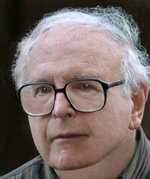
While the automated search produces the relevant results, Jack Davis is the Sherman Kent of our time and deserves a cleaner quicker result. Here is the human in the loop distillation of this great man's contributions as they appear on this web site and the two web sites in Sweden where all our stuff is safely preserved.
Who’s Who in Public Intelligence: Jack Davis
Review: Improving CIA Analytic Performance–Four Papers by Jack Davis
2003 Davis (US) Analytic Paradoxes: Can Open Source Intelligence Help?
1997 Davis A Compendium of Analytic Tradecraft Notes
Search: jack davis and his collected memoranda o
Search: The Future of OSINT [is M4IS2-Multinational]
Journal: Opinion on the Failure of “The System”
Worth a Look: Book Reviews on Analysis
Review: Assessing the Tradecraft of Intelligence Analysis
Review: Tell Me No Lies: Investigative Journalism That Changed the World
Review: The Landscape of History–How Historians Map the Past (Paperback)
Review: Strategic Intelligence–Windows into a Secret World
2000 PRIMER on Open Sources & Methods
Review: Thinking in Time–The Uses of History for Decision-Makers
1998 Open Source Intelligence: Private Sector Capabiltiies to Support DoD Policy, Acquisition, and Operations
Review: Strategic intelligence for American world policy (Unknown Binding)
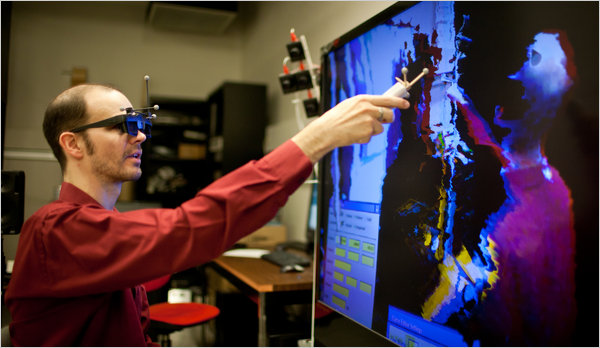
With Kinect Controller, Hackers Take Liberties
Mr. Kreylos, who specializes in virtual reality and 3-D graphics, had just learned that he could download some software and use the device with his computer instead. He was soon using it to create “holographic” video images that can be rotated on a computer screen. A video he posted on YouTube last week caused jaws to drop and has been watched 1.3 million times.
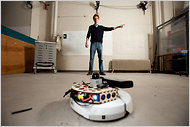
Mr. Kreylos is part of a crowd of programmers, roboticists and tinkerers who are getting the Kinect to do things it was not really meant to do. The attraction of the device is that it is outfitted with cameras, sensors and software that let it detect movement, depth, and the shape and position of the human body.

Phi Beta Iota: Microsoft took a few days to “get it” but their “final answer” is exactly right: “Anytime there is engagement and excitement around our technology, we see that as a good thing,” said Craig Davidson, senior director for Xbox Live at Microsoft. “It’s naïve to think that any new technology that comes out won’t have a group that tinkers with it.” Kudos as well to the New York Times for a lovely piece of useful inspiring reporting.

The New York Times November 17, 2010
A Business Creator Sees Big Returns From Social Media
By DARREN DAHL
Asked to name the world’s wealthiest entrepreneurs, few people would think of Eric Lefkofsky, who is 40 and keeps a deliberately low profile in his hometown of Chicago. But Mr. Lefkofsky has an impressive entrepreneurial track record, one that recently led Forbes to estimate his wealth at $750 million.
The first business Mr. Lefkofsky started, StarBelly, made tools for building Web sites; he sold it in 2000 for $240 million. He then started two companies that have since gone public — InnerWorkings, which provides printing capabilities over the Web, and Echo Global Logistics, a transportation and logistics outsourcing business he founded with a law school friend, Brad Keywell. He also founded MediaBank, which helps companies buy advertising. In each case, Mr. Lefkofsky used the power of technology and the Internet to update an industry.
And then came Groupon, the social-coupon Web site that he bankrolled and started in 2008 with Andrew Mason — a venture that has been called the fastest-growing company ever. Groupon offers its followers a deal-of-the-day coupon, sponsored by a local business, that the followers are encouraged to share with their social networks. The local business gets customers, and Groupon takes a share of the coupon proceeds — a business model that has led to talk that Groupon, still privately owned, could be worth as much as $3 billion. More recently, Mr. Lefkofsky and Mr. Keywell started an investment fund with $100 million of their earnings. It’s called Lightbank, and it invests only in early-stage technology companies that are built around social media. The following is a condensed version of a recent conversation with Mr. Lefkofsky.
Today, with permission, I present Tom Atlee's newest vision, “Are We Ready to Change the Game Yet?,” and at the end, a link to his 2000 audio interview with Jim Rough, pioneer of Citizen Wisdom Councils and author of Society's Breakthrough.
ARE WE READY TO CHANGE THE GAME YET?
by Tom Atlee

Some people say Gandhi was about nonviolence. And he was.
But he is significant for something else that I believe is far more important:
He changed the game.
With no one's permission, he reconfigured the playing field of colonialism to a higher Game in which everything the British did in their smaller, narrower game backfired on them. Prisons, guns, threats and bureaucracies of control not only ceased to work like they used to, but actually generated more power for Gandhi's world-changing Game.
Gandhi's Game involved, in his words, “experiments in Truth” — a search for Truth, a bigger Truth, a common inclusive Truth, a win-win Truth in every situation. The British — and even many of Gandhi's compatriots — were not aligned to that Truth. They wanted victory, control, and righteousness. These things trapped them in their smaller game until, one by one, and sometimes wholesale, Gandhi's commitment to Truth won their hearts and minds — and Shift happened.
Unfortunately he failed to create adequate social institutions that embodied, sustained, and empowered the Search for Truth by the whole of society. He depended on individuals seeing the light and being transformed. The miracle of his work is that so many people did transform — and continue to transform even to this day — inspired by his words, his life, his work. But in the end, what he left was an inspiring possibility, not an India or a world that was united, peaceful, just and sustainable.
Today's world calls us, with increasing intensity, not just to carry on Gandhi's work, but to carry it further. It isn't a matter of doing nonviolence as he and Martin Luther King, Jr., did it. It is a matter of changing the game.
Which brings me to the current state of U.S. politics and governance. These games are desperately in need of changing. Several recent innovations offer us the possibility to actually accomplish that and the timing is ripe.
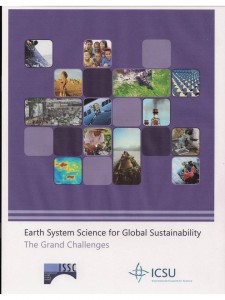
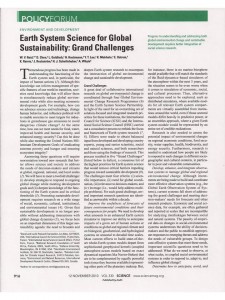
The International Council for Science (ICSU) is spearheading a consultative Visioning Process, in cooperation with the International Social Science Council (ISSC), to explore options and propose implementation steps for a holistic strategy on Earth system research. Five Grand Challenges were identified during step 1 of the process. If addressed in the next decade, these Grand Challenges will deliver knowledge to enable sustainable development, poverty eradication, and environmental protection in the face of global change.
The details of the Grand Challenges are contained in the document ‘Earth System Science for Global Sustainability: The Grand Challenges’, representing input from many individuals and institutions.
INTERNATIONAL COUNCIL FOR SCIENCE – PRESS RELEASE
Thursday 11 November 2010
Scientific Grand Challenges identified to address global sustainability
Paris, France—The international scientific community has identified five Grand Challenges that, if addressed in the next decade, will deliver knowledge to enable sustainable development, poverty eradication, and environmental protection in the face of global change. The Grand Challenges for Earth system science, published today, are the result of broad consultation as part of a visioning process spearheaded by the International Council for Science (ICSU) in cooperation with the International Social Science Council (ISSC).
The consultation highlighted the need for research that integrates our understanding of the functioning of the Earth system—and its critical thresholds—with global environmental change and socio-economic development.
The five Grand Challenges are:
Continue reading “Reference: Earth System Science for Global Sustainability–Grand Challenges”
