A meeting to determine how the internet should be governed is under way in Sao Paulo, Brazil.
The country's president, Dilma Rousseff, organised the two-day NetMundial event following allegations the US National Security Agency (NSA) had monitored her phone and emails.
Last month the US announced plans to give up its oversight of the way net addresses are distributed. But campaigners have warned the move could backfire.
The US currently determines who runs the Internet Assigned Numbers Authority (IANA), the body responsible for regulating the internet's codes and numbering systems. But Washington now aims to pass the duty over to the “global multi-stakeholder community” by September 2015. Human rights group Article 19 supports that idea, but said there were potential pitfalls.
Leading management thinker Philip Roscoe argues that economics is not a science, it's a way of thinking – one that, over the course of the 20th century, has come to dominate the decision-making of both individuals and governments. Every day we make choices – where to live, what to eat, how to educate our children and care for our parents – in which the influence of economics invariably promotes self-interest over social obligations. But all of today's big problems require collective action, so a way of thinking shaped by economic principles is a huge obstacle to change. Can we begin to think differently?
Over the next century communities worldwide will experience an unprecedented shift of weather instability. Extreme weather events are ecological spasms often driving economic spasms and regional collapses. Concerned citizens and opinion leaders need to prepare before these eco-spasms proliferate. Far from being prepared, most leaders and power brokers are not mindful of the rethinking that is required. This working paper and appendix offers a brief economic vision, a set of economic principles, and list of problematic trends to help respond to the challenges as we work for a better day. –Randy Hayes
Foundation Earth’s Strategic Response:
It would be foolhardy to think that restructuring the global economy for long-term deep sustainability is an easy task, but we aren’t the type of people to give up. We will make this meaningful shift or we will go down fighting. Foundation Earth will put forth its solutions as thoughtfully and powerfully as we can, given our humble resources. Together we can help ensure that nature’s life support systems are healthy and that biological diverse systems, particularly large wild areas, are protected. Such systems are key to humanity’s wellbeing and the entire web of life.
There is indeed an “invisible hand” which left to its own devises promotes general good. That hand turns out to be nature’s ways – nourishing all things. The industrial economic invisible hand could best be called “Cheater Economics” (externalizing pollution costs). We call for a “True Cost Economy” based on nature’s ways.
This campaign can be thought of a twenty-five year process to help foster such a shift. In [Dick] Cheneyesque fashion, the known unknowns and the unknown unknowns present sizable difficulties. Nature has a non-linear way of being. Will the soft landing of a semi-elegant twenty-five year economic transition be possible? Certainly not if we are headed to a four degree world. It will more likely be mini-collapses and rebuilding. We will prepare for both scenarios as best we can.
Nature’s “invisible hand” left to its own devises may indeed promote general good, but our collective campaign for a better world will need an active and visible hand. Please let us know what else you think we should be looking at and how you might help to enact this vision. Additional information on the model & the context of this work is included in Appendix I. The basic vision includes:
If I had a lot of money, I couldn’t afford to live as well as I do.
– Mike Roselle, grassroots organizer and a founder of Earth First
The Vision Starts with an Integrated Set of Goals:
When financial crimes go unpunished, the root problem of fraud never gets fixed — and these are the consequences
Joseph and Mary Romero of Chimayo, N.M., found that their mortgage note was assigned to the Bank of New York three months after the same bank filed a foreclosure complaint against them; in other words, Bank of New York didn’t own the loan when they tried to foreclose on it.
Glenn and Ann Holden of Akron, Ohio, faced foreclosure from Deutsche Bank, but the company filed two different versions of the note at court, each bearing a stamp affirming it as the “true and accurate copy.”
Mary McCulley of Bozeman, Mont., had her loan changed by U.S. Bank without her knowledge, from a $300,000 30-year loan to a $200,000 loan due in 18 months, and in documents submitted to the court, U.S. Bank included four separate loan applications with different terms.
It might be a fun exercise to sit with the leading practitioners of high-performance embedded computing (HPEC) to trade opinions about what are the toughest, gnarliest, most knee-buckling HPEC challenges in the foreseeable future.
We would hear the usual — bistatic radar, adaptive electronic warfare (EW), and wide-area communications intelligence. Well, I've got one that's a real beaut, and one that I think we're all going to be hearing a lot more about: hypertemporal imaging for persistent surveillance.
Yeah, it was a new one on me, too. Put simply, hypertemporal imaging involves multispectral or hyperspectral imaging over time. Where persistent surveillance is concerned, it's also a gigantic exercise in gathering gazillions of bits of data, and then throwing most of them away.
Multispectral and hyperspectral imaging involves slicing an image into a few or even many different spectral bands to uncover details that otherwise might be lost. This alone already present a formidable digital signal processing challenge. Now add the dimension of time and the problem grows by orders of magnitude.
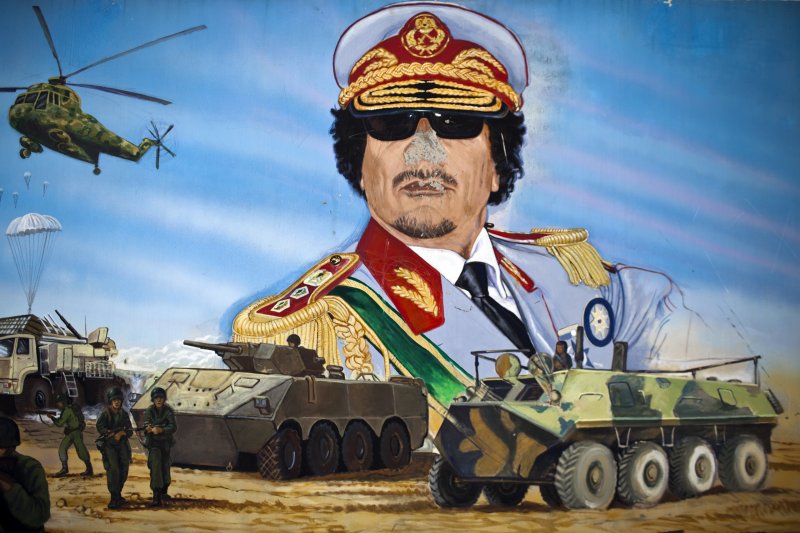
A camp on the Libyan coastline meant to train terror-hunters has instead become a haven for terrorists and al Qaeda.
A key jihadist leader and longtime member of al Qaeda has taken control of a secretive training facility set up by U.S. special operations forces on the Libyan coastline to help hunt down Islamic militants, according to local media reports, Jihadist web forums, and U.S. officials.
Click on Image to Enlarge
In the summer of 2012, American Green Berets began refurbishing a Libyan military base 27 kilometers west of Tripoli in order to hone the skills of Libya’s first Western-trained special operations counter-terrorism fighters. Less than two years later, that training camp is now being used by groups with direct links to al Qaeda to foment chaos in post-Qaddafi Libya.
Last week, the Libyan press reported that the camp (named “27” for the kilometer marker on the road between Tripoli and Tunis) was now under the command of Ibrahim Ali Abu Bakr Tantoush, a veteran associate of Osama bin Laden who was first designated as part of al Qaeda’s support network in 2002 by the United States and the United Nations. The report said he was heading a group of Salifist fighters from the former Libyan base.