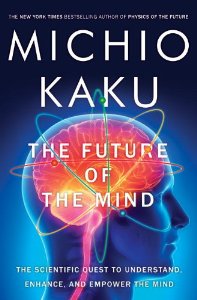
Worth a Look: Michio Kaju on The Future of the Mind

5 Star, Consciousness & Social IQ, Intelligence (Public), Worth A Look
Amazon Page
Amazon Page

The New York Times best-selling author of Physics of the Impossible, Physics of the Future and Hyperspace tackles the most fascinating and complex object in the known universe: the human brain.

For the first time in history, the secrets of the living brain are being revealed by a battery of high tech brain scans devised by physicists. Now what was once solely the province of science fiction has become a startling reality. Recording memories, telepathy, videotaping our dreams, mind control, avatars, and telekinesis are not only possible; they already exist.
 
The Future of the Mind gives us an authoritative and compelling look at the astonishing research being done in top laboratories around the world—all based on the latest advancements in neuroscience and physics.  One day we might have a “smart pill” that can enhance our cognition; be able to upload our brain to a computer, neuron for neuron; send thoughts and emotions around the world on a “brain-net”; control computers and robots with our mind; push the very limits of immortality; and perhaps even send our consciousness across the universe.

Dr. Kaku takes us on a grand tour of what the future might hold, giving us not only a solid sense of how the brain functions but also how these technologies will change our daily lives. He even presents a radically new way to think about “consciousness” and applies it to provide fresh insight into mental illness, artificial intelligence and alien consciousness.

With Dr. Kaku's deep understanding of modern science and keen eye for future developments, The Future of the Mind is a scientific tour de force–an extraordinary, mind-boggling exploration of the frontiers of neuroscience.
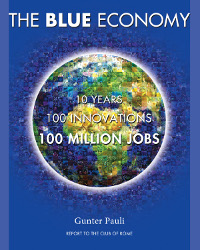

Worth a Look: The Blue Economy by Gunter Pauli

5 Star, Complexity & Resilience, Decision-Making & Decision-Support, Environment (Solutions), Intelligence (Public), Worth A Look
Amazon Page
Amazon Page

The Blue Economy

by GUNTER PAULI author of the Report to the Club of Rome

Blue Economy is  ZERI’s philosophy in action.

Blue Economy is where the best for health and the environment is cheapest and the necessities for life are free thanks to a local system of production and consumption that works with what you have.

“Innovative business models are capable of bringing competitive products and services to the market responding to basic needs while building social capital and enhance mindful living in harmony with nature's evolutionary path.

“Competitiveness”is harnessing and optimizing the innate virtues and values connecting untapped local potential – like a natural system, where the seeds lie fallow only to sprout with amazing vigor at the first rain unleashing joy and happiness as the conditions for mind full-living are met in balance and in harmony.

BLUE ECONOMY PRINCIPLES

Continue reading “Worth a Look: The Blue Economy by Gunter Pauli”

Anthony Judge: Metascience Enabling Upgrades to the Scientific Process

Academia, Commerce, Cultural Intelligence, Government
Anthony Judge
Anthony Judge

Metascience Enabling Upgrades to the Scientific Process

Beyond Science 2.0 in the light of polyhedral metaphors?

Introduction
Enhanced simulation of scientific processes
Topography of the challenges of humanity
Reconsidering the imaginary unit (i) — the “fudge factor” of science
Symbolic implications: ICSU as a case study
Psychosocial coherence as a resonance hybrid?
Global conversation and the nature of any emergent consensus
Emergence of global coherence through Science 2.0?
References

David Swanson: War Can Be Ended — And No, the US Civil War Was Not About Slavery and Not Worth the Human and Other Enduring True Costs

Cultural Intelligence, Peace Intelligence
David Swanson
David Swanson

War Can Be Ended

Part I Of BOOK: War No More: The Case For Abolition

Slavery Was Abolished

In the late eighteenth century the majority of people alive on earth were held in slavery or serfdom (three-quarters of the earth’s population, in fact, according to the Encyclopedia of Human Rights from Oxford University Press). The idea of abolishing something so pervasive and long-lasting as slavery was widely considered ridiculous. Slavery had always been with us and always would be. One couldn’t wish it away with naive sentiments or ignore the mandates of our human nature, unpleasant though they might be. Religion and science and history and economics all purported to prove slavery’s permanence, acceptability, and even desirability. Slavery’s existence in the Christian Bible justified it in the eyes of many. In Ephesians 6:5 St. Paul instructed slaves to obey their earthly masters as they obeyed Christ.

Slavery’s prevalence also allowed the argument that if one country didn’t do it another country would: “Some gentlemen may, indeed, object to the slave trade as inhuman and evil,” said a member of the British Parliament on May 23, 1777, “but let us consider that, if our colonies are to be cultivated, which can only be done by African negroes, it is surely better to supply ourselves with those labourers in British ships, than buy them from French, Dutch or Danish traders.” On April 18, 1791, Banastre Tarleton declared in Parliament—and, no doubt, some even believed him—that “the Africans themselves have no objection to the trade.”

By the end of the nineteenth century, slavery was outlawed nearly everywhere and rapidly on the decline. In part, this was because a handful of activists in England in the 1780s began a movement advocating for abolition, a story well told in Adam Hochschild’s Bury the Chains: Prophets and Rebels in the Fight to Free an Empire's Slaves. This was a movement that made ending the slave trade and slavery a moral cause, a cause to be sacrificed for on behalf of distant, unknown people very different from oneself. It was a movement of public pressure. It did not use violence and it did not use voting. Most people had no right to vote. Instead it used so-called naive sentiments and the active ignoring of the supposed mandates of our supposed human nature. It changed the culture, which is, of course, what regularly inflates and tries to preserve itself by calling itself “human nature.”

Continue reading “David Swanson: War Can Be Ended — And No, the US Civil War Was Not About Slavery and Not Worth the Human and Other Enduring True Costs”

Marcus Aurelius: Four Washington Think Tanks Presume to Define Defense

Peace Intelligence
Marcus Aurelius
Marcus Aurelius

Four Washington think tanks held their own exercise to provide alternate analyses and budget proposals to the ongoing Department of Defense Quadrennial Defense Review (QDR), DoD's Congressionally mandated internal cut drill.

Read all about it at Joint Think Tank Event: Alternatives to the QDR and FY15 Defense Budget | CSBA

While the four think tanks came up with different answers, the area where they generally agreed was significant, arguably massive, decrements to the Army in order to free up dollars for gadgets and other stuff.

Continue reading “Marcus Aurelius: Four Washington Think Tanks Presume to Define Defense”

Paul Craig Roberts: Market Manipulations Become Extreme, Desperate — Federal Reserve Failing

Commerce, Commercial Intelligence, Corruption, Government
Paul Craig Roberts
Paul Craig Roberts

Market Manipulations Become More Extreme, More Desperate

Paul Craig Roberts and Dave Kranzler

In two recent articles we explained the hows and whys of gold price manipulation. The manipulations are becoming more and more blatant. On February 6 the prices of gold and stock market futures were simultaneously manipulated.

Read full post with graphics.

noble gold