
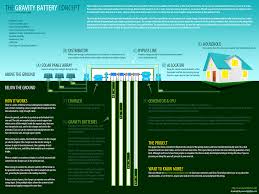
Explaining the gravity battery concept, with detailed illustrations on storing energy using simply the force of gravity.

The truth at any cost lowers all other costs — curated by former US spy Robert David Steele.
Explaining the gravity battery concept, with detailed illustrations on storing energy using simply the force of gravity.

Cryptography Breakthrough Could Make Software Unhackable
As a graduate student at the Massachusetts Institute of Technology in 1996, Amit Sahai was fascinated by the strange notion of a “zero-knowledge” proof, a type of mathematical protocol for convincing someone that something is true without revealing any details of why it is true. As Sahai mulled over this counterintuitive concept, it led him to consider an even more daring notion: What if it were possible to mask the inner workings not just of a proof, but of a computer program, so that people could use the program without being able to figure out how it worked?'
The idea of “obfuscating” a program had been around for decades, but no one had ever developed a rigorous mathematical framework for the concept, let alone created an unassailable obfuscation scheme. Over the years, commercial software companies have engineered various techniques for garbling a computer program so that it will be harder to understand while still performing the same function. But hackers have defeated every attempt. At best, these commercial obfuscators offer a “speed bump,” said Sahai, now a computer science professor at the University of California, Los Angeles. “An attacker might need a few days to unlock the secrets hidden in your software, instead of a few minutes.”

Watson with its Head in the Cloud
IBM’s Watson is proceeding to the cloud. Apparently, though, the journey is proving more challenging than expected. The Register reports, “IBM’s Watson-as-a-Cloud: Is it a Bird? Is it a Plane? No, it’s Another Mainframe.” Writer Jack Clark peers through the marketing hype, maintaining that Watson does not translate to the cloud as easily as IBM would have us believe.
The key to Watson’s functionality is its DeepQA analysis engine, which uses an amalgam of Apache‘s Hadoop, Apache’s UIMA, and other tools to achieve machine learning. This means, says Clark, that more work than one might expect must be done to get set up with the cloudy Watson.
He specifies:
“Applying DeepQA to any new domain requires adaptation in three areas:
Continue reading “Stephen E. Arnold: IBM Flails at Cloud and Machine Learning”

The self-censorship in American corporate media, as well as the deliberate obfuscation that arises from focusing attention on the meaningless and ephemeral, in my mind, is a trend that is becoming a major issue. It is almost impossible to get the level of news required for an informed electorate from mainstream sources.
Media Blacks Out New Snowden Interview the Government Doesn't Want you to See
JAY SYRMOPOULOS – B Swann
Phi Beta Iota: Below is the video in question, available here since it was first offered.
See Especially:
See Also:

AIPAC and Abramoff Operated Child Sex Blackmail Ring
Stew Webb
Veterans Today, 2 February 2014
Read full online report with documents, videos, and links.
Continue reading “Stew Webb: Pedophilia in Washington — The Story Continues…”

Less than a decade after Washington endorsed a fraudulent case for invading Iraq, similarly misinformed and politically motivated claims are pushing America toward war with Iran. Challenging the daily clamor of U.S. saber rattling, Flynt and Hillary Mann Leverett argue that America should renounce thirty years of failed strategy and engage with Iran—just as Nixon revolutionized U.S. foreign policy by going to Beijing and realigning relations with China.
In Going to Tehran, former analysts in both the Bush and Clinton administrations, the Leveretts offer a uniquely informed account of Iran as it actually is today, not as many have caricatured it or wished it to be. They show that Iran's political order is not on the verge of collapse, that most Iranians still support the Islamic Republic, and that Iran's regional influence makes it critical to progress in the Middle East. Drawing on years of research and access to high-level officials, the Leveretts’ indispensable work makes it clear that America must “go to Tehran” if it is to avert strategic catastrophe.
 The Year of Iran: Tehran’s Challenge to American Hegemony in 2014
This strategy aims to replace American hegemony, regionally and globally, with a more multi-polar distribution of power and influence.
The United States is not the first imperial power in decline whose foreign policy debate has become increasingly detached from reality—and history suggests that the consequences of such delusion are usually severe.
Hassan Rohani’s election as Iran’s president seven months ago caught most of the West’s self-appointed Iran “experts” by (largely self-generated) surprise. Over the course of Iran’s month-long presidential campaign, methodologically-sound polls by the University of Tehran showed that a Rohani victory was increasingly likely.
Yet Iran specialists at Washington’s leading think tanks continued erroneously insisting (as they had for months before the campaign formally commenced) that Iranians could not be polled like other populations and that there would be “a selection rather than an election,” engineered to install Supreme Leader Ayatollah Ali Khamenei’s “anointed” candidate—in most versions, former nuclear negotiator Saeed Jalili.
On election day, as Iranian voters began casting their ballots, the Washington Post proclaimed that Rohani “will not be allowed to win”—a statement reflecting virtual consensus among American pundits.
Of course, this consensus was wrong—as have been most of the consensus judgments on Iran’s politics advanced by Western analysts since the country’s 1979 revolution.
Continue reading “4th Media: The Year of Iran – Challenging US Hegemony”
