The Martin Fleischman Memorial Project (MFMP) is a modular, open source LENR/Cold Fusion commercialization project designed to rival the aspirations of proprietary LENR/CF corporations such as Leonardo (Rossi), Brillouine, and Defkalion. Lead researcher Tyler van Houwelingen calls the MFMP the “Linux of LENR”.
Their Mission Statement:To make the biggest impact and overcome the hurdle of institutional bias against this type of phenomenon, we aim to make the whole process, from the apparatus to the procedures, to the whole plan of the project, as transparent and understandable as possible. We want this project to be for the people by the people as much as possible. We will be open about the plan, the designs, the process, the data and the results.The other part of the plan is you. We will pursue crowd-sourced funding, crowd-sourced engineering, and hope for near real time scientific review. Are we 100% sure the New Fire is real and reproducible? No. But given there is significant evidence that it is, isn't the upside for the world worth attempting to validate it?

Inside the beltway, it’s doofuses ‘R us and perhaps the world’s biggest collection of gangsters, liars, criminal psychopaths and incompetents.
And now it’s getting exposed, even in the major mass media and the alternative Internet Media is going wild exposing the dark criminal underbelly of the USG and American Intel leaders who have now lost all the respect of “we the people” and have damaged their agencies beyond repair.
Phi Beta Iota: Full post provided below or available at link above. This is a solid example of a growing body of literature illustrative of the gap between the American public and its government.
Storms, floods, earthquakes, tsunamis — with more than half the world’s population now concentrated in cities, the economic threat of natural disasters in metropolitan areas looms ever larger.
The 2011 earthquake and tsunami in northern Japan set a new standard for disaster with almost 20,000 people killed and a record $300 billion in economic losses. Later that year, Bangkok broke the cost record for freshwater floods, with $47 billion in losses. A year later Hurricane Sandy caused $60 billion in storm-surge damage in New York and New Jersey.
Click on Image to Enlarge
A new report by Swiss Re Ltd., the world’s second-biggest reinsurer, ranks 616 metro areas by the value of working days at risk from five natural perils, as well as by number of residents potentially affected. Click ahead to see whether your city is among the most vulnerable. The areas are ranked by potential economic impact.
India-Pakistan:For the record. Indian Prime Minister Manmohan Singh and Pakistani Prime Minister Mohammad Nawaz Sharif met in New York on the 29th. Shivshankar Menon, Indian national security affairs adviser, said that the talks were useful and constructive and that both sides agreed on the need to promote the realization of a complete ceasefire in Kashmir and accepted invitations to visit each other's country.
Comment: Although meetings at the UN General Assembly session are mostly symbolic, they become substantive when they do not take place. The reciprocal invitations stake out a way ahead for more substantive exchanges.
Click on Image to Enlarge
The fundamental obstacle to a durable peace is Kashmir. Pakistani governments must at least pay lip service to Kashmiri independence in some form in order to mollify powerful security and political interests. India cannot alter the status of Jammu and Kashmir State without amending its constitution, wherein the state is listed as one of the constituent Indian states.
There is little room for compromise except to agree to combat terrorism, maintain trade and a ceasefire along the Line of Control and the borders and not permit provocations to escalate. Yet there are hotheads on both sides that do and will violently oppose peace.
Criticism of U.S. intelligence takes many forms: Intelligence agencies are too secretive, or they are too leaky. They over-collect, or they under-perform. Or all of these, and more besides.
Many of the criticisms can be reduced to a single argument: The U.S. intelligence community has become too large to be properly managed.
Interestingly, this is a view that is held by some within U.S. intelligence itself, according to a new dissertation by a CIA sociologist who studied and worked at the National Counterterrorism Center (NCTC).
“I actually fear that the IC is too big,” a CIA analyst at the NCTC told sociologist Bridget Nolan. “It's crossed the point where it's [producing] healthy competitive analysis. We've gotten to the point where we're in each other's way. We're hindering the mission.”
“Something that's worth considering,” another CIA analyst said, “is completely counterintuitive, which is to make the CT [counterterrorism] community smaller, not larger. I think there are far more people at CIA HQ now than when we defeated the Soviet Union in the Cold War. What the hell?”
As for the NCTC itself, yet another analyst said, “If it were to continue existing, it should be about one-tenth its current size.”
I lived in Iraq during the 2003 Shock and Awe bombing. On April 1st, about two weeks into the aerial bombardment, a medical doctor who was one of my fellow peace team members urged me to go with her to the Al Kindi Hospital in Baghdad, where she knew she could be of some help. With no medical training, I tried to be unobtrusive, as families raced into the hospital carrying wounded loved ones.
Amazon Page
At one point, a woman sitting next to me began to weep uncontrollably. “How I tell him?” she asked, in broken English. “What I say?” She was Jamela Abbas, the aunt of a young man, named Ali. Early in the morning on March 31st, U.S. war planes had fired on her family home, while she alone of all her family was outside. Jamela wept as she searched for words to tell Ali that surgeons had amputated both of his badly damaged arms, close to his shoulders. What’s more, she would have to tell him that she was now his sole surviving relative.
I soon heard how that conversation had gone. It was reported to me that when Ali, aged 12, learned that he had lost both of his arms, he responded by asking “Will I always be this way?”
Returning to the Al Fanar hotel, I hid in my room. Furious tears flowed. I remember pounding my pillow and asking “Will we always be this way?”
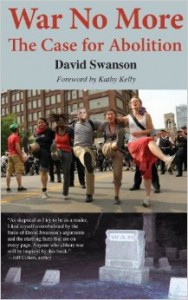
David Swanson reminds me to look to humanity’s incredible achievements in resisting war, in choosing the alternatives which we have yet to show our full power to realize.
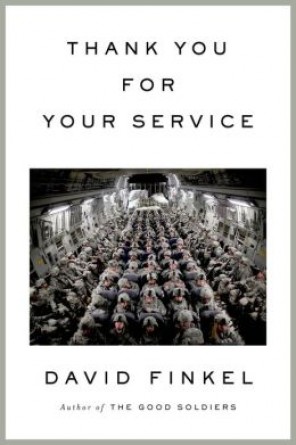
Nominally a sequel to The Good Soldiers, his 2009 account of an American infantry battalion at war in Iraq, David Finkel’s new book actually serves as a perfect companion to George Packer’s recent bestseller, The Unwinding. Like Packer, Finkel examines the human detritus left in the wake of fraudulent promises and collapsed illusions. In The Unwinding, Packer contemplates the fate of those victimized by cataclysmic economic change. In Thank You for Your Service, Finkel looks at those victimized by egregious military malpractice.
The post-industrial, high-tech, information-age economy unveiled near the end of the 20th century supposedly offered a template for permanent prosperity. The Great Recession upended such expectations. Although some Americans have gotten very rich indeed, far larger numbers of ordinary citizens find themselves unemployed and unemployable. With impressive sensitivity, Packer tells their story.
Amazon Page
Concocted at about the same time, a post-industrial, high-tech, information-age approach to waging war supposedly offered a template for assured victory. Iraq and Afghanistan have shredded such pretensions. Although some high-ranking military and civilian officials found ways to cash in, far larger numbers of ordinary soldiers (and their families) suffered, many of them grievously. In painful, intimate and at times almost voyeuristic detail, Finkel tells their story.
More specifically, Finkel, a reporter with The Washington Post, attends to what he calls the “after war.” His concern is with the soldiers who return from the war zone bearing wounds — and with the loved ones on whom those wounds also become imprinted. Above all, he is concerned with wounds that may not be fully visible: the post-traumatic stress disorder (PTSD), traumatic brain injury and related conditions that affect roughly a half-million younger veterans. Make that a half-million and counting.
To translate this disturbing statistic into flesh and blood, Finkel checks in on some of the soldiers featured in his previous book. What he finds is anger, anxiety, shame, depression, guilt, sleeplessness, self-abuse, spousal abuse, child abuse, alcohol abuse, drug abuse and suicidal tendencies, sometimes acted on, sometimes not. Shouting matches, crying jags and bizarre behavior along with guns and two-pack-a-day smoking habits abound, but not much in the way of useful therapy. Of one soldier, Finkel writes: “He began to take sleeping pills to fall asleep and another kind of pill to get back to sleep when he woke up. He took other pills, too, some for pain, others for anxiety. He began to drink so much vodka that his skin smelled of it, and then he started mentioning suicide.”