National Commission on Intelligence Misuse to Justify War
722 12th Street, N.W., 4th Floor
Washington, D.C. 20005
bruce@intelcommission.org
Phone: 703-963-4968
May 3, 2013
President Barack Obama
The White House
1600 Pennsylvania Avenue, N.W.
Washington, D.C. 20500
Re: Releasing the Innocent Prisoners at Guantanamo Bay
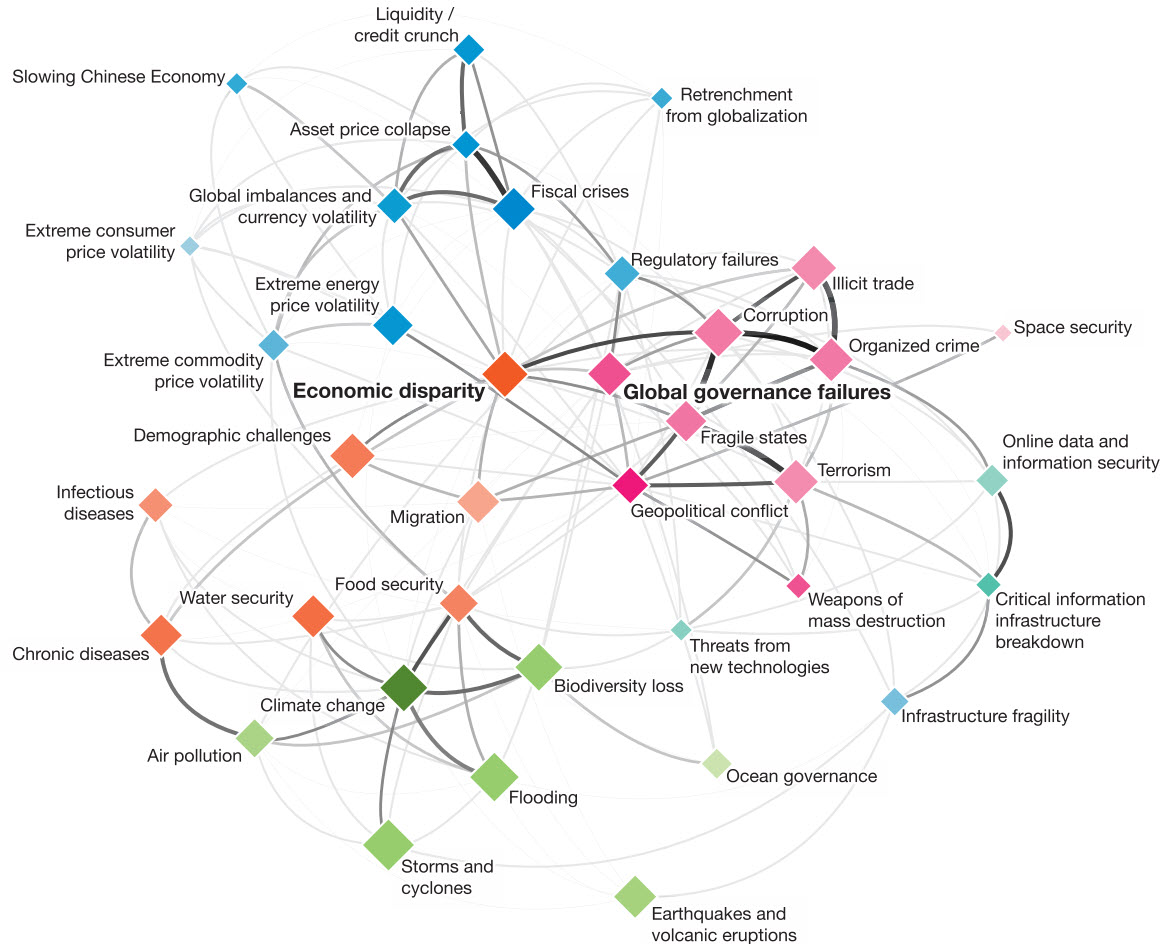
Our global networks have generated many benefits and new opportunities. However, they have also established highways for failure propagation, which can ultimately result in man-made disasters. For example, today’s quick spreading of emerging epidemics is largely a result of global air traffic, with serious impacts on global health, social welfare, and economic systems.
In a Nature paper on globally networked risks, ETH Zürich Prof. Dr. Dirk Helbing, Chair of Sociology, illustrates how cascade effects and complex dynamics amplify the vulnerability of networked systems. For example, just a few long-distance connections can largely decrease our ability to mitigate the threats posed by global pandemics.
Initially beneficial trends, such as globalization, increasing network densities, higher complexity, and an acceleration of institutional decision processes may ultimately push man-made or human-influenced systems towards systemic instability, Helbing finds. Systemic instability refers to a system that will get out of control sooner or later, even if everybody involved is well skilled, highly motivated and behaving properly. Crowd disasters are shocking examples illustrating that many deaths may occur even when everybody tries hard not to hurt anyone.
Click on Image to Enlarge – Risks Interconnection Map 2011 illustrating systemic interdependencies in the hyper-connected world we are living in (credit: World Economic Forum)
Today, millions of people face extreme insecurity as a result of conflicts and economic crises — not only in acute conflicts like Syria but also in many lower-profile crises. To be sure, great strides have been made since the start of this century, notably in reducing global poverty, due in large part to the concerted action and targeted goals to be achieved by 2015 that were set in motion at the landmark 2000 UN Millennium Summit. However, there is no denying that, in too many parts of our world, the international community fails to protect people whose lives are dangerously at risk.
This calls upon us to mount a new response to meeting human needs, one that recognizes the complex nature of the problems now before us. Such a response exists in the concept of human security, which was advanced a decade ago with the release of the findings of the UN Commission on Human Security, which I co-chaired with Amartya Sen.
U.S. officials show Israeli counterparts video trial of ‘bunker buster' bomb that could be used to destroy Iran's Fordow nuclear installation, Wall Street Journal reports.
3D printing technology is taking off in the medical science community, especially in emerging methods known as “bioprinting.” Instead of inks, plastics and other artificial materials, science and medical labs use a patient’s actual living human cells to replicate organs that the body can recognize and accept.
3D bioprinting has tremendous promise for medical professionals, but it could also forever change areas such as cosmetic surgery and food engineering (not to mention counterfeiting or spy disguises). Here are some of the latest innovations happening in 3D printing and 3D bioprinting.
This is perhaps the saddest story of all concerning the bees. As is so often the case today, I take it to be a an example of a state of consciousness that is killing us, as surely as it is killing the bees. Bee keepers steal all the honey from the bees that they lay up to keep themselves healthy, and feed them high fructose corn syrup. It is now emerging that this is one of! the reasons the bees are dying.
The Great Schism Trend is reaching a kind of crescendo, whose outcome is unclear to me. This could pass, or it could continue to develop to crisis. I am using this South Carolina story, but I could have picked Alabama, or Kansas. All at the same time. This is an assertion of states rights over federal laws, and it must go to the Supreme Court, as will several of the others cases! .
Syria:Comment: Israeli and Western news outlets report the Syrian government is rebounding and the army is on the offensive. The clearest sign of greater vigor is President Asad's public appearance at a power station in Damascus. This is his first public appearance since January, but he gave two televised interviews in April.
While Asad activities are confidence builders, the army's continuing offensive against rebel-held sections of the city of Homs is a more tangible manifestation of resurgence. The operation, thus far, has succeeded in taking back parts of Homs that had been held by rebels for a year.
Hezbollah is providing flank support by attacking opposition fighters on the border town of Qusayr, which is located along the route between Damascus and the Alawite core region to the north. Syria forces also are fighting in the port town of Baniyas.
A reasonably successful offensive in this region would secure the western and most productive parts of Syria for the regime and essentially fragment the country. It also would ensure that attempts to provide western arms to the rebels via the Mediterranean ports would be subject to capture by Syrian and Hezbollah forces.
Syrian leaders appear to be trying to improve their political and military positions before the US leadership makes up its mind about increased intervention. They are also taking advantage of continuing disunity and fractiousness among the rebel groups. The Times of Israel judged that the decline in opposition fortunes began when the rebel al Nusrah Front announced its allegiance to al Qaida.