Berto Jongman: Fukushima, Chernobyl, and the Frog in Boiling Water — An Anthropological Perspective on the Deceived, the Forgotten, & the Dying

03 Economy, 07 Health, 07 Other Atrocities, 08 Proliferation, 08 Wild Cards, 11 Society, Civil Society, Commerce, Earth Intelligence, Government
Berto Jongman
Berto Jongman

Fukushima isn’t Chernobyl?  Don't Be So Sure

by SARAH D. PHILLIPS

CounterPunch,  Weekend Edition March 15-17, 2013

The March 11, 2011 Tohoku earthquake and tsunami caused the deaths of approximately 16,000 persons, left more than 6,000 injured and 2,713 missing, destroyed or partially damaged nearly one million buildings, and produced at least $14.5 billion in damages. The earthquake also caused a triple meltdown at the Fukushima Daiichi nuclear power plant on Japan’s eastern coast. After reading the first news reports about what the Japanese call “3.11,” I immediately drew associations between the accident in Fukushima and the Chernobyl nuclear disaster of 1986 in what was then the Soviet Union. This was only natural, since studying the cultural fallout of Chernobyl has been part of my life’s work as an anthropologist for the past 17 years. Knowing rather little about Japan at the time, I relied on some fuzzy stereotypes about Japanese technological expertise and penchant for tight organization and waited expectantly for rectification efforts to unfold as a model of best practices. I positioned the problem-riddled Chernobyl clean-up, evacuation, and reparation efforts as a foil, assuming that Japan would, in contrast, unroll a state-of-the-art nuclear disaster response for the modern age. After all, surely a country like Japan that relies so heavily on nuclear-generated power has developed thorough, well-rehearsed, and tested responses to any potential nuclear emergency? Thus, I expected the inevitable comparisons between the world’s two worst nuclear accidents to yield more contrasts than parallels.

Continue reading “Berto Jongman: Fukushima, Chernobyl, and the Frog in Boiling Water — An Anthropological Perspective on the Deceived, the Forgotten, & the Dying”

Search (3): Analytic Models, 10 Threats, Threat Support to Acquisition

Searches
Ada Bozeman
Ada Bozeman

Ada Bozeman, in Strategic Intelligence and Statecraft: Selected Essays, has written:

(There is a need) to recognize that just as the essence of knowledge is not as split up into academic disciplines as it is in our academic universe, so can intelligence not be set apart from statecraft and society, or subdivided into elements…such as analysis and estimates, counterintelligence, clandestine collection, covert action, and so forth. Rather … intelligence is a scheme of things entire. (Bozeman 1998: 177).

The principal failing of all intelligence endeavors to date, both in government (including law enforcement and the military), and in the private sector (across academia, civil society, commerce, the media, and non-government/non-profit), has been the lack of coherent comprehensive analytic models that by their very nature, foster an appreciation for the whole.  In one word, they lack integrity — they lack the integrity of being whole; they lack the integrity of providing for relationships among all factors; and they lack the integrity of providing for true cost cradle to grave economic cost-benefit analytics.

The analytic model is what determines the maturity of the intelligence process, but it is irrelevant if the rest of “the thing entire” is a mess.  If counterintelligence is not sufficient to eradicate traitors and special interests corrupting the decision-cycle entire; if collection is not coherent and responsive; if processing is marginal at best; and if constituencies are either ignored or ignorant — one cannot have intelligence.  Intelligence without integrity is not intelligence.  Integrity in this context is not about individual honor, rather it is about the coherence — the state of being whole and unfragmented — the integral consciousness of  the whole, with intelligence and its constituencies being “one mind, one soul.”

There are four Whole of Government constituencies for decision-support that are not being addressed coherently because the Office of Management and Budget does not appear to “do” Whole of Government” management: strategy, policy, acquisition, operations.  The individual Departments cannot be expected to make up for this deficiency at the presidential level–but they should be held accountable for coherent threat support to acquisition in the context of respect those of the ten threats to humanity that are within their mandate.  Our current practice of doing intelligence support to each stovepipe in isolation from the whole is counter-productive, and we generally only do the “threat” in generic terms and do not tailored analytic support to strategy development and testing; to 360 degree policy both current and future; or to acquisitions beyond token support to individual weapons systems that are never themselves called into question for being unnecessary, unaffordable, and often untransportable..

Continue reading “Search (3): Analytic Models, 10 Threats, Threat Support to Acquisition”

John Maguire: Mesh Networks and Pirate Internet

Autonomous Internet

maguire“From SOPA and PIPA to ACTA to CISPA to the TPP and now back to CISPA, internet activists have been caught up in a deliberately bewildering game of whack-a-mole with freedom-crushing legislation. Now, ISPs are doing an end run around the whole legislative process altogether and voluntarily collaborating with the entertainment industry to spy on their own customers. All of this is enough to leave concerned netizens demoralized, and in the war of attrition that is exactly the goal. Join us today on The Corbett Report as we explore a real, grassroots, alternative solution to the problem of internet censorhip that can help to end this government/corporate control over our communication once and for all.”

For our interests, if you care to watch this, you could probably just skip to 21.30 ~; as the first half the video is just concerned with discussing SOPA, etc, and general activism that you're likely already aware of. From 22min till the end is where they really dig into pirate internet solutions and mesh networks that are the meat of the issue.

http://www.corbettreport.com/episode-262-solutions-pirate-internet/

22-28Min: James Corbett and radio-host Jack Blood discuss the possibility for setting up pirate-internet networks as a response to the incessant efforts of internet-fascists and their legislative puppets to pass proposals such as CISPA. Blood mentions his experience/success with localized, pirate broadcasting that circumvents centralized/censored networks.

28-38Min: Clip from a CNet-Trialogue that discusses what are known as Mesh Networks. Mesh Networks, originally conceived of by the Military-Industrial Complex, are a tool citizens can now leverage to liberate themselves and set up decentralized, uncensored internet accessibility. Requiring only a small investment into already-existing radio equipment, people can set up these networks by first adapting their Smart-Phones. Because of their processing power Smart Phones can serve as Mesh Network nodes that allow for the creation of a node-to-node Wi-Fi Network. This allows for the complete bypassing of any potential government lockdown.

38-43Min: Corbett highlights the work of Tony Cartalucci @ http://localorg.blogspot.com/. Cartalucci's article Decentralizing Telecom explains the practical side of implementing these new types of web-networks at a local level.

See Also:

P2P / Autonomous Internet Roadmap

PBI / Autonomous Internet (147)

Berto Jongman: Legendary Russian Documentary on Nazi Interest in Antartica, Now with English Sub-Titles

08 Wild Cards, Cultural Intelligence, Earth Intelligence, Extraterrestial Intelligence, Government, History, IO Secrets, IO Technologies, Military, YouTube
Berto Jongman
Berto Jongman

Includes 1947 US naval expedition led by Robert Byrd broken off after being attacked by objects that vertically take off from the sea. Russian scientists hypothesize US military HAARP bases on Antartica and Alaska are intended for identifying the characteristics of wormholes used by alien visitors to access and leave earth.

Published on Sep 25, 2012

Phi Beta Iota:  RIVETING.  Superb subtitles easy to follow.  Brilliant photography.

Below the Line: Lengthy overview of film.

Continue reading “Berto Jongman: Legendary Russian Documentary on Nazi Interest in Antartica, Now with English Sub-Titles”

Theophillis Goodyear: The GOP Digs America a Deeper Grave

Civil Society, Corruption, Cultural Intelligence, Government
Theophillis Goodyear
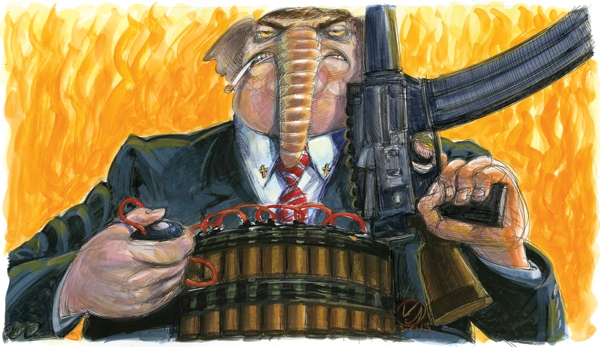
I agree the two parties have become virtually indistinguishable in many respects. But the Republican Party is far more dangerous, in my opinion. And I think Democrats kowtow to big business interests and the Military Industrial Complex mainly because they are more or less forced to if they want to be able to consistently challenge Republican Party dominance. That's no excuse, of course. But I think it's very misleading to portray both parties are essentially opposites sides of the same coin. Anyway, this article points out some important differences between the two parties.
Click on Image to Enlarge

The GOP's Real Agenda

Since last fall, Republicans have pretended to be more moderate – but their politics are harsher and more destructive than ever

After watching voters punish the GOP in the 2012 elections, Republican elites have been talking a brave game about reforms that would make the party less repulsive to Latinos, women and gay-friendly millennials. Florida Sen. Marco Rubio, the GOP's hip-hop-quoting young standard-bearer, is pressing conservatives to back an amnesty for undocumented immigrants. Dozens of party stalwarts, headlined by former Utah Gov. Jon Huntsman, renounced their opposition to gay marriage in a Supreme Court brief. GOP bigwigs have even launched New Republican – a group modeled after Bill Clinton's centrist Democratic Leadership Council – which seeks to rebrand the party as “colorblind,” “not anti-government” and dedicated to “ending corporate welfare.”

How the GOP Became the Party of the Rich

Don't be fooled. On the ground, a very different reality is unfolding: In the Republican-led Congress, GOP-dominated statehouses and even before the nation's highest court, the reactionary impulses of the Republican Party appear unbowed. Across the nation, the GOP's severely conservative agenda – which seeks to impose job-killing austerity, to roll back voting and reproductive rights, to deprive the working poor of health care, and to destroy agencies that protect the environment from industry and consumers from predatory banks – is moving forward under full steam.

Michel Bauwens: Abandoning Checks & Balances

Civil Society, Cultural Intelligence, Ethics, IO Impotency
Michel Bauwens
Michel Bauwens

Question authority!

‘We are abandoning all the checks and balances’

WASHINGTON – Evgeny Morozov is a Belarus-born technology writer who has held positions at Stanford and Georgetown universities in the United States. His first book, The Net Delusion: The Dark Side of Internet Freedom, argued that “Western do-gooders may have missed how [the Internet] … entrenches dictators, threatens dissidents, and makes it harder — not easier — to promote democracy.” The New York Times described it as “brilliant and courageous.”

In his second book, To Save Everything, Click Here: The Follow of Technological Solutionism, Click Here, Morozov critiques what he calls “solutionism” — the idea that given the right code, algorithms and robots, technology can solve all of mankind’s problems, effectively making life “frictionless” and problem-free.

Evgeny Morozov
Evgeny Morozov

Morozov argues that this drive to eradicate imperfection and make everything “efficient” shuts down other avenues of progress and leads ultimately to an algorithm-driven world where Silicon Valley, rather than elected governments, determines the shape of the future.

. . . . . . . . . .

All solutions come with cost. Shifting a lot of the responsibility to the individual is a very conservative approach that seeks to preserve the current system instead of reforming it. With self-tracking we end up optimizing our behavior within the existing constraints rather than changing the constraints to begin with. It places us as consumers rather than citizens. My fear is policymakers will increasingly find that it is much easier, cheaper and sexier to invite the likes of Google to engage in some of this problem-solving rather than do something that is much more ambitious and radical.

. . . . . . . . . .

I have a lot of respect for these people as engineers, but they are being asked to take on tasks that go far beyond engineering — tasks that have to do with human and social engineering rather than technical engineering. Those are the kind of tasks I would prefer were taken on by human beings who are more well rounded, who know about philosophy and ethics, and know something about things other than efficiency, because it will not end well.

. . . . . . . . . .

The newspaper offers something very different from Google’s aggregators. It offers a value system, an idea of what matters in the world. Newspapers need to start articulating that value.

. . . . . . . . . .

There are many problems I have with TED. It has created this infrastructure where it very easy to be interesting without being very deep. If TED exercised their curatorial powers responsibly, they would be able to separate the good interesting from the bad interesting. But my fear is they don’t care as long as it drives eyeballs to the website. They don’t align themselves with the thinkers, they align themselves with marketing, advertising, futurists who are interested in ideas for the sake of ideas. They don’t care how these ideas relate to each other and they don’t much care for what those ideas actually mean. TED has come to exercise lots of power but they don’t exercise it wisely.

Read full article.

Yoda: New Pope — Argentine, Trained in Philosophy & Psychology

Civil Society, Cultural Intelligence, Peace Intelligence
Got Crowd? BE the Force!

May the force be with him.

The new Pope is the oldest of the seven cardinals identified by Phi Beta Iota as being of interest in relation to the educational table prepared by Anthony Judge.  Argentine, trained in philosophy and psychology as well as theology, he is, as with the others selected by Phi Beta Iota, NOT DOGMATIC.

Latinos have always been the heart of the Catholic Church, and one of the greatest misteps of prior Popes was the rejection — the condemnation — of liberation theology.  The Most Holy Father is the first Latino and the first Jesuit to be appointed leader of the Catholic Church.

It will be most interesting to see if the new Most Holy Father elevates the other six cardinals Phi Beta Iota studied, particularly Cardinals Fernando Filoni of Italy, now Prefect of the Congregation for the Evangelization of Peoples; Cardinal George Alencherry of India; and Cardinal John Njue of Kenya.

Anthony Judge: Scrutinizing the Cardinals by Educational Disciplines

pope francisAbout the New Pope:

Cardinals Pick Bergoglio, Who Will Be Pope Francis

Pope Francis takes Vatican trappings to a new plain

Pope Francis, a new era: Editorial

Pope Francis: Argentina's Cardinal Jorge Mario Bergoglio is new Catholic leader

Why the election of Pope Francis matters to developing countries

See Also:

Berto Jongman: Catholic Church — Dead or Just Comatose? + Catholic / Pedophilia RECAP

Catholic Church Getting Serious About “Truth”

Egypt & Jordan: Muslim & Christian Side by Side

Event: 26 Oct 2011 Assisi Italy Pope, Peace, & Prayer — 5th Inter-Faith Event Since 1986 — Terms of Reference…


noble gold