Yoda: Cornell Notes Method & Online Template

IO Mapping
Got Crowd? BE the Force!

Useful, this is.

Turn your notes into writing using the Cornell method

This post is by Dr Katherine Firth who works in Academic Skills at the University of Melbourne, with a particular interest in research student literacies. Basically, Katherine is a Thesis Whisperer, like me. Unlike me, Katherine is still an active researcher in her field of 20th-century poetry. Over coffee Katherine told me about the ‘Cornell Method’ and kindly agreed to write a post. I found it enlightening, I hope you do too.

I take a lot of notes.  Even when I was doing my PhD and I was taking thousands of pages of notes, I took them by hand.  I tried using a computer, but there are so many things that are really hard to do on screen (drawing an arrow to make a connection between points, for example) that are really quick on paper.  Also, you only need one hand to write notes, but two hands to type.  And that free hand comes in useful for holding open books, grasping coffee cups, or stuffing your face with Gummi bears.

. . . . .
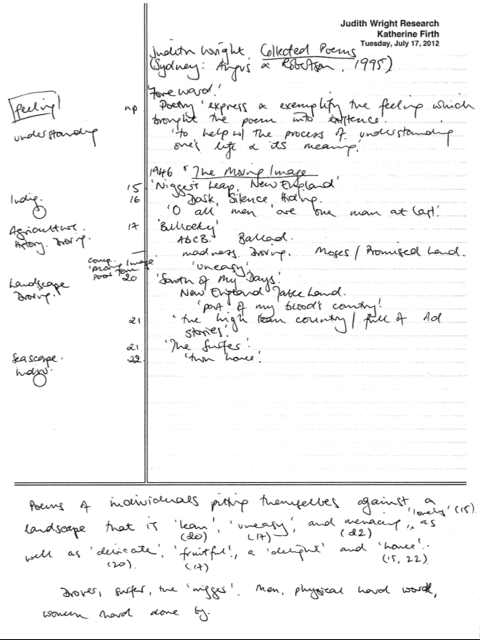
Click on Image to Enlarge

Firstly, the template gives you less space to write notes.  You aren’t supposed to record everything you see, or even everything that is interesting.  Having fewer lines to write notes encourages you to be selective—just to chose the quotes or paraphrases or details you expect to include in your thesis.  It’s so liberating.  And it’s so quick.  In under an hour, I went from opening the book for the first time to producing the notes in Figure 2.

Secondly, the template gives you a bigger margin than in a usual ruled note book.  This is where you put key words, identify themes, or recurrent patterns.  This is great to helping you to analyse what you’re putting down, and to find the relevant quote when you go back to it.  It also helps you to stay on track.  You can check: ‘are my key words the same as the ones in my research question / thesis title?’

But thirdly, and most valuably, the template gives you a big space at the bottom to write sentences that summarise the page.  That is, you start writing your critical response on the notes themselves.

TEMPLATE PDF CREATOR

Continue reading “Yoda: Cornell Notes Method & Online Template”

Owl: 70 Things That Will Go Wrong in a Disaster

Cultural Intelligence, IO Impotency, Law Enforcement
Who?  Who?
Who? Who?

70 Things That Can and Will Go Wrong in a Disaster

The first 25:

1. In an earthquake, there may be violent ground shaking; it will seem to last much longer than it actually does.

2. Fires will occur, caused by electrical shorts, natural gas, fireplaces, stoves, etc.

3. Fires in collapsed buildings will be very difficult to control.

4. The extent of the disaster will be difficult to assess, though this will be necessary to assure proper commitment of resources.

5. Emergency equipment and field units will commit without being dispatched. There will be an air of urgency and more requests for aid than units available to send.

6. Communications will be inadequate; holes will appear in the system and air traffic will be incredibly heavy.

7. Trained personnel will become supervisors because they will be too valuable to perform hands-on tasks.

8. Responding mutual aid units will become lost; they will require maps and guides.

9. Water will be contaminated and unsafe for drinking. Tankers will be needed for fire fighting and for carrying drinking water.

Continue reading “Owl: 70 Things That Will Go Wrong in a Disaster”

Owl: UPDATED Top US War Criminals Named [Synopsis Added]

04 Inter-State Conflict, 07 Other Atrocities, 09 Justice, 11 Society, Corruption, Government, Law Enforcement
Who?  Who?
Who? Who?

I put this first bit together to make it easier to grasp the depth and breadth of this scholarly and legal indictment.

Scholar Names Top US War Criminals

More Than Thirty Top U.S. Officials Guilty of War Crimes

According to the distinguished American international law authority, Francis Boyle, a Professor of International Law at the University of Illinois, Champaign, and the author of numerous books on the subject,  “More than 30 top U.S. officials, including presidents G.W. Bush and Obama, are guilty of war crimes or crimes against peace and humanity,” and “legally akin to those perpetrated by the former Nazi regime in Germany.” “In international legal terms, the U.S. government itself should now be viewed as constituting an ongoing criminal conspiracy under international law,” Boyle said in an address Dec. 9th to the Puerto Rican Summit Conference on Human Rights at the University of the Sacred Heart in San Juan. The serial aggressions of the U.S. violate such basic documents of international law as the Nuremberg Charter, the Nuremberg Judgment, and the Nuremberg Principles, Boyle said. As well, they violate the Pentagon’s own U.S. Army Field Manual 27-10 on The Law of Land Warfare, which applies to the President himself as Commander-in-Chief of U.S. Armed Forces under Article II, Section 2 of the U.S. Constitution. U.S. administrations since 9/11 may be charged with “crimes against peace” for their attacks in Afghanistan, Iraq, Pakistan, Libya, Somalia, Yemen, and Syria, “and perhaps their longstanding threatened war of aggression against Iran,” Boyle said. Boyle said the so-called “targeted killing” of human beings in a non-battlefield situation is “pure murder” under basic principles of Anglo-American common law and international criminal law. And in this case, where these murders are both widespread and systematic, these murders constitute a Crime against Humanity under Article 7(1)(a) of the Rome Statute for the International Criminal Court. Although the United States is not a party to the Rome Statute, Boyle said, “nevertheless President Obama is subject to the jurisdiction of the ICC and its Prosecutor for murdering people in ICC member States.”

Boyle's List of War Criminals:

Civilian
Both presidents since 2001
Their vice-presidents – Dick Cheney and Joseph Biden
Secretaries of Defense Donald Rumsfeld, Robert Gates and Leon Panetta
Secretaries of State Colin Powell, Condoleeza Rice, and Hillary Clinton
National Security Advisors Stephen Hadley, James Jones, and Thomas Donilon
Director of National Intelligence John Negroponte and James Clapper
Central Intelligence Agency (CIA) Directors George Tenet, Leon Panetta, and David Petraeus

Military
Members of the Joint Chiefs of Staff
Some Regional Commanders-in-Chiefs, especially for the U.S. Central Command (CENTCOM), and more recently, AFRICOM
Chairman General Martin Dempsey, U.S. Army
JCS members including Admiral James Winnefeld Jr.; General Raymond Odierno, Chief of Staff of the Army;  General James Amos, Commandant of the Marine Corps; Admiral Jonathan Greenert, Chief of Naval Operations; and General Mark Welsh, Chief of Staff of the Air Force
Central Command heads since the U.S. invasion of Afghanistan include Lt. General Martin Dempsey; Admiral William Fallon; General John Abizaid; General Tommy Franks; Lt. General John Allen; and current commander General James Mattis. General Carter Ham of AFRICOM bears like responsibility.

2012 More Than Thirty Top U.S. Officials Guilty of War Crimes

Read full article.

Continue reading “Owl: UPDATED Top US War Criminals Named [Synopsis Added]”

Jon Lebkowsky: Guns and Homicide in the USA

09 Justice, Civil Society, Law Enforcement
Jon Lebkowsky
Jon Lebkowsky

Guns in America, a Statistical Look

Violent crime rates have been falling in recent years, but the number of people killed by firearms in the United States remains high.  According to the FBI Uniform Crime Report, between 2006 and 2010 47,856 people were murdered in the U.S. by firearms, more than twice as many as were killed by all other means combined.

FBI Expanded Homicide Data Table 8

Murder Victims by Weapon, 2006–2010


Continue reading “Jon Lebkowsky: Guns and Homicide in the USA”

Eagle: We MUST Control Baseball Bats

Offbeat Fun, Officers Call
300 Million Talons...
300 Million Talons…

Phi Beta Iota strongly supports the registration of all baseball bats, and licensing of the right to own a bat, together with mandatory training in the safe use of a baseball bat.  The training should be repeated every two years, as unsafe habits can creep back in without the strictest government oversight and micro-management of the extremely serious threat to our obese children that are too slow to run away from a crazed lunatic weilding a lethal baseball bat.  This is of such great importance to our nation that we would like to see the Department of Homeland Security propose a Baseball Bat Authority (BBA), make that a model, and then move down the lethality pecking order to create separate new Authorities for the control of hockey sticks, lacross sticks, tennis rackets, and so on.  Eventually handball players should be required to register their hands and demonstrate safe hand use practices.

Click on Image to Enlarge

We Must Stop Baseball Bat Violence!

By Mark R. Ferran, BSEE

A Message from the Coalition to Stop Bat Violence. (Formerly known as the Coalition to Stop Gun Violence).

Setting: The Year 2020, six months after the last privately-owned gun was found and destroyed. We have finally made All Americans (including intruders) Safe from Gun Violence in Americans' Homes. But we must continue our struggle to make All Americans safe from Violence in homes and businesses, and on the streets.

“Adolpho Hernandez was executed today for the Sept. 30, 1988, robbery and murder of 69-year-old Elizabeth Alvarado who was beaten to death with a baseball bat bat inside her Lubbock, Texas, home.” (“Elizabeth's family was again devastated one year later, when Elizabeth's granddaughter, Melissa Ann Garcia, was raped and stabbed to death by Texas death row inmate Jack Wade Clark.”

Read full article with many explicit guidelines.

See Also:

Ban guns and other inanimate objects for the good of all


Anthony Judge: Beware of Legality, Accountability, Marketability, Security! Be where the Four Hoarsemen of the Apocalypse are not?

Cultural Intelligence, Ethics
Anthony Judge
Anthony Judge

Beware of Legality, Accountability, Marketability, Security!

Be where the Four Hoarsemen of the Apocalypse are not?

Introduction
Being wary of “legality”
Being wary of “accountability”
Being wary of “marketability”
Being wary of “security”
Systemic implications of “horsemen” and “hoarsemen” and correspondences between them
Being wary of the Four Hoarsemen acting together
Being where and how “to be”?
Conclusion
References

Phi Beta Iota:  This is one of Anthony Judge's shorter and more poignant essays.  It is reproduced in full below the line, along with his links, and our on duty editor has added links to the Amazon pages of all the books that he cites.  In this essay, complicity is the opposite of integrity, the single word (integrity) most embedded across Phi Beta Iota the Public Intelligence Blog.  To read the essay at its source, click on the title above.

Continue reading “Anthony Judge: Beware of Legality, Accountability, Marketability, Security! Be where the Four Hoarsemen of the Apocalypse are not?”

Richard Falk: The Future of International Law and Human Rights

Cultural Intelligence, Ethics
Richard Falk
Richard Falk

The Future of International Law and Human Rights

An Interview With Richard Falk

by CIHAN AKSAN and JON BAILES

Richard A. Falk is professor emeritus of international law at Princeton University and an appointee to two United Nations positions on the Palestinian territories. He has authored, edited or contributed to 40 books, including The Great Terror War; The Costs of War: International Law, the UN, and World Order after Iraq; Achieving Human Rights; and International Law and the Third World: Reshaping Justice.

Read questions and answers.

Cihan Aksan and Jon Bailes are the editors of www.stateofnature.org. The following is a chapter from their new book of interviews, Weapon of the Strong: Conversations on US State Terrorism (Pluto Press, 2012).

Weapon of the Strong analyses the forms of US state terrorism through exclusive, never before published interviews with leading commentators and theorists. The interviews explore the different aspects of state terrorism: its functions, institutional supports and the legal and moral arguments surrounding it, and consider specific case studies in Europe, Latin America and the Middle East.”

noble gold