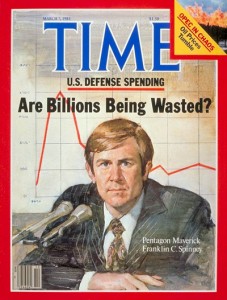
Chuck Spinney: Political Fluff on Iraq vs Real-World Appraisals

03 Economy, 04 Inter-State Conflict, 05 Civil War, 05 Iran, 07 Other Atrocities, 08 Wild Cards, 10 Security, Corruption, Government, Military, Officers Call
Chuck Spinney

After running for President in 2008 on a platform that criticized Iraq as a “dumb war,” Barack Obama just declared America’s misbegotten Iraqi adventure to be an “extraordinary achievement” in a speech to soldiers at Fort Bragg. That declaration of success is not enough for Congressman Duncan Hunter, who took Obama to task, saying, “And even now, as president, he refuses to acknowledge that victory was achieved,”

Such is the self-referencing nonsense produced in contemporary American political discourse shaped by a perpetual election cycle that disconnects debate from the real world and stifles rational governance, but keeps the masses entertained and distracted, much like the circuses did for the Roman masses in the waning days of the Empire. With American politicians are arguing endlessly how great a victory we achieved in Iraq, a natural question remains unasked: What does the rest of the world — particularly the Arab world — thinks of our ‘success'?

Attached, FYI, are two thoughtful alternative points of view on this question.

The first headline is from Rami Khouri's.  He is a columnist for the Lebanese Daily Star and is syndicated by the prestigious Agence-Global. The second headline is from Patrick Cockburn's, writing in the Independent [UK].  He is one of the most well informed western reporters now writing about the Middle East.

Praise Tunisia, not the Iraqi nightmare

By Rami G. Khouri, Daily Star, 14 December 2012

The United States under President George W. Bush drew on a deep well of nonsense, lies and fantasy when it entered Iraq in 2003. President Barack Obama continued this bipartisan American tradition when he said Monday that the departure of American forces from Iraq left behind a country that can be a model for other aspiring democracies. On the other side of the Arab world on the same day, the Tunisian people elected a new president, providing a more credible example of how Arabs can aspire to become democratic without foreign armies destroying their national fabric.  Read more.

Wars without victory equal an America without influence

World View: For all its military might, the US has failed to get its way in Afghanistan and Iraq, severely denting the prestige of the world's only superpower
Patrick Cockburn, Independent, 12 December 2011

Phi Beta Iota:  Mr. Cockburn's article contains one major assumption, to wit that the US  Government will not attack Iran nor condone an Israeli attack on Iran.  We disagree.  Now more than ever, Israel is bent on attacking Iran and drawing the US in–the deployment of US/NATO troops all around Syria, the plans for major NATO air operations ostensibly against Syria (long billed, falsely, as an Iranian puppet state) all point to precisely the opposite: a cresendo joint US-Israel mega-attack on Iran and Syria together.


Tom Atlee: Four Types of Power

Cultural Intelligence
Tom Atlee

Dear friends,

Stimulated by Occupy and an expanding inquiry into new forms of economics, combined with my ongoing interest in bringing wisdom to politics and governance, I've stumbled on a productive approach to pulling it all together:  Start from an exploration of Power – particularly, but not only, social power.  This brings both politics and economics under the same roof, and oddly integrates protest movements, alternative technologies and social forms, and the human potential movement.  More on that later.

Right now, I want to share some notes on types of power.  If you have thoughts about these lists, please share them on my blog so others can see them and all the comments will be gathered together in one place where it will be easier for me to review and learn from them all.

I hope you find these interesting and thought-provoking.  I look forward to any comments you may have.

Coheartedly,
Tom

================

FOUR TYPES OF POWER

by Tom Atlee

Continue reading “Tom Atlee: Four Types of Power”

Berto Jongman: The Kandahar Audio Casette Collection – Central to Understanding Emergence of Al Qaeda Prior to 9/11

09 Terrorism, 11 Society, Audio, Civil Society, Cultural Intelligence
A collection of more than 1500 audiocassettes from Kandahar.  The collection is central to understanding al-Qaida's emergence as an organisation before 9/11.
A first inventarisation and description can be found in: Flagg Miller. Insight from Bin Laden's audiocassette library in Kandahar. CTC Sentinel, 4(10), October 2011.
An analysis of Flag Miler can also be found in : J.Deol, Z. Kazmi (Eds) Contextualizing jihadi thought. New York: Horst & Company, Columbia University Press, 2012.

NIGHTWATCH: Push-Back on US Across AF PK IR SY

02 Diplomacy, 04 Education, 05 Iran, 08 Wild Cards, 10 Security, 11 Society, Government, IO Multinational

In summary:  US took ten years to make an issue of two Pakistani fertilizer factories that are the primary source for all Improvised Explosive Devices (IED) killing and maiming in AF.  Taliban gets what it wants in AF school programs, Iran makes progress in AF, SY and on the side with Saudi Arabia.

Continue reading “NIGHTWATCH: Push-Back on US Across AF PK IR SY”

Winslow Wheeler: Leon Panetta & F-35 in a Nose Dive

Corruption, Military
Winslow Wheeler

With his own words, Leon Panetta has shown that he is little more than a mouthpiece for keeping the defense budget at historically high levels and is incapable of coping with the coming era of modest (yes, modest) Pentagon budget reductions. Using DOD's budget history and the ongoing decay (not a typo) of our military forces at ever increasing spending levels as my perspective, I seek to explain in an essay that is running this morning at Time Magazine's Battleland blog. My thanks to journalist Mark Thompson for running this piece.

Is Leon Panetta the Right Man to be Secretary of Defense?

Winslow Wheeler

TIME Battlefield, December 13, 2011

Read  full post with graphics.

This morning, three publications reported more (and important) information about a report submitted to Acting Acquisition Czar Robert Kendall in November about the F-35.  This “Quick Look Report” was previously reported by Bloomberg News (Tony Capaccio).  Today's articles expand the coverage of the contents of the report.  These articles by Jason Sherman and colleagues at Inside Defense, Bill Sweetman of the Ares Defense Technology Blog, and Bob Cox at the Fort Worth Star Telegram are below.

F-35 Joint Strike Fighter Concurrency Quick Look Review

Concerns About JSF's Lethality, Survivability Triggered ‘Concurrency Risk' Review

JSF – What's Really Happening: Internal Pentagon report finds major problems with F-35 performance and components

Phi Beta Iota: A series of civilian and military leaders have willfully refused to be honest about the future of defense, to the point that we now have smaller older forces and we do not have what we need to implement anything even remotely like the 1998 “four forces after next.”  DoD is in total amoral melt-down, where the 4% of the force that has integrity takes 80% of the casualties and receives 1% of the total budget–and still does not have a hand-held weapon able to out-gun the Taliban.

See Also:

Continue reading “Winslow Wheeler: Leon Panetta & F-35 in a Nose Dive”

Howard Rheingold: Bottlenose Social Dashboard Beta

IO Impotency

Jon Mitchell

ReadWriteWeb, December 12, 2011

In the words of Nova Spivack, we are approaching The Sharepocalypse. The real-time Web sounded like a great idea, but it has become impossible to manage. The success of social media has proven, ironically, to be its biggest challenge. The services we already use are getting busier, and whole new networks are popping up all the time. Email used to be the only problem. Today, the info streams are legion.

It's hard enough being a normal user, but some have millions of people tweeting at them! How are they supposed to process all those messages? In the Information Age, you'd think more data would be a good thing, but on the social Web, the opposite is true. But the aforementioned Nova Spivack – along with co-founder Dominiek ter Heide – has just unveiled Bottlenose, and it could be the tool that helps us avert The Sharepocalypse in the nick of time.

Read more.

Phi Beta Iota:  We are less enthusiastic.  As one commentator notes, “Bottlenose is completely useless to you until you have an account at facebook/twitter/both. ”  Until we achieve the open source tri-fecta (at least) most of this is as dumb as Google — math hacks on digital garbage.

noble gold