Known for tackling the most pressing issues that face our world, the Worldwatch Institute has dedicated the 2011 edition of its flagship report to a compelling look at the global food crisis, with particular emphasis on what innovators globally can do to help solve a worldwide problem. State of the World 2011 not only introduces us to the latest agro-ecological innovations and their global applicability but also gives broader insights into issues including poverty, international politics, and even gender equity.
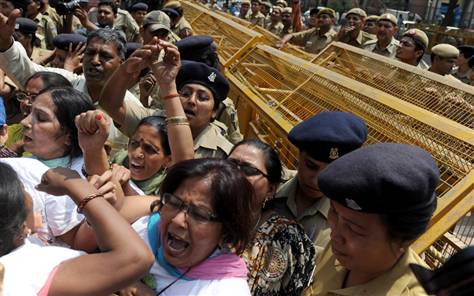
Activists from India's main opposition Bharatiya Janata Party (BJP) women's wing shout slogans against the Congress-led government during a protest against an increase in milk, vegetables and food prices in New Delhi on April 1, 2010. The BJP activists protested against the price hikes of essential commodities. Food inflation is still at 17 percent according to official figures.
Global food chain stretched to the limit
Soaring prices spark fears of social unrest in developing world
Strained by rising demand and battered by bad weather, the global food supply chain is stretched to the limit, sending prices soaring and sparking concerns about a repeat of food riots last seen three years ago.
Signs of the strain can be found from Australia to Argentina, Canada to Russia
Phi Beta Iota: Absent a radical break-through in energy that enables water desalination and purification, the combined collapse of the global financial system and the global food system could mark the beginning of a quarter century of “tribulation.”
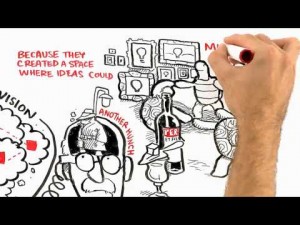
Steve Johnson in an animated conversation (literally) derived from the juices flowing through his book, Where Good Ideas Come From: The Natural History of Innovation. Ideas grow from slow hunches in collision with each other, and depend on great nurturing ground: coffee houses, salons, etc. I love his conclusion: “Chance favors the connected mind.”
Phi Beta Iota: Simply extraordinary. Worth watching (4:07) more than once.
It's a good think Ike is dead… else he would realize his nightmare survived. Chuck
Newsday January 13, 2011 Pg. 34
The Military-Industrial-Congressional Complex
Eisenhower warned against the influence of arms production, but did we listen?
By Bob Keeler
EXTRACT: Now, the deficit has caused some unexpected voices to say, ever so softly, that everything is on the table – including defense cuts. Last week, Gates talked about plans to slow the defense budget's growth by $78 billion over five years. That dainty nibble is a start, but we need big bites. A group called the Sustainable Defense Task Force has laid out ways to cut $1 trillion in 10 years. That's better.
I have read the released Odom interview MFR. Odom is not kind (perhaps not fair) to CIA or Gen Mike Hayden. Interview, like all others in extensive series, was done circa 2003-2004. Some prominent military SO names, such as Schoomaker and Boykin are among the interviewees. Extent of redaction ranges from fairly light to very heavy. Pre-sanitization/release original classification of interview MFRs ranges from U to TS//SCI (multiple caveats). As documented, little/no evidence that 9/11 Commission interviewers operated in hostile/coercive manner. Even through sanitization, knowledgeable readers can glean some interesting opinions.
The CIA is “out of control” and often refuses to cooperate with other parts of the national security community, even undermining their efforts, said former National Security Agency head William Odom, according to a recently released record of a 9/11 Commission interview.
“The CIA currently doesn't work for anyone. It thinks it works for the president, but it doesn't and it's out of control,” says a report summarizing remarks made by Odom, a retired three-star general who served as director of the NSA from 1985 to 1988.
Odom, who also served on the National Security Council staff during the Carter administration, was known as an outspoken advocate for intelligence reform. He died in 2008.
. . . . . . .
While deeply critical of the CIA, Odom also had harsh words for other NSA directors, including Adm. Bobby Inman, whom he accused of “playing games” in Washington. He also said that Gen. Michael Hayden, then the director of the NSA, was “destroying” the agency and didn't know his “intellectual limits.”
Mark Zuckerberg is Time's Man of the Year, the movie about him seems likely to be an Oscar winner, and now Goldman Sachs is raising $1.5 billion from its favorite investors on behalf of the social networking company.
At the very same moment, Facebook's only real competitor –NewsCorps' waning social networking site, MySpace — is shedding employees and expenses, most likely in hopes of a fire sale.
But appearances can be deceiving. In fact, as I read the situation, we are witnessing the beginning of the end of Facebook. These aren't the symptoms of a company that is winning, but one that is cashing out.
The Institute’s mission is to provide innovative strategies, working models and timely information to support environmentally sound and equitable community development. To this end, ILSR works with citizens, activists, policymakers and entrepreneurs to design systems, policies and enterprises that meet local or regional needs; to maximize human, material, natural and financial resources; and to ensure that the benefits of these systems and resources accrue to all local citizens.
Since 1974, the Institute for Local Self-Reliance has been working to enable communities with tools to increase economic effectiveness, reduce wastes, decrease environmental impacts and provide for local ownership of the infrastructure and resources essential for community well-being.



 . Ideas grow from slow hunches in collision with each other, and depend on great nurturing ground: coffee houses, salons, etc. I love his conclusion: “Chance favors the connected mind.”