Journal: AlterNet on “Beyond Madness”–Patraeus in Pakistan

Methods & Process, Military, Peace Intelligence

‘Beyond Madness': Obama's War on Terror Setting Nuclear-Armed Pakistan on Fire

Rather than seeking to stabilize Pakistan, General David Petraeus has been irresponsibly lighting matches with his shortsighted use of Special Forces and drone strikes

by Fred Branfman

EXCERPT 1:  But rather than seeking to stabilize Pakistan, General David Petraeus has, incredibly, been irresponsibly lighting matches through his shortsighted and relentless effort to secure Afghanistan by using U.S. forces and drone strikes, and pressuring the Pakistani Army to attack Taliban “sanctuaries” in Pakistan’s northwest provinces. Wajid Shamsul Hasan, Pakistan's High Commissioner to London for the past 16 years and a pillar of the Establishment, has recently stated that U.S. drone and gunship attacks in Pakistan have “set the country on fire” and threatened that such acts could eventually lead to attacks on U.S. personnel in Pakistan.  Petraeus has disastrously miscalculated. The more “progress” he tries to show in Afghanistan, the more he weakens the U.S. position in far more important Pakistan.

EXCERPT 2:  The single most important — yet surprisingly ignored — revelation of Bob Woodward's new book, Obama's Wars, is that Petraeus and the Obama team never discussed how their strategy for attacking Taliban sanctuaries in Pakistan was weakening the Pakistani state. Woodward also makes clear that it is Petraeus, not Obama, who is driving U.S. policy in “Af-Pak.” CIA Director Leon Panetta declared that “no Democratic president can go against military advice, especially if he asked for it. So just do it. Do what they say,” according to the book. Petraeus’ power derives from America’s unconscious need for a military hero and his perceived and overblown success in Iraq. But this perception has blinded normally sensible observers to his disastrous performance in Pakistan since becoming Centcom commander in October 2008.

Tip of the Hat to John Steiner via E-Mail.

Phi Beta Iota: the author has pulled together a number of linked references and this is a useful article narrowly focused.  He missed the larger picture, the fact that Obama has no strategy and no brain trust (the emphasis being on brains in touch with reality).  Obama will get his Wall Street reward on his present course, but he is neither leading nor serving the nation with his ideologically passive-aggressive incoherence across the board–nothing serious on all ten threats to humanity, nothing serious on all twelve core policies, an intelligence community that is pathologically expensive and ineffective, and a Pentagon that is so out of control as to be a cancer on the public blood, treasure, and spirit.  these are all good people trapped in a bad system–they desperately need a “wake-up call” and we are not sure that is achievable at this point.


Search: causes of iter-state conflict

Searches
Interstate Conflict Hits

Spelling matters–attention to detail!

Results for search spelled correctly (1)

Results for seach simplified to inter-state conflict (36)

DuckDuckGo, vastly better than Google in its presentation, suggested removing the hyphen and that improved the results.

Based on all of the resources available to the Phi Beta Iota team, we believe that inter-state conflict happens due to artificial scarcities imposed by corrupt elites, and the failure of the elites since World War II to focus on educating the public to achieve collective intelligence capable of creating a prosperous world at peace.  For one third of what we spend on war (which enriches banks, not people) we could provide every person on the planet with free cell phone and call center access for life (education one cell call at a time), and thereby–with accountability through transparency–create infinite wealth by leveraging the five billion poor whose annual economy is FOUR TIMES LARGER than that of the one billion rich.  This is a mind-set change, it is NOT about money.

See Also:

Worth a Look: Book Review Lists (Negative)

Worth a Look: Book Review Lists (Positive)

Journal: Free to the Public is new Services Science

Civil Society, Cultural Intelligence

Library Digitization for Free

November 30, 2010

November 30, 2010 – Treasures of Connecticut Libraries allows libraries to digitize, for free, up to 100 items in their collection, and then to upload their collection to a CONTENTdm site managed by the state library in Hartford. This collaboration is providing a relatively inexpensive model for libraries that want to expand awareness of their collections and demonstrate their value to a wider public.

We found this information on Library Journal in their article, “In Connecticut, a Small Model of Collaboration.” The project now has 26 participating libraries and their partners, and the searchable collection includes historical photographs, maps, postcards, videos and more.

Read full original blog by Marjorie Hlava…

Tip of the Hat to Marjorie Hlava at LinkedIn.

Journal: Community Asset-Based Sustainable Democracy

03 Economy, 11 Society

November 30, 2010 10:35

To Buy, to Bid, to Build: Community Rights for an Asset Owning Democracy

Source: ResPublica

From the Introduction:

Welfare states around the world will be forced by hard budgetary constraints to reconsider their current model of provision. The state needs to redefine its relationship with individuals and, crucially, with communities. It must find a way of re-endowing communities with independence and self-sufficiency, of giving them the wherewithal to transform themselves and their neighborhoods. The starting point is rethinking how it can leverage and direct not only its revenue budgets but – as this paper will discuss in detail – also its capital assets in a way that broadens and deepens social action and civic participation.

The opportunity for this new relationship in the UK has arrived sooner than expected or hoped. Given the extent of budgetary cuts, a large proportion of the public estate is no longer sustainable in its current form. We now face an unprecedented mass divestment of state assets, which among other things is likely to include: • Libraries. • Swimming pools. • Community centres. • Public spaces. • Council offices. • Courts. • Police stations. • Prison buildings. • The road network. • British Waterways. • RDA, MoD and Whitehall assets. • Ports.

In the years to come, a huge amount of this wealth will suddenly cease to be public and there is a real risk that such assets will not only be privatised (as during the 1980s) but privatised in such a way as to reinforce existing inequalities of wealth. There is a danger that the net result will be a rent seekers’ paradise, where vested interests triumph over communal need and wealth flows backwards to the already established and upwards to the already wealthy.

We believe that the opposite is possible. Public assets can – and, wherever desirable, should – become community assets, owned mutually or by individual shareholders or stakeholders in association with communities. These public goods can, if properly directed and organised, capitalise both civil society and the bottom 10 per cent of society which currently has negative net wealth.

+ Direct link to document (PDF; 532 KB)

Tip of the Hat to Gary Price at LinkedIn.

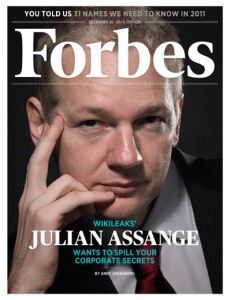
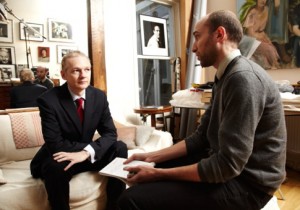
Reference: WikiLeaks Interview in Forbes–Promoting Business Ethics

03 Economy, 07 Other Atrocities, 11 Society, About the Idea, Commerce, Commercial Intelligence, Corporations, Cultural Intelligence, Ethics, Historic Contributions, InfoOps (IO), Journalism/Free-Press/Censorship, Money, Banks & Concentrated Wealth, Officers Call, Power Behind-the-Scenes/Special Interests, Privacy, Reform
Andy Greenberg

Nov. 29 2010

Fascinating article, including leaks in the pipeline (banks), whistleblowers, censorship, his story, trying to stop leaks, spying, untrustful competitors, secrecy, war, field of intelligence, etc.  … “our primary defense isn’t law, but technology…courage is contagious” (p.8) —  JAS

Forbes Cover Story . . . Forbes Transcript

Following is an excerpt from page 5 regarding moving in the direction of ethical business — JAS

Forbes Cover Story

What do you think WikiLeaks mean for business? How do businesses need to adjust to a world where WikiLeaks exists?

WikiLeaks means it’s easier to run a good business and harder to run a bad business, and all CEOs should be encouraged by this. I think about the case in China where milk powder companies started cutting the protein in milk powder with plastics. That happened at a number of separate manufacturers.

Let’s say you want to run a good company. It’s nice to have an ethical workplace. Your employees are much less likely to screw you over if they’re not screwing other people over.

Then one company starts cutting their milk powder with melamine, and becomes more profitable. You can follow suit, or slowly go bankrupt and the one that’s cutting its milk powder will take you over. That’s the worst of all possible outcomes.

The other possibility is that the first one to cut its milk powder is exposed. Then you don’t have to cut your milk powder. There’s a threat of regulation that produces self-regulation.

It just means that it’s easier for honest CEOs to run an honest business, if the dishonest businesses are more effected negatively by leaks than honest businesses. That’s the whole idea. In the struggle between open and honest companies and dishonest and closed companies, we’re creating a tremendous reputational tax on the unethical companies.

No one wants to have their own things leaked. It pains us when we have internal leaks. But across any given industry, it is both good for the whole industry to have those leaks and it’s especially good for the good players.

But aside from the market as a whole, how should companies change their behavior understanding that leaks will increase?

Do things to encourage leaks from dishonest competitors. Be as open and honest as possible. Treat your employees well.

I think it’s extremely positive. You end up with a situation where honest companies producing quality products are more competitive than dishonest companies producing bad products. And companies that treat their employees well do better than those that treat them badly.

Would you call yourself a free market proponent?

Absolutely. I have mixed attitudes towards capitalism, but I love markets. Having lived and worked in many countries, I can see the tremendous vibrancy in, say, the Malaysian telecom sector compared to U.S. sector. In the U.S. everything is vertically integrated and sewn up, so you don’t have a free market. In Malaysia, you have a broad spectrum of players, and you can see the benefits for all as a result.

How do your leaks fit into that?

To put it simply, in order for there to be a market, there has to be information. A perfect market requires perfect information.

There’s the famous lemon example in the used car market. It’s hard for buyers to tell lemons from good cars, and sellers can’t get a good price, even when they have a good car.

By making it easier to see where the problems are inside of companies, we identify the lemons. That means there’s a better market for good companies. For a market to be free, people have to know who they’re dealing with.

The InterviewYou’ve developed a reputation as anti-establishment and anti-institution.

Not at all. Creating a well-run establishment is a difficult thing to do, and I’ve been in countries where institutions are in a state of collapse, so I understand the difficulty of running a company. Institutions don’t come from nowhere.

It’s not correct to put me in any one philosophical or economic camp, because I’ve learned from many. But one is American libertarianism, market libertarianism. So as far as markets are concerned I’m a libertarian, but I have enough expertise in politics and history to understand that a free market ends up as monopoly unless you force them to be free.

WikiLeaks is designed to make capitalism more free and ethical.

But in the meantime, there could be a lot of pain from these scandals, obviously.

Pain for the guilty.

Do you derive pleasure from these scandals that you expose and the companies you shame?

It’s tremendously satisfying work to see reforms being engaged in and stimulating those reforms. To see opportunists and abusers brought to account.

———————————

Thanks to: Dan Drasin via John Steiner.

Reference: WikiLeaks and Al Qaeda as Open Source Insurgencies

10 Security, 11 Society, Blog Wisdom, Civil Society, Counter-Oppression/Counter-Dictatorship Practices, Cultural Intelligence, Ethics, Money, Banks & Concentrated Wealth, Officers Call, Peace Intelligence, Power Behind-the-Scenes/Special Interests, Reform, Strategy, Threats

Journal: The Security and Secrecy “Tax” – Global Guerrillas

By John Robb at Global Guerrillas (Networked tribes, systems disruption, and the emerging bazaar of violence. Resilient Communities, decentralized platforms, and self-organizing futures)

Wikileaks and Al Qaeda's Open Source Jihad are both open source insurgencies. While there are obvious differences between the two, what's more interesting is how they are similar. Namely: as open source insurgencies both groups use systems disruption (the ability…

Tip of the Hat to Mario Profaca at Facebook.

Phi Beta Iota: The deeper interpretation of the similarity of Al Qaeda and WikiLeaks is that they are both finding huge audiences for what they are offering, and they are both playing off of a massive public distaste for Open Veins of Latin America, Killing HopeRule by Secrecy, Sorrows of Empire, Web of Deceit, The Fifty Year Wound, etc.  The USA has created its enemies because of its hubris and the corruption inherent in how it has supported dictators and predatory immoral capitalism, imposing virtual colonialism and unilateral militarism, all without regard to either the rights of the indigenous parties treated as “collateral damage” or the interests of the American citizen-voter-taxpayer whose blood, treasure, and spirit have been consumed by an elite class that comprises an “Other Atrocity” on a global scale.  It troubles us that there is no one in the Administration with the intellectual breadth of mind and the intestinal fortitude to point out to President Barack Obama that he has a game-changing choice in front of him.  We (the 800 contributors, 80 active, 8 frequent) of Phi Beta Iota have always been open, honest, and loyal–these insurgencies are occurring because the US Government failed to heed the early warnings that began in the 1970's and reached a crecsendo in the 1990's.  There is still time for Barack Obama to Change the Game!

See Also:

Legitimate Grievances Part I (Domestic versus US Government)

Legitimate Grievances Part II (Global versus US Government)

Reference: No Labels “Non-Party” = “Four More Years” for Wall Street

Reference: Crash Course on Reality

Journal: Taliban Laughing–the Clowns Dance On…

Journal: Debt, Defense, and the Diem Moment in AF

Worth a Look: Book Reviews on Elite Rule

Worth a Look: Book Reviews on Empire as Cancer Including Betrayal & Deceit

Life & Death by Medicine: The Science & Politics of the Vaccine Wars

02 Infectious Disease, 04 Education, 07 Health, 07 Other Atrocities, Politics of Science & Science of Politics, Power Behind-the-Scenes/Special Interests, Videos/Movies/Documentaries

For a look into the vaccine conflict, see Frontline's “The Vaccine War“. For counter-vaccine viewpoints,  Vaccineinitiative.org hosts white papers, articles, opinion pieces, scholarly reports from scientists, physicians, activists, who are offering constructive challenges to the belief of the safety and efficacy of vaccines.


Gary Null Speaking Out at the NYS Assembly Hearing | 10-13-2009 | (part 1 of 3)

Continue reading “Life & Death by Medicine: The Science & Politics of the Vaccine Wars”

noble gold