Phi Beta Iota: Our hope for the round after banks would be massive leakage from the Republican National Committee and the Democratic National Committee. This “open everything” meme is way cool. Think of it as tough love.
Facebook Question and Answer
Jonathan Kan So, do WikiLeaks make your Open Source Intelligence dream comes true?
The short answer is no–WikiLeaks is the lowest form of open source raw sewage–BUT WikiLeaks is serving an enormous purpose in demonstrating without equivocation that “rule by secrecy” is unethical, inept, and not in the public interest. It is a catalyst for change, not change itself. For change the game, see Tom Atlee on politics (search Tom Atlee Change the Game) and for substance see my M4IS2 Briefing to South America, at www.tinyurl.com/SteeleCHILE. Pass it on. The revolution has started without a single politician being involved.
Not on the site, but always appreciated as a lead, the event has taken place so it will not be placed in Events.
Rule one with Word Press is to do short simple searches.
Global Challenges Forum does NOT produce the sought after conference but see the interesting results in related hits by clicking on the bold active search set.
Similarly Carol Dumaine does NOT produce the sought after conference (which our network did not notice beforehand) but produces very important hits on Carol Dumaine, who has been, like Carmen Medina, Janet Platt, Dennis McCormick, Diane Webb, and Andy Shepard and a handful of others in DoD such as Dr. Dr. Dave Warner, Eric Rasmussen, Chris Rasmussen, disciplined in accepting the system's inability to change or even notice the need to change. Click on her name as highlighted for those results.
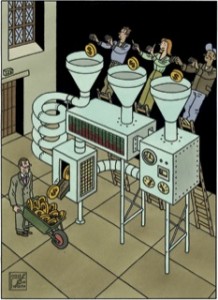
Much of what investment bankers do is socially worthless.
by John Cassidy, New Yorker
NOVEMBER 29, 2010
For years, the most profitable industry in America has been one that doesn’t design, build, or sell a single tangible thing.
. . . . . .
Most people on Wall Street, not surprisingly, believe that they earn their keep, but at least one influential financier vehemently disagrees: Paul Woolley, a seventy-one-year-old Englishman who has set up an institute at the London School of Economics called the Woolley Centre for the Study of Capital Market Dysfunctionality. “Why on earth should finance be the biggest and most highly paid industry when it’s just a utility, like sewage or gas?” Woolley said to me when I met with him in London. “It is like a cancer that is growing to infinite size, until it takes over the entire body.”
. . . . . .
Full Source Online
Perhaps the most shocking thing about recent events was not how rapidly the big Wall Street firms got into trouble but how quickly they returned to profitability and lavished big rewards on themselves. Last year, Goldman Sachs paid more than sixteen billion dollars in compensation, and Morgan Stanley paid out more than fourteen billion dollars. Neither came up with any spectacular new investments or produced anything of tangible value, which leads to the question: When it comes to pay, is there something unique about the financial industry? [Answer: no, they are overpaid but not held accountable.]
. . . . . .
In 1940, a former Wall Street trader named Fred Schwed, Jr., wrote a charming little book titled “Where Are the Customers’ Yachts?,” in which he noted that many members of the public believed that Wall Street was inhabited primarily by “crooks and scoundrels, and very clever ones at that; that they sell for millions what they know is worthless; in short, that they are villains.” It was an extreme view, but public antagonism toward bankers and other financiers kept them in check for forty years. Economic historians refer to a period of “financial repression,” during which regulators and policymakers, reflecting public suspicion of Wall Street, restrained the growth of the banking sector. They placed limits on interest rates, prohibited deposit-taking institutions from issuing securities, and, by preventing financial institutions from merging with one another, kept most of them relatively small. During this period, major financial crises were conspicuously absent, while capital investment, productivity, and wages grew at rates that lifted tens of millions of working Americans into the middle class.
Since the early nineteen-eighties, by contrast, financial blowups have proliferated and living standards have stagnated. Is this coincidence? For a long time, economists and policymakers have accepted the financial industry’s appraisal of its own worth, ignoring the market failures and other pathologies that plague it. Even after all that has happened, there is a tendency in Congress and the White House to defer to Wall Street because what happens there, befuddling as it may be to outsiders, is essential to the country’s prosperity. Finally, dissidents like Paul Woolley are questioning this narrative. “There was a presumption that financial innovation is socially valuable,” Woolley said to me. “The first thing I discovered was that it wasn’t backed by any empirical evidence. There’s almost none.” ♦
Phi Beta Iota: The Republic has lost the art of seeing the Big Picture. The failure of the US infected all other countries. Failed states have risen from 25 or so to over 175, and the USA is now on the verge of becoming a failed state itself.
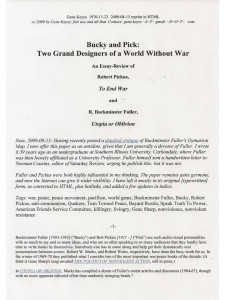
Extract from Conclusion in the Above: I have observed the World Game as a student-participant, and wish it well. I have also observed Bob Pickus's work, as a student-participant in Turn Toward Peace, and wish him well. There are still other alternatives, but whichever road leads us faster into a world without war, what I gain most from Pickus and Fuller is their sense of the Big Picture. No one else can match their indefatigable and comprehensive efforts to see the problem whole, and to steer the world's energy into a grand design of peace.
Insofar as I know, the DoD military Services remain under broad and explicit proscription from accessing the Wikileaks site or the Wikileaks releases in any form. Some of the Service directives are very intimidating, threatening court martials for military members, loss of security clearances, etc., etc. From the broadcast media, it appears that major lockdowns of information will shortly follow. And SPC Bradley Manning, currently confined at Quantico, will probably walk as, I suspect, will Hasan at Fort Hood. MA
Phi Beta Iota: This demonstrates that the National Clandestine Service (NCS) is completely ignorant of what can be known through open sources, and that the Secretary of State is not doing her job of assuring that diplomacy is not micro-tasked into what are clearly clandestine and covert operations support functions absolutely not appropriate to diplomatic status. These people should not have message release authority. The US Government needs a total make-over. First, however, CIA needs a director that is fully capable on day one.
WASHINGTON — The United States has expanded the role of American diplomats in collecting intelligence overseas and at the United Nations, ordering State Department personnel to gather the credit card and frequent-flier numbers, work schedules and other personal information of foreign dignitaries.
Revealed in classified State Department cables, the directives, going back to 2008, appear to blur the traditional boundaries between statesmen and spies.
The cables give a laundry list of instructions for how State Department employees can fulfill the demands of a “National Humint Collection Directive” in specific countries. (“Humint” is spy-world jargon for human intelligence collection.) One cable asks officers overseas to gather information about “office and organizational titles; names, position titles and other information on business cards; numbers of telephones, cellphones, pagers and faxes,” as well as “internet and intranet ‘handles’, internet e-mail addresses, web site identification-URLs; credit card account numbers; frequent-flier account numbers; work schedules, and other relevant biographical information.”
Philip J. Crowley, a State Department spokesman, on Sunday disputed that American diplomats had assumed a new role overseas.
(1) Not sure there's anything new here; (2) not sure the establishment agrees. MA
Phi Beta Iota: If President Obama wishes to change the game, he needs to change his core staff including the Director of the Office of Management and Budget (OPM), appoint the Coalition Cabinet he has been playing kitchen with, and slam Congress with the Electoral Reform Act (1 page, 9 points) in celebration of President's Day in February 2011. Anyone voting no in a roll call vote will be scheduled for a recall initiative in their home state or district. Similarly, if Director Clapper wishes to change the game to something that meets the needs of 100% of his legitimate clients 90% of the time (instead of just meeting the needs of the top tier 4% of the time), he needs to demand the right to appoint a new Director of the Central Intelligence Agency (CIA), someone who is a kick-ass Big Picture thinker with both service across CIA, across the military intelligence functions (rank is a disqualifier) and with outside the wire experiences ideally including direct exposure to 66 countries interested in learning about Open Source Intelligence (OSINT), with M4IS2 deeply embedded as the next big thing “central” to “intelligence,” and a deep commitment to doing the right thing, not doing the wrong thing righter. CIA could be the turning point for the Obama presidency. How CIA goes in the next 180 days could well determine whether there is or is not a second Obama Administration. The chances of anything good happening are under 30%.
This summer, a former spy who calls himself Ishmael Jones got into trouble with his old bosses at the Central Intelligence Agency.
No, the agency didn’t put out a contract on his life or ship him to Guantánamo. Instead, in July, it sued Jones, the author of “The Human Factor: Inside the C.I.A.’s Dysfunctional Intelligence Culture,” accusing him of breaking his secrecy agreement and failing to get the required approval to publish. If the C.I.A. intended to make the book disappear, it failed. When the suit was reported last month, the book — a modest seller when first published in 2008 — shot up the Amazon rankings.
. . . . . .
Such cases [child wanna-bees that self-destruct] are common, Charles Faddis, a case officer for 20 years, argues in “Beyond Repair.” Faddis describes the agency as rife with incompetence at every level and compares its leadership training unfavorably with that of the military. “Sixty years after its founding,” he writes, the agency “has never developed any system for the selection, training and cultivation of leaders.” Even the Sept. 11 attacks did not produce meaningful change. Faddis argues that adding a director of national intelligence to oversee the agency simply imposed another layer of bureaucracy. Of the 4,000 new employees in the director’s office, “not a single one of them runs operations. Not a single one of them recruits assets or produces intelligence. What they do produce, however, is process, lots of it.”
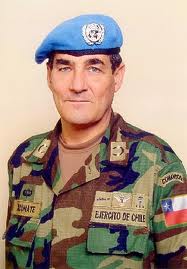
Major General Eduardo Aldunate has served as a Chilean Army officer since 1973. He has been an instructor and commander in mountain infantry units and special forces units and was the Deputy Force Commander of MINUSTAH between September 2005 and September 2006. He heserved as commander of Military Schools for the Chilean Army. He has written books and academic articles on military leadership and strategic and civilian-military relations for civilian and military publications.