Open Source Mobile Tech (SMS) Platforms for Credit, Education, Legal, and Medical

01 Poverty, 03 Economy, 04 Education, 07 Health, 09 Justice, Collective Intelligence, International Aid, Mobile, Technologies

FrontlineSMS is an open-source software that enables two-way text messaging between cheap mobile phones and laptops over cellular (GSM) networks.

FrontlineSMS: Credit
FrontlineSMS:Credit aims to make every formal financial service available to the entrepreneurial poor in 160 characters or less. By meshing the functionality of FrontlineSMS with local mobile payment systems, implementing institutions will be able to provide a full range of customizable services, from savings and credit to insurance and payroll.


FrontlineSMS: Learn (not finished yet)
FrontlineSMS:Learn leverages ubiquitous mobile technology—SMS or “text messaging”—to support and strengthen education and training initiatives and human capacity development and make learning opportunities available anytime and anywhere. Using the application knowledge and higher-order reasoning and decision-making skills can be developed, reinforced and assessed leading to improved transfer of learning, increased knowledge retention, long-term changes in behavior and, ultimately, improvements in service delivery.

FrontlineSMS: Legal (new)
These low-cost systems enable remote coordination between informal dispute resolution workers and the formal legal system, improving service delivery, range, and cost efficiency.

In addition to this core platform, FrontlineSMS:Legal is developing additional plug-ins that will add value to local organizations working to provide legal services. FrontlineSMS:Legal products offer several key functionalities:

Continue reading “Open Source Mobile Tech (SMS) Platforms for Credit, Education, Legal, and Medical”

Journal: Wal-Mart Wants to Screw 1.5 Million Women (Again, This Time in Front of the Supreme Court)

03 Economy, 11 Society, Civil Society, Commerce, Commercial Intelligence

Full Story Online

Wal-Mart Stores Inc. asked the U.S. Supreme Court to block female employees from suing on behalf of as many as 1.5 million women in what would be the largest gender-bias suit against a private employer in U.S. history.

. . . . . . .

The company agreed in 2008 to pay as much as $640 million to settle 63 federal and state class actions claiming the company cheated hourly workers and forced them to work through breaks.

. . . . . .

The case is Wal-Mart Stores v. Dukes.

Tip of the Hat to Monica Nixon at LinkedIn.

WAL-MART–Proud to be the Enron of the Retail Industry.

See Also:

Review: Wal-Mart–The High Cost of Low Price (2005)

Review: An Atlas of Poverty in America–One Nation, Pulling Apart, 1960-2003

Review: Big-Box Swindle–The True Cost of Mega-Retailers and the Fight for America’s Independent Businesses

Review: No Logo–No Space, No Choice, No Jobs (Paperback)

Review: The Global Class War –How America’s Bipartisan Elite Lost Our Future – and What It Will Take to Win it Back (Hardcover)

Review: The Globalization of Poverty and the New World Order (Paperback)

Review: Nobodies–Modern American Slave Labor and the Dark Side of the New Global Economy

Review: Screwed–The Undeclared War Against the Middle Class — And What We Can Do About It

Review: The People’s Business–Controlling Corporations and Restoring Democracy The People’s Business: Controlling Corporations and Restoring Democracy

Review: State of the Unions–How Labor Can Strengthen the Middle Class, Improve Our Economy, and Regain Political Influence

Journal: Contractors Accountable for Toxic Results

03 Economy, 09 Justice, Commerce, Commercial Intelligence, Ethics, Officers Call

Strike Two on “Just Following Orders” Defense

David Isenberg
David Isenberg Author, Shadow Force: Private Security Contractors in Iraq

Posted: September 9, 2010 04:28 PM

To paraphrase Yogi Berra it's déjà vu all over again for KBR.

In my Aug. 31 post I wrote about a significant pro-veteran ruling in the Oregon KBR Qarmat Ali litigation. This is the case where Oregon National Guard troops allege KBR's liability for negligence and for fraud arising out of plaintiffs' exposure to sodium dichromate and resultanthexavalent chromium poisoning while assigned to duty at the Qarmat Ali water plant in 2003.

Paul Papak, the federal district judge rejected the motion by KBR and co-defendants to dismiss the suit for lack of subject-matter jurisdiction and rejected it.

Read Entire Posting at Huffington Post

Journal: ESRI Puts GeoPortals into Open Source

Commercial Intelligence, IO Mapping, IO Sense-Making, Tools

On the move to open source (or some other non-open source license like CC) and which license will be used:

“Reason for making Geoportal open source? Like anyone, Esri responds to trends in the IT industry, we listen to requests from our users to take a more collaborative approach to development, and source code was already part of the Geoportal license: It just made sense to do this now. The choice for creative commons has not been finalized, but is a good model for the approach we’re looking for. We are still reviewing the most optimal license model.”

Read Rest of Update

Phi Beta Iota: If Oracle were to leverage Sun Office and immediately offer the eighteen analytic functionalities defined in Diane Webb's CATALYST, all as open source, that would be a game-changer.  In the meantime, hats off to ESRI for finally getting the picture on F/OSS.

See Also:

Graphic: Analytic Tool-Kit in the Cloud (CATALYST II)

Memorandum: USSOCOM Software List and STRONG ANGEL TOOZL

2001 Porter (US) Tools of the Trade: A Long Way to Go

1988-2009 OSINT-M4IS2 TECHINT Chronology

Worth a Look: 1989 All-Source Fusion Analytic Workstation–The Four Requirements Documents

Journal: General Mike Flynn from AF to DC

08 Wild Cards, Military, Officers Call

U.S. intel chief in Afghanistan leaves post

By Anne Gearan and Kimberly Dozier – The Associated Press
Posted : Thursday Sep 9, 2010 12:11:01 EDT

KABUL, Afghanistan — An Army spokesman says the top U.S. and NATO intelligence officer in Afghanistan is on his way to another job.

Spokesman Col. Thomas Collins did not say what job Maj. Gen. Michael Flynn would take, as the move had not yet been approved by the chairman of the Joint Chiefs of Staff.

But two defense officials say Flynn will become a top troubleshooter for the Director of National Intelligence. The officials spoke Thursday on the condition of anonymity to discuss matters of intelligence.

Flynn is expected to be replaced by Brig. Gen. Stephen Fogarty, the current intelligence officer at the U.S. Central Command in Florida.

See Also:

Reference: Fixing Intel–A Blueprint for Making Intelligence Relevant in Afghanistan

Continue reading “Journal: General Mike Flynn from AF to DC”

Journal: Information Operations Strategy

IO Multinational, IO Sense-Making
Full Article Online

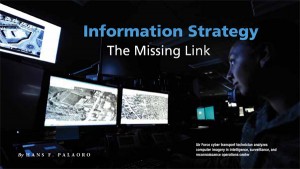
Lieutenant Colonel Hans F. Palaoro, USAF, wrote this essay while a student at the Industrial College of the Armed Forces. It won the Strategy Article category of the 2010 Chairman of the Joint Chiefs of Staff Strategic Essay Competition.

EXTRACT:   While information power is well accepted as one of the four elements of national power, neither the term nor the concept appeared in the 2006 National Security Strategy. It is strangely absent from the “full array of political, economic, diplomatic, and other tools at our disposal” that is the basis of the document.4 Nor does information power appear in the 2008 National Defense Strategy.5 Moreover, although there is no vetted definition of information power, the concept is understood and the link to how the military should exercise it is obvious: information operations. Considerable attention has already been given to the “defensive” side of the information domain.6 What is still lacking is the offense.

The problem with the current IO model is that it fails to orchestrate the tools of information power toward a common goal. One reason is that the legal and bureaucratic limits on who can do certain things have caused an almost irrational phobia against integrated efforts. For example, fear of crosscontamination of public affairs (PA), public diplomacy (PD), and strategic communication with psychological operations (PSYOP) actively opposes effective coordination of these obviously interdependent tools of information strategy.

Tip of the Hat to Dale Mark Benedict at LinkedIn.

Continue reading “Journal: Information Operations Strategy”

Journal: Cognitive Dissonance in Afghanistan Part II

Cultural Intelligence, IO Multinational, IO Sense-Making, Military, Officers Call, Peace Intelligence
Col Lawrence Sellin: Traitor or Truth-Teller?

Fired colonel calls PowerPoint a crutch

Army Times, By Andrew Tilghman – Staff writer
Posted : Thursday Sep 9, 2010 8:29:12 EDT

Army Reserve Col. Lawrence Sellin has no regrets about publishing a rant about the military’s overreliance on PowerPoint presentations — despite the fact it got him fired from his job at joint command headquarters in Afghanistan.

. . . . . . .

Sellin said his controversial article was the last of several efforts to find something meaningful to do at ISAF headquarters.

. . . . . .

Sellin’s screed highlights a long-simmering controversy inside the military bureaucracy.

Marine Gen. James Mattis, currently chief of U.S. Central Command, told a military conference earlier this year that “PowerPoint makes us stupid.”

And Army Brig. Gen. H.R. McMaster banned PowerPoint presentations as a brigade commander during his successful efforts to secure the northern Iraqi city of Tal Afar in 2005.

Sellin said his complaint is not solely about PowerPoint, the presentation software created in 1987.

“I don’t hate PowerPoint. It’s a useful tool,” he said. “But it can be a crutch as a substitute for thinking. It’s too easy to produce a lot of slides and create volume, not quality. You really think that with a lot of detailed slides that you’re making progress, when you are actually not.”

Continue reading “Journal: Cognitive Dissonance in Afghanistan Part II”

noble gold