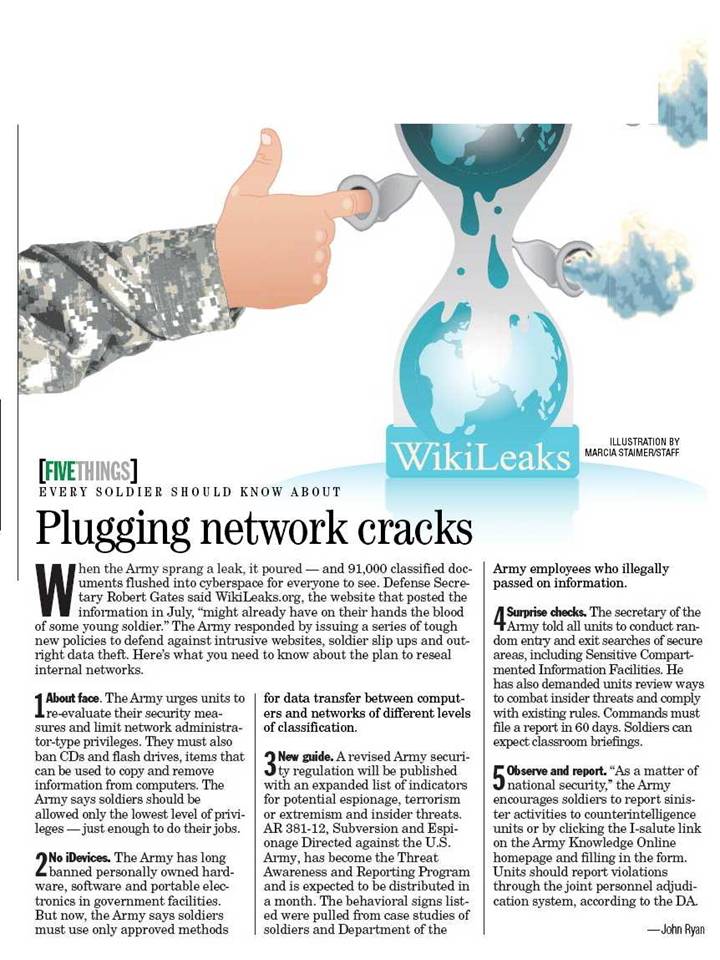
Army Times article, second below, reports what the beginning of what I expect will be a major decline in functionality of Army computer systems. While some sort of institutional response to the alleged Wikileaks traitor, Specialist Bradley Manning, is appropriate, I don't think this is it. This is a simplistic approach, the sort of thing the KGB did and presumably the sort of the SVR continues to do.
By the way, IMHO, 91K classified documents on the Internet is not some sort of an inadvertent security violation. It's almost certainly one of the national security crimes; I think it's treason. Better to concentrate on the perpetrator — try him, convict him, and then, maybe, violate in some significant ways his Constitutional protection against “cruel and unusual punishment” as a highly visible deterrent against espionage.
NOTE: Image links to source generally as persistent link not available.
Below the line: PBI comment and cyber-security recap (34).
CIA rendition: US court throws out torture case, citing state secrets
Appeals court judges sound apologetic tone in ruling; plaintiffs say they were tortured overseas in ‘extraordinary rendition' program.
Under the state secrets doctrine, courts have generally granted deference to executive branch claims that certain litigation may involve highly sensitive US government information which, if disclosed, would cause significant damage to national security.
. . . . . .
In a dissent joined by four other judges, Judge Michael Hawkins said the court was wrong to dismiss the entire lawsuit at such an early stage. He said the case should be remanded to a federal judge to determine to what extent actual evidence in the case might raise a threat of disclosing state secrets.
Hawkins acknowledged that the state secrets doctrine is an established precedent. But he said the privilege need not be so broadly enforced.
“The doctrine is so dangerous as a means of hiding governmental misbehavior under the guise of national security, and so violative of common rights of due process, that courts should confine its application to the narrowest circumstances that still protect the government’s essential secrets,” he wrote.
The majority concluded its opinion with a quasi apology to the plaintiffs. “Our holding today is not intended to foreclose – or to prejudge – possible nonjudicial relief, should it be warranted for any of the plaintiffs,” Judge Fisher said.
Five years ago at IC2 Institute in Austin, we were talking about digital convergence, and those talks spun off an organization called the Digital Convergence Initiative, the idea being to build a local business cluster of convergent companies. We were ahead of our time, and it was hard for many to get their heads around how such a “horizontal” cluster would work. We were onto an effect of convergence that could be pretty interesting: the edges of verticals will blur, and companies that before convergence had nothing in common will find affinities and synergies that create new forms of business.
Phi Beta Iota: We have been beneficiaries of Jon Lebkowsky's good-hearted genius and will start following his blog, which is being added to Righteous Sites today. The ten areas covered by the cited article include Shopping, Relationships, Business Deliveries, Maps, Education, Politics, Society, War, Advertising. The bottom line for the public is that accountability and transparency is virtually inevitable, and we will eventually eradicate corruption including fraud, waste, and abuse. The only question is how soon and will it be soon enough. We think it will. Like Jon, we are optimists.
Here are the last two paragraphs with the links recommended:
Linked data and the future
The examples of data mentioned in this article are innovative, exciting and life changing, but the best is yet to come. The majority of the information that we use in our daily lives is “dumb”, or unconnected. The next step is “linked data”, or data that talks to each other. In the UK, Tim Berners-Lee and the team behind Data.gov.uk are aiming to create a linked database of Government information. By providing all data the Government produces in a linked format, individuals will be able to pull in different sets of data to produce new and innovative ways of understanding how our Government and the world works.
FluidDB, a start-up company run by Terry Jones, and with backing from Tim O'Reilly and Esther Dyson and others, is tackling this field from a different angle. FluidDB wants to create a “writeable world”, where physical objects have virtual identities, which can be updated and called upon by any individual with access to the internet. That could mean tweets and status updates about everything from a brand of toothpaste to the Eiffel Tower could contribute to a collective database. The possibilities for collaboration are endless.
Spelling matters, but in this case, the human in the loop is glad to have a chance to highlight the below reference, which is available for all countries in the world on a case by case basis.
East View Cartographic; East View Arabia, China, Russia Access All is the only stop we make when we need cartographic or terrain products. They are the ones who noticed and then pointed out to the USG that the Russians had mapped all the tunnels but put the text on the reverse side of their combat charts–no one spoke Russian at NGA. We once got an entire border region from them, both sides, 1:50,000, not available from the NGA within a couple of days. They are also the organization that made it possible for the UN Eastern Force Commander to finally get the Dutch to create $3 million in 1:50,000 charts as shown in the below link.
Renewed instability in global food markets requires urgent response, UN expert said
An independent United Nations human rights expert today called on governments and the international community to promptly tackle the renewed instability of global food markets, noting the related social unrest that has hit some countries in recent weeks.
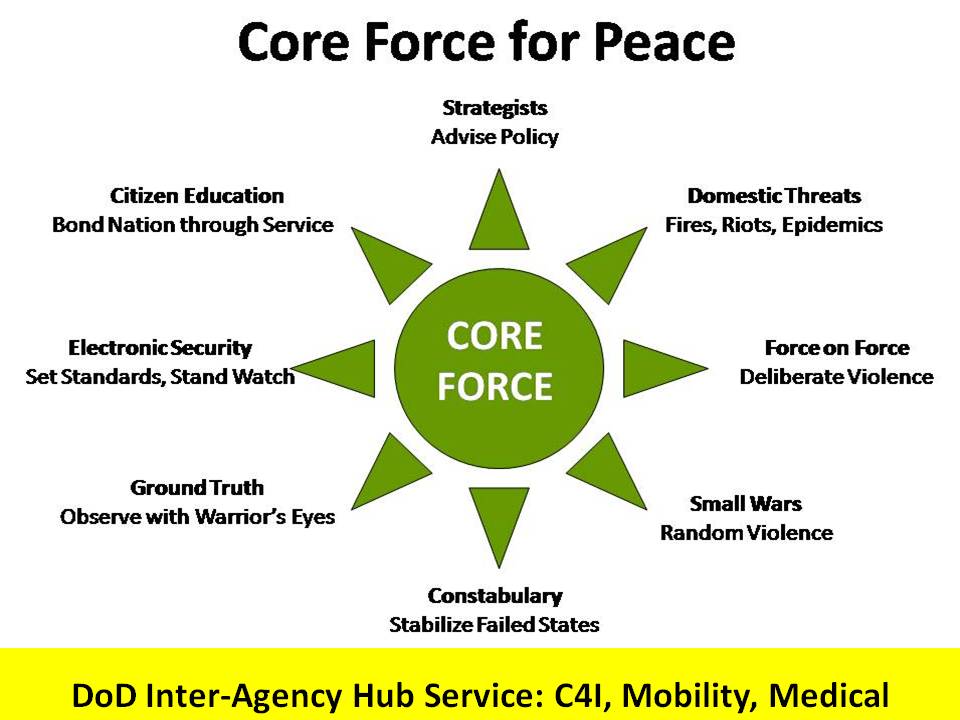
This graphic was created for a lecture to Eastern European Parliamentarians at the George C. Marshall Center in the mid-tolate 1990's. Many understood back then that the Department of Defense (DoD) was the only element of the U.S. Government (USG) capable of serving as a hub or backbone for USG Whole of Government and dynamic or surge inter-agency operations as well as multinational operations other than war (OOTW).
Unfortunately, the military services have managed to avoid, undermine, or ignore leadership from a series of Secretaries of Defense, so today we do not have a Global Information Grid (GIG) nor do we have joint mobility, weapons, or communications systems that are truly inter-operable.
Originally posted online in 2008 when this Blog was first created, we are updating the publication date to make it more easily visible–this will be, we believe, a central graphic for the multinational endeavors of the future.