Journal: 4 countries clear hurdle for non-Latin Web names

Technologies
Full Story Online

NEW YORK (AP) — Egypt, Russia, Saudi Arabia and the United Arab Emirates are the first countries to win preliminary approval for Internet addresses written entirely in their native scripts.

Since their creation in the 1980s, Internet domain names have been limited to the 26 characters in the Latin alphabet used in English, as well as 10 numerals and the hyphen. Technical tricks have been used to allow portions of the Internet address to use other scripts, but until now, the suffix had to use those 37 characters.

An announcement Thursday by the Internet Corporation for Assigned Names and Numbers, known as ICANN, paves the way for an entire domain name to appear in Cyrillic or Arabic by the middle of this year. Applications for strings in other languages are pending.

Journal Haiti: Silly Question–Regional Traffic Management? Strategic Resettlement?

Peace Intelligence
Click to See Full Slide

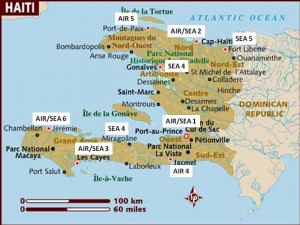
Here are the viable air and sea landing points for Haiti, trying to leave Dominican Republic out of it, they have enough problems.

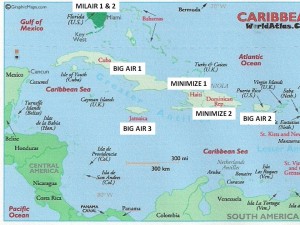
Below are a few “Big Air” triage points, with corresponding seaport triage that can then be migrated to small boats, landing craft, etcetera.

So here is the silly question…has anybody thought to set up a regional traffic management plan that triages big air into little air and big boats into small boats?

Click to See Full Slide

Has anyone set up a bottom-up Range of Needs Table?

Has anyone convened a Haitian Population Resettlement Council that goes straight to moving 400,000 to new zones where free lumber, bricks, cement and so on can be brought in by landing craft?

This would appear to be a huge opportunity to think before acting, and to then execute several strategic moves that lift Haiti out of poverty rather than just covering up the mess in the short term.  Civil Affairs Brigade could really make a difference here, along with STRONG ANGEL  It is very rugged terrain but the ocean is open and people can be moved by landing craft and ambhibious ships.   IOHO.

Continue reading “Journal Haiti: Silly Question–Regional Traffic Management? Strategic Resettlement?”

Journal: Haiti Update 22 January 2010 AM

Peace Intelligence

In Need of Port Repairs, Haiti Relocating 400,000

PORT-AU-PRINCE, Haiti  —  Haitian officials are planning a massive relocation of 400,000 people from makeshift camps to the outskirts of the capital as the U.S. government tackles repairs to the damaged main port — dual efforts to help residents survive the aftermath of the catastrophic earthquake.

The plan to temporarily relocate thousands is aimed at staving off the spread of disease at hundreds of squalid settlements across the city where homeless families have no sanitation and live under tents, tarps or nothing at all.

As aid begins to flow, Haiti considers fate of millions of homeless

Haiti's main port reopens for relief vessels: Haiti's relief pipeline shifted from the air to the sea as the U.S. military opened the island's main port

Phi Beta Iota: The port “re-opening” is so severely over-stated as to call into question the sanity of those implying this to the media (if they did–if not, this should be publicly corrected.  One pier with cracks handling one truck at a time and extremely limited fuel bunkerage is not “open.” ) All of this was known when we posted CAB 21 Peace Jumper Sequence of Events.  The US military appears to be treating this as a casual “one thing at a time” series of decisions instead of doing what we suggested in the first place: get a grip on reality, open two C-130 airfields, do massive airdrops of water, food, plastic, and lumber, and think creatively–for example, roll out every Sea Bee, Red Hat, and Army engineering unit, ramp up the second port on the far end of the island and start moving people in that direction, finish Route 9 the way we promised and then reneged ten years ago, triage all cargo at point of loading (push the information perimeter out and create a needs-driven bottom-up Reverse TIPFID).  And so on.  False reassurances at this point are going to assure a plague-ridden calamity in the next few weeks. From where we sit it is obvious the US Intelligence Community is as useless in Haiti as it has been in Afghanistan.  It's time for DoD to try something new, what we have is not working.  Haiti is an open source information problem.  Haiti is also a Strategic Communications and Multinational Engagement challenge, a rare opportunity to test drive STRONG ANGEL  for real and set the stage for truly multinational Stabilization & Reconstruciton operations on a come as you are basis.

Journal: Haiti Rolling Update

See also:

Review: Catastrophe & Culture–The Anthropology of Disaster

Review: The Upside of Down–Catastrophe, Creativity, and the Renewal of Civilization

Worth a Look: Book Reviews on Leadership for Epoch B

Worth a Look: Book Reviews on Stabilization & Reconstruction

Search: smart nation intelligence reform electoral reform national security reform

Searches

Lovely to see a search like this.  Here are the core references and then a comment and then a number of other references, but the reality is that this entire website is about creating a smart nation, and world brain, and four reforms: electoral, intelligence, governance, and national security.

Afterthought:  all the references from the early 1990's are sad but still relevant.  99% of our “managers” have been repeating the same year's experience each year for the past 20-30 years.  There has been no cumulative learning, no strategic development, and that is why we need the four reforms and a smart nation–all of which is rooted in creating a defense open source intelligence grid that is capable of Multinational Engagement that leverages 90 militaries to create two-way reachback across all eight tribes in all languages all the time.

Smart Nation Core References

Legislation: Smart Nation-Safe Nation Act of 2009

2008: Creating a Smart Nation

2008 World Brain as EarthGame

2008 COLLECTIVE INTELLIGENCE: Creating a Prosperous World at Peace

2008: Creating a Smart Nation

2006 INFORMATION OPERATIONS: All Information, All Languages, All the Time

2006 THE SMART NATION ACT: Public Intelligence in the Public Interest

2006 Forbes Blank Slate On Education

2006 Forbes Blank Slate On Intelligence

2006 Yekelo (ZA) Continental Early Warning & Information Sharing: A Military Perspective on Deterring & Resolving Complex Emergencies

2002 THE NEW CRAFT OF INTELLIGENCE: Personal, Public, & Political

1996: CREATING A SMART NATION: Strategy, Policy, Intelligence & Information

1995 Creating a Smart Nation: Strategy, Policy, Intelligence, & Information

1995 GIQ 13/2 Creating a Smart Nation: Strategy, Policy, Intelligence, and Information

1995 National Information Strategy 101 Presentation to CENDI/COSPO*

1993 Corporate Role in National Competitiveness: Smart People + Good Tools + Information = Profit

1993 From Schoolhouse to White House

1992 AIJ Winter National Security Act of 1992

Journal: Rob Simmons, THE Smart Nation/ Open Source Intelligence Champion on the Hill, Running for U.S. Senate, Challenging Senator Chris Dodd

Memoranda: OSS CEO to DNI One-Pager

Memorandum: $2 Billion Obligation Plan Centered on Defense, for a New Open Source Agency

Memoranda: Creating a New Agency with a New Mission, New Methods, and a New Mind Set

Memoranda: Policy-Budget Outreach Tool

2004 OSS CEO Response to Defense Intelligence Agency (DIA) Call for Data on Open Source Intelligence (OSINT)

2004 Modern History of Public Intelligence and the Opposition

FOUR REFORMS

Memoranda: Four Reforms for Public Consideration

Below the Fold: Intelligence Reform, Electoral Reform, National Security Reform, Governance Reform, Other References on Smart Nation and Four Reforms

Continue reading “Search: smart nation intelligence reform electoral reform national security reform”

Search: the method used by the c.i.a in learning

04 Education, Government, Reform

This is both a very intelligent search and a very funny search.  CIA and the rest of the IC do not have a “method” because they do not do “learning” in the classical sense.  It is virtually all “on the job” training and the culture across the board is one of hubris as in “we know best, if you have time for training–which we consider a vacation–then you must not be essential or having anything urgent to do.”

The National Intelligence University has taken a few baby steps, perhaps moving the US Intelligence Community from the first grade to the fourth grade, absolutely no further.  The legal, security, management, budget, and cultural mind-sets are simply too daunting.

The ONE THING that could be taught early, and is not, because all of the management levels crush it along with creativity and freedom of expression, is INTEGRITY.  The truth at any cost reduces all others costs.  Most managers in most of the secret agencies believe they are the sole arbiters of the truth, the truth must by definition be secret, and anyone who disagrees with them is a traitor, stupid, or a loose-cannon.

Continue reading “Search: the method used by the c.i.a in learning”

Journal: GPS Finally Fully Integrated in Voice Comms

Geospatial, IO Mapping, Mobile, Tools

Full Story Online

Nokia Voice Nav Spells Doom For TomTom, Garmin

Jared Newman, PC World

Jan 21, 2010 4:18 pm

As Nokia takes on Google with turn-by-turn voice navigation on select smartphones, the worst nightmares of GPS device makers are coming true.

Nokia and Google are both using free GPS applications as a lure to their products. That means they're competing, which means those free applications will get better. As that happens, it'll be harder for TomTom, Garmin and Magellan to make their paid software or hardware seem attractive.

Already, Nokia claims to have one-upped Google in the crucial area of pre-loaded maps. While Google Maps Navigation requires a data connection, Ovi Maps uses a combination of pre-loaded and online maps, but can load directions even in a dead zone. When it does need to load information, Nokia says it's more efficient than Google's application, requiring only 200 KB of data over a 12-mile stretch of road compared with 2 MB for an Android phone.

Continue reading “Journal: GPS Finally Fully Integrated in Voice Comms”

Journal: Intelligence & Innovation Support to Strategy, Planning, Programming, Budgeting, & Acquisition

Analysis, Budgets & Funding, Collaboration Zones, Communities of Practice, Ethics, Geospatial, History, InfoOps (IO), Information Operations (IO), Key Players, Methods & Process, Mobile, Policies, Policy, Real Time, Reform, Strategy, Technologies, Threats, Tools, True Cost
Robert David STEELE Vivas

Chuck Spinney is still the best “real” engineer in this town–almost everyone else is staggering after fifty years of government-specification cost-plus engineering.  Also, as Chuck explores in the piece on Complexity to Avoid Accountability is Expensive we in the “requirements” business are as much to blame–Service connivance with complexity has killed acquisition from both a financial inputs and a war-fighting relevance outcome point of view.  The Services have forgotten the basics of requirements definition and multi-mission interoperability and supportability.

The Marine Corps Intelligence Center (MCIC) was created by General Al Gray, USMC (Ret), then Commandant of the Marine Corps, for three reasons:

1.  Intelligence support to constabulary and expeditionary operations from the three major services was abysmal to non-existent.

2.  Intelligence  support to the Service level planners and programmers striving to interact with other Services, the Unified Commands, and the Joint Staff was non-existent–this was the case with respect to policy, acquisition, and operations.  The cluster-feel over Haiti and the total inadequacy of our 24-48 hour response tells us nothing has changed, in part because we still cannot do a “come as you are” joint inter-agency anything.

Continue reading “Journal: Intelligence & Innovation Support to Strategy, Planning, Programming, Budgeting, & Acquisition”

noble gold