SmartPlanet: China’s Global Investment in One Map

02 China, 03 Economy, Commercial Intelligence, Cultural Intelligence

smartplanet logoChina’s massive foreign investment, in one map

By | October 22, 2013, 5:32 AM PDT

Click on Image to Enlarge

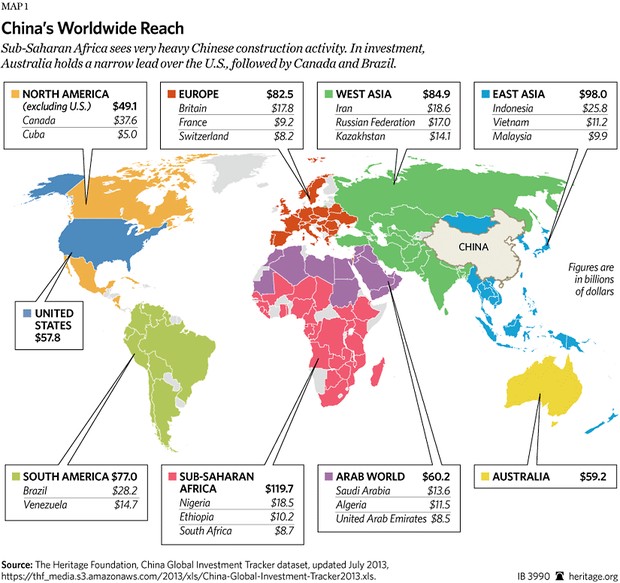
Living in the United States, the scale of foreign investment by Chinese companies isn’t so obvious. Much of the $57.8 billion of Chinese investment in the U.S. since 2005 has been in the finance sector. I didn’t comprehend the scale of the Chinese investment until I visited Ethiopia earlier this month where nearly all the construction projects — including a major light rail line — were being done by Chinese firms (sub-Saharan Africa has the most investment from China of any region). Many huge factories on the outskirts of the capital city are joint projects between China and Ethiopia with the flags of both countries flying side-by-side. The redevelopment of a major road was paid for by Chinese government and is now dubbed “Ethio-China Friendship Avenue.” In other words, the scale of Chinese investment is overtly apparent in Ethiopia and many other countries around the world, if not as obvious in the developed world.

Heritage Foundation provides more insight into China’s massive investment all over the world with a new report showing moderate growth in Chinese investment so far in 2013 and the map above with total investment and contracts won since 2005. There’s also a fascinating interactive map with detailed information on Chinese investment for every country where it has investments over $100 million.

Most people I talked to in Ethiopia about all the Chinese investment had mixed feelings. They were glad for the investment — in just a few years the country will have its first light rail — but there’s also skepticism. What are their ulterior motives? Will all the investment ultimately help Ethiopians in the long run? Why us?

As Quartz points out, even if Chinese companies have nothing to hide there’s good reason to be skeptical. The main reason? A lack of transparency. In a report on 100 multinational corporations in emerging markets, Transparency International, an anti-corruption organization, shows that Chinese multinationals perform poorly. “Results show that companies from China lag behind in every dimension with an overall score of 20 percent (2 out of a maximum of 10),” the report said. “Considering their growing influence in markets around the world, this poor performance is of concern.”

Daring to Hope: Afghanistan 21 Fellows Take Aim at Myriad Issues Facing Their Country

08 Wild Cards
Click on Image to Enlarge

Daring to Hope: Afghanistan 21 Fellows Take Aim at Myriad Issues Facing Their Country

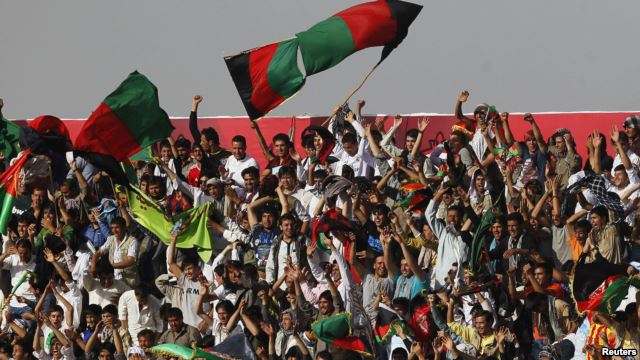
There may be no nation on earth where 2014 looms with as much excitement and trepidation as it does in Afghanistan. This country, torn by strife and poverty for so long, will see two seminal changes in the coming year: The end of the long presidency of Hamid Karzai; and the end of the long presence of international combat forces on its soil. As Afghanistan's foreign minister (and now presidential candidate) Zalmai Rassoul told an Asia Society audience in New York recently, “it will be a critical time and a critical moment for our people.”

It is a “critical moment,” then, for any future leaders of Afghanistan — and a perfect time to welcome the latest group of fellows in Asia Society's landmark program Afghanistan 21. For nearly a decade we have been selecting young leaders from across the Asia Pacific, and from all manner of professional backgrounds, to serve in a broad leadership network known as Asia 21. As the years have passed, and the network has grown into a movement (800-strong now), some fascinating offshoots have sprouted. Afghanistan 21 is one of these — a nascent network of young leaders, in a nation that will need great leadership, no matter what transpires in 2014 and beyond.

This week we announce our choices for the new “Class” for Afghanistan 21. And we think you'll agree — it's a fascinating group. Ten young men and six young women; journalists and business people, diplomats and NGO workers. Oh — and one very celebrated athlete. Together they will gather in Kabul, bringing their rich and diverse backgrounds to the table, and take aim at the myriad issues facing their country.

Continue reading “Daring to Hope: Afghanistan 21 Fellows Take Aim at Myriad Issues Facing Their Country”

Berto Jongman: Russia’s Illegals and “Day X” Behind the Lines General War Plan

04 Inter-State Conflict, 06 Russia, 07 Other Atrocities, 08 Proliferation, Cultural Intelligence, Government, Officers Call, Peace Intelligence
Berto Jongman
Berto Jongman

An inside look into Russia’s Foreign Intelligence Service – mysterious Directorate “S”, Department “12″

EXTRACT:

“The formula Day X in our documents meant the beginning of a large scale war against the west. Our department 12 (together with department 8) was in charge of perpetrating acts of sabotage and terror on the enemy territory…to participate in so called: direct actions, which are clandestine acts of biological sabotage and terrorism against potential strike targets. These included: “Army targets and classified biological warfare ammunition, stockpiles, military garrisons, bases and military (and other) defense commands, like those which surveillance of biological weapons activities. Civil targets included public drinking water systems, food stores and pharmaceutical and biotechnological plants, also the economy.”

Amazon Page
Amazon Page

He concluded by saying: “our tools for these actions included, first and foremost our illegals, whom we had planted in the target country. These were the most reliable, well trusted special agents.”

Read full article.

Continue reading “Berto Jongman: Russia's Illegals and “Day X” Behind the Lines General War Plan”

SchwartzReport: All Dried Up – China Water Crisis

02 China, 12 Water

schwartzreport newAll Dried Up
The Economist (U.K.)

Water is destiny. And here, once again, is evidence of this. China's water and, thus, food problems hold tremendous implications for not just China but the world.

BEIJING — CHINA endures choking smog, mass destruction of habitats and food poisoned with heavy metals. But ask an environmentalist what is the country’s biggest problem, and the answer is always the same. ‘Water is the worst,” says Wang Tao, of the Carnegie-Tsinghua Centre in Beijing, ‘because of its scarcity, and because of its pollution.” ‘Water,” agrees Pan Jiahua, of the Chinese Academy of Social Sciences. ‘People can’t survive in a desert.” Wang Shucheng, a former water minister, once said: ‘To fight for every drop of water or die: that is the challenge facing China.”

He was not exaggerating. A stock image of China is a fisherman and his cormorant on a placid lake. The reality is different. The country uses 600 billion cubic metres (21,200 billion cubic feet) of water a year, or about 400 cubic metres a person-one-quarter of what the average American uses and less than half the international definition of water stress.


Continue reading “SchwartzReport: All Dried Up – China Water Crisis”

NATO ACT CFC: Water Security: Afghanistan Transboundary Water Resources in Regional Context

08 Wild Cards, 12 Water

logo cfcWater Security: Afghanistan Transboundary Water Resources in Regional Context

NATO Allied Command Operations (ACO) Civil-Military Fusion Centre (CFC)

Rainer Gonzalez Palau
Afghanistan Team Leader
Social and Strategic Infrastructure Desk Officer

This document outlines the global trends in water security and the threats to regional stability posed by the transboundary water resources. Moreover, the document presents salient details in the particular case of Afghanistan's transboundary water resources, reviews disputes over the four main international basins Afghanistan shares with its neighbouring countries, and introduces a framework to properly manage water resources. Further information on these issues is available at www.cimicweb.org. Hyperlinks to source material are highlighted in blue and underlined in the text.

Within the next twenty years, the global demand for water will exceed expected supply by forty per cent, according to a report by McKinsey & Company. Since “water security is the gossamer that links together the web of food, energy, climate, economic growth, and human security challenges,” a shortage of water will escalate food prices, disrupt energy availability, limit trade, increase refugee flows and undermine authority, says the World Economic Forum (WEF). If the worsening water security structural problem is unheeded, it will inevitably tear into various parts the global economic system. Illustratively, water was at the heart of the agricultural challenges that caused the unprecedented volatility in food prices between 2007 and 2010. As economies grow and societies develop more water is needed to match the accelerating demand for food and obtain energy to supply the rapidly increasing urban and industrial systems. At the same time rainfall and weather patterns shift and rivers and groundwater sources are becoming more polluted.

This report is divided into four sections: (i) global trends in water security issues and how these can affect global stability in the future; (ii) drivers of transboundary water management conflicts in Central and South Asia; (iii) overview of the four critical international basins that Afghanistan shares with neighbouring countries; and (iv) recommendations by experts for improving water management and avoiding conflict over transboundary water resources.

PDF (15 Pages):  201310_CFC_Afghanistan_Transboundary_Resources_final

Robert Young Pelton: My Refs on Afghanistan

08 Wild Cards
Robert Young Pelton
Robert Young Pelton

The last census taken in Afghanistan was in the 70's. The UN and other humanitarian agencies have done surveys with gaps for “dangerous” areas. The finite answer is that no one knows how many Afghans there are let alone census quality demographic information.

Here is a typical study with the usual disclaimers: http://measuredhs.com/pubs/pdf/FR248/FR248.pdf
Taliban: Once again you hit a sore spot with the U.S. focus on the region. “Anti Government Forces” run the spectrum from foreign jihadis to squabbling political/tribal/ethnic factions.The taliban flow into regions evacuated by the US military and rapidly tax and press gang the population into a cohesive force. When special operations troops are present, their  numbers are reduced. In the south there is a significant support and once again no hard numbers.  We didn't count the Viet Cong in Viet-Nam, and we have failed to count the Taliban in Afghanistan.  The short answer is “enough.”
This is as good as it gets with the same caveats for “dangerous” areas…the places the talibs thrive.

Smart Planet: Fukushima Now a Global Disaster

03 Environmental Degradation, 07 Health, 07 Other Atrocities, 08 Proliferation, 08 Wild Cards, 11 Society, Earth Intelligence

smartplanet logoFukushima nuclear disaster now global environmental problem

The Japanese government has asked for help — but is the plea two years too late?

Despite previous assurances, the Fukushima nuclear power plant disaster continues to contaminate the world’s oceans — and the Japanese government is finally asking for international help.

The March 2011 power plant meltdown was the worst nuclear disaster since Chernobyl, and after frequent attempts to stem contamination — including the use of ice rings and the construction of a second processing plant to filter radioactive particles from contaminated water — the Japanese government has finally asked for global aid to stem radioactive leaks entering the Pacific Ocean, which is endangering the world’s food supply and ecosystems.

At a conference on Sunday, Prime Minister Shinzo Abe said:

“We are wide open to receive the most advanced knowledge from overseas to contain the problem. My country needs your knowledge and expertise.”

Despite Abe’s comments to the International Olympic Committee last month that the leaks were “under control,” untold thousands of tons of radioactive liquid have entered the world’s oceans, with plant operator Tokyo Electric Power Co. (TEPCO) reporting a new leak this week caused by human error, and a spill of 80,000 gallons in August.

Via: IBM Times

noble gold