“Very leery” of going to a developing country like India or Thailand, which both draw so-called medical tourists, he ultimately chose to have his hip replaced in 2007 at a private hospital outside Brussels for $13,660. That price included not only a hip joint, made by Warsaw-based Zimmer Holdings, but also all doctors’ fees, operating room charges, crutches, medicine, a hospital room for five days, a week in rehab and a round-trip ticket from America.
The more one shares, the more one undermines a future patent application and a system that encourages privatization [profit for the few, suffering for the many]
Charles Davis
Al Jazeera, 3 August 2013
EXTRACT:
Signed into law by President Bill Clinton, the Economic Espionage Act of 1995 makes it a federal offence punishable by up to 15 years in prison for someone to “knowingly” deliver a “trade secret” into the hands of a foreign government or institution. As written, that means even if someone had the most honest of intentions – hey, maybe people outside of America get cancer too – they would still be considered a spy for letting a scientific secret cross a body of water. If that secret is ever disclosed, it will be disclosed on corporate America's terms. And it will make someone a lot of money.
Consider the case of Hua Jun Zhao. A researcher at Wisconsin Medical College, Zhao was recently accused of stealing several vials of a potentially cancer-fighting compound he was working on with the intent of passing it on to a university in China, allegedly as his own work. If true, Zhao certainly committed a crime – theft – and perhaps intended to commit academic fraud. But when the FBI came knocking, the $8,000 in missing goods was treated as espionage. Zhao, according to the bureau, was a spy.
In a press release, the FBI alleged that the Chinese native used his position to “illegally acquire patented cancer research material and to have taken steps to provide that material to Zhejiang University in China”. Among the goals served by his arrest, the bureau stated, was protecting America's “competitiveness in an age of globalisation”. By law, the espionage case had to first be approved by a top official at the Justice Department.
How to turn the US-Mexican border into a war zone [profitable for the few]
Todd Miller
al Jazeera, 3 August 2013
The first thing I did at the Border Security Expo in Phoenix this March was climb the brown “explosion-resistant” tower, 10 metres high and 3 metres wide, directly in the centre of the spacious room that holds this annual trade show. From a platform where, assumedly, a border guard would stand, you could take in the constellation of small booths offering the surveillance industry's finest products, including a staggering multitude of ways to monitor, chase, capture, or even kill people, thanks to modernistic arrays of cameras and sensors, up-armored jeeps, the latest in guns, and even surveillance balloons.
Although at the time, headlines in the Southwest emphasised potential cuts to future border-security budgets thanks to Congress's “sequester”, the vast Phoenix Convention Center hall – where the defence and security industries strut their stuff for law enforcement and the Department of Homeland Security (DHS) – told quite a different story. Clearly, the expanding global industry of border security wasn't about to go anywhere. It was as if the milling crowds of business people, government officials, and Border Patrol agents sensed that they were about to be truly in the money thanks to “immigration reform”, no matter what version of it did or didn't pass Congress. And it looks like they were absolutely right.
All around me in that tower were poster-sized fiery photos demonstrating ways it could help thwart massive attacks and fireball-style explosions. A border like the one just over 161 kilometres away between the United States and Mexico, it seemed to say, was not so much a place that divided people in situations of unprecedented global inequality, but a site of constant war-like danger.
Below me were booths as far as the eye could see surrounded by Disneyesque fake desert shrubbery, barbed wire, sand bags, and desert camouflage. Throw in the products on display and you could almost believe that you were wandering through a militarised border zone with a Hollywood flair.
To an awed potential customer, a salesman in a suit and tie demonstrated a mini-drone that fits in your hand like a Frisbee. It seemed to catch the technological fetishism that makes Expo the extravaganza it is. Later I asked him what such a drone would be used for. “To see what's over the next hill,” he replied.
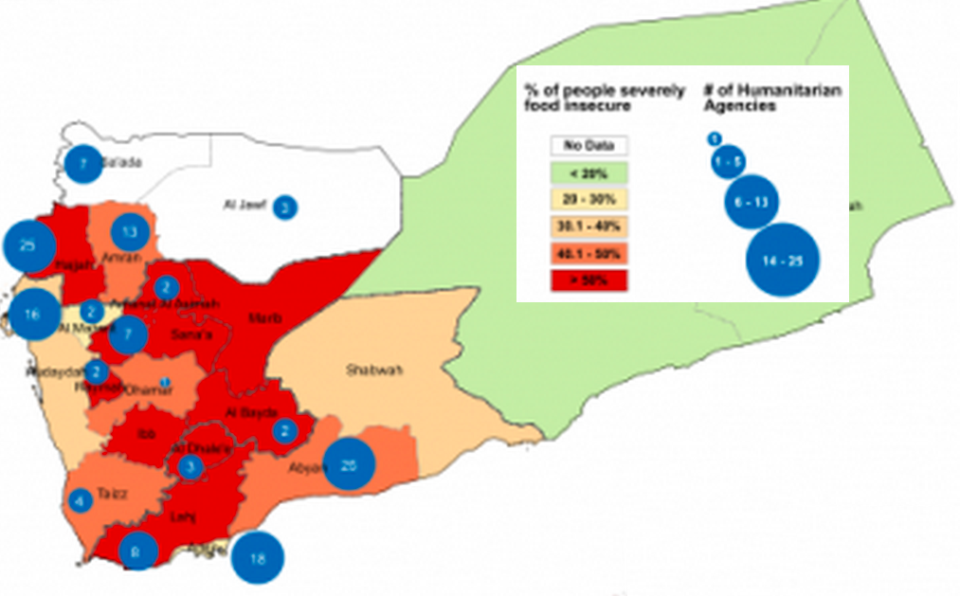
40% of Yemen’s water is used to cultivate qat, which is labeled as a narcotic, but it’s effect is similar to that of milder amphetamines. Fully 75% of all Yemeni men use this drug, which is both legal in the eyes of the government and accepted under the laws of Islam. The drug is commonly used there, as well as in Djibouti, Eritrea, Ethiopia, and Somalia.
One of my most popular columns was about escaping from the Matrix existence in which Americans live. It is a world of disinformation and misinformation in which facts are fiction, and abstract theories are substituted for empirical reality.
Official government statistics are make-believe. The government makes inflation and unemployment disappear by how it defines inflation and unemployment, and it makes the economy grow by how it defines Gross Domestic Product. The definitional basis determines the statistical result.
. . . . . . .
The lack of reality in America is extreme. I do not believe anything like it has ever existed in the modern world. Essentially, no one in government or out understands anything.
The combination of the power of vested interests with ideological thinking remote from empirical reality is destroying the US economy and the economic prospects of the American people.
It is painfully self-evident that our financial system doesn't just enable theft, it is theft by nature and design. If you doubt this, please follow along.Inflation is theft, but we accept inflation because we've been persuaded it benefits us. Here's the basic story: our financial system creates new credit money (i.e. debt) in quantities that are only limited by the appetites of borrowers and the value of assets they buy with freshly borrowed money.