Chuck Spinney: Break Syria, Mali, Niger? Do We Really Want to Keep Making a Costly Mess?

02 Diplomacy, 09 Justice, 10 Security, 11 Society
Chuck Spinney

NOVEMBER 12, 2012

An Era of Conflicts

The New Political Map of the Middle East

by PATRICK COCKBURN, Counterpunch

http://www.counterpunch.org/2012/11/12/the-new-political-map-of-the-middle-east/

President Obama is lucky in his opponents, particularly when it comes to explaining why America’s influence is waning in the Middle East. The issue was hardly mentioned in the election, aside from a botched attempt by Mitt Romney to blame the administration for the death of Chris Stevens, the US ambassador to Libya, and for the burning of the US consulate in Benghazi.

Romney soon steered away from his initial posture of attacking Obama for “apologising for America” and failing to assert US power. He recognised that the one thing the US electorate does not want is another war in the Middle East. By beating the patriotic drum too hard, Romney risked voters remembering that it was the Republicans who, not so long ago, led them into failed wars in Iraq and Afghanistan. On a more prosaic level, Romney may have sensed he would be vulnerable on topics he knew nothing about.

This near immunity from effective criticism during the campaign does not mean that Obama is not facing dangers across the region with which he has previously failed to grapple successfully.

Afghanistan is a good example. The “surge”, which preoccupied the White House when Obama first took office in 2009, led to an extra 33,000 soldiers being sent to Afghanistan, where they wholly failed to eliminate the Taliban. The remaining 112,000 Nato troops will be withdrawn by the end of 2014, bringing to an end one of the more disastrously unproductive wars in American history. The US and its allies are supposedly training up Afghan security forces to take their place, but so many American and British soldiers have been killed by Afghan soldiers and police that the transition is turning into a debacle.

Continue reading “Chuck Spinney: Break Syria, Mali, Niger? Do We Really Want to Keep Making a Costly Mess?”

Marcus Aurelius: New Information on Benghazi Consulate Attack — Multiple Military Rescue Forces Told to Stand Down

04 Inter-State Conflict, 05 Civil War, 07 Other Atrocities, 10 Security, Corruption, Director of National Intelligence et al (IC), DoD, Government, Ineptitude, Military
Marcus Aurelius

New intel on the Benghazi Consulate attack

by

SOFREP, October 26, 2012

EXTRACT:

At that point, they called again for military support and help because they were taking fire at the CIA safe house, or annex. The request was denied. There were no communications problems at the annex, according those present at the compound. The team was in constant radio contact with their headquarters. In fact, at least one member of the team was on the roof of the annex manning a heavy machine gun when mortars were fired at the CIA compound. The security officer had a laser on the target that was firing and repeatedly requested back-up support from a Spectre gunship, which is commonly used by U.S. Special Operations forces to provide support to Special Operations teams on the ground involved in intense firefights. The fighting at the CIA annex went on for more than four hours — enough time for any planes based in Sigonella Air base, just 480 miles away, to arrive. Fox News has also learned that two separate Tier One Special operations forces were told to wait, among them Delta Force operators. 

Read full article.

Continue reading “Marcus Aurelius: New Information on Benghazi Consulate Attack — Multiple Military Rescue Forces Told to Stand Down”

Steve Aftergood: Defense Office of Hearings and Appeals Deepens Its Lack of Integrity – “Negative Reciprocity” Means Unsigned Unsworn Summary Statements from CIA — Itself Notorious –Can Kill a Contractor’s Career – UPDATED

07 Other Atrocities, 09 Justice, 10 Security, 11 Society, Corruption, Director of National Intelligence et al (IC), DoD, Idiocy, Ineptitude, Military, Officers Call
Steven Aftergood

“NEGATIVE RECIPROCITY” EMERGES IN THE SECURITY CLEARANCE SYSTEM

In the world of security clearances for access to classified information, the term “reciprocity” is used to indicate that one executive branch agency should ordinarily recognize and accept a security clearance that has been granted by another executive branch agency.

This is not just a nice, cost-efficient thing to do, it is actually a requirement of law.  Under the 2004 intelligence reform law, “all security clearance background investigations and determinations… shall be accepted by all agencies.”

This requirement for mutual recognition and acceptance applies equally to the higher order clearances of the intelligence community, where reciprocity is intended to promote employee “mobility” throughout the intelligence system, according to the 2009 Intelligence Community Directive 709.

So possessing a clearance from one agency should simplify the process of access approval at another agency.  But the opposite is not supposed to be true.  If an agency refuses for some reason to recognize the clearance granted by another agency, that refusal is not supposed to incur loss of clearance in the original agency.

Officially, such “negative reciprocity” is not an authorized, legitimate security clearance practice.  And yet there are signs that it is being adopted within the Department of Defense Office of Hearings and Appeals (DOHA), which rules on contested security clearance cases.

A new paper by attorney Sheldon I. Cohen describes a series of DOHA rulings in which a perverse form of negative reciprocity has been used to justify the denial or revocation of a security clearance, to the obvious detriment of due process.

“While the burden of proof has always been placed on the employee by the DOHA Appeal Board to show why he or she should be granted a security clearance, until now there was a modicum of a right to confrontation, and a right to challenge the evidence presented by the government,” Mr. Cohen wrote.

But in a ruling he describes, “anonymous redacted reports and other agency's decision are enough to deny or revoke a DoD clearance regardless of contrary evidence.”

Continue reading “Steve Aftergood: Defense Office of Hearings and Appeals Deepens Its Lack of Integrity – “Negative Reciprocity” Means Unsigned Unsworn Summary Statements from CIA — Itself Notorious –Can Kill a Contractor's Career – UPDATED”

David Isenberg: Heavy Metal in Iraq = 50% or More Babies with Congenital Birth Defects – Mercury, Lead, and Depleted Uranium

04 Inter-State Conflict, 07 Health, 07 Other Atrocities, 08 Wild Cards, 10 Security, 11 Society, DoD, IO Deeds of War, Military
David Isenberg

Heavy Metal in Iraq

By David Isenberg, Oct. 22, 2012

Every war is hell, particularly for civilians. And while every war produces deadly familiar impacts on the civilian population whether it is death and injuries due to combat or subsequent illness and death due to destruction of infrastructure sometimes the impact can be unique.

Sadly, such seems to be the case in Iraq which links the past war there with a “staggering” increase in birth defects in areas of the country where bombing and heavy fighting occurred.

A recent study, titled “Metal Contamination and the Epidemic of Congenital Birth Defects in Iraqi Cities” was underwritten by the Department of Obstetrics and Gynecology at the University of Michigan and which was published in the Bulletin of Environmental Contamination and Toxicology, focused on the cities of Basra and Fallujah, where serious fighting occurred during the war.  According to the study:

Continue reading “David Isenberg: Heavy Metal in Iraq = 50% or More Babies with Congenital Birth Defects – Mercury, Lead, and Depleted Uranium”

Leah Lynn Plante: Our Tunesian Fruit Seller?

05 Civil War, 07 Other Atrocities, 09 Justice, 10 Security, 11 Society, Corruption, Government, Idiocy, Ineptitude, Law Enforcement
Leash Lynn Plante

Political Prisoner Leah Lynn Plante Released!

Last week Leah Lynn Plante was arrested and placed in solitary confinement for remaining silent during a grand jury trial. Due to the secrecy of the proceedings, little information has come to light about her or her two friends, Katherine “Kteeo” Olejnik and Matthew Kyle Duran since the story went viral last week.

However, word was just sent out from Leah's supporters that she had been released, although unfortunately her two friends still remain behind bars.

Continue reading “Leah Lynn Plante: Our Tunesian Fruit Seller?”

Mini-Me: CIA Station Chief – Drone War Creating More Enemies Than We Destroy

07 Other Atrocities, 08 Wild Cards, 09 Justice, 10 Security, 11 Society, Corruption, Government, IO Deeds of War, Peace Intelligence
Who? Mini-Me?

Huh?

Drone War Creating More Enemies Than it Destroys

New American, 20 October 2012

EXTRACT:

Reuters explains that “Western diplomats in Sanaa say al Qaeda is a threat to Yemen and the rest of the world.” An argument can be made that a bigger threat to the world is the United States’ daily drone attacks that destroy our own dedication to the rule of law and serve as effective recruiting tool for those seeking revenge for the killing.

The former CIA Pakistan station chief agrees. Speaking of the rapid expansion of the drone war in Yemen, Robert Grenier told the Guardian (U.K.):

That brings you to a place where young men, who are typically armed, are in the same area and may hold these militants in a certain form of high regard. If you strike them indiscriminately you are running the risk of creating a terrific amount of popular anger. They have tribes and clans and large families. Now all of a sudden you have a big problem…. I am very concerned about the creation of a larger terrorist safe haven in Yemen.

And:

We have gone a long way down the road of creating a situation where we are creating more enemies than we are removing from the battlefield. We are already there with regards to Pakistan and Afghanistan.

Read full article with many links.

Continue reading “Mini-Me: CIA Station Chief – Drone War Creating More Enemies Than We Destroy”

Berto Jongman: Food Security Index & Map 2013

01 Agriculture, 03 Economy, 05 Energy, 06 Family, 07 Health, 09 Justice, 10 Security, 11 Society, 12 Water, Earth Intelligence
Berto Jongman

Food security in 75% of African countries at high or extreme risk – Maplecroft global index

‘Arab Awakening' countries at increased risk from 2013 food price shocks

10/10/2012

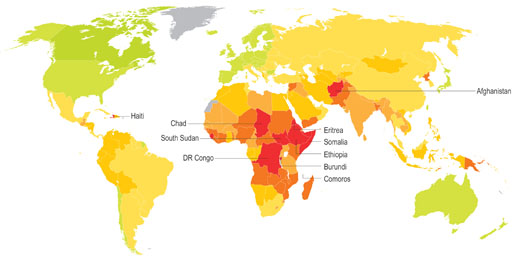
Despite strong economic growth, food security remains an issue of primary importance for Africa, according to a new study by risk analysis company Maplecroft, which classifies 75% of the continent’s countries at ‘high’ or ‘extreme risk.’

Click on Image to Enlarge

In the light of recent food price spikes, the findings are especially significant for areas of sub-Saharan Africa where poverty, armed conflict, civil unrest, drought, displacement and poor governance can combine to create conditions where a food crisis may take hold.

Africa accounts for 39 of the 59 most at risk countries in Maplecroft’s Food Security Risk Index and hosts nine of the eleven countries in the ‘extreme risk’ category. These include: Somalia and DR Congo (ranked joint 1st in the index), Burundi (4), Chad (5), Ethiopia (6), Eritrea (7), South Sudan (9), Comoros (10) and Sierra Leone (11). The countries of Haiti (3) and Afghanistan (8) complete the category.

Read full article.