The U.S. intervention in Libya’s civil war, intervention that began with a surplus of confusion about capabilities and a shortage of candor about objectives, is now taking a toll on the rule of law. In a bipartisan cascade of hypocrisies, a liberal president, with the collaborative silence of most congressional conservatives, is traducing the War Powers Resolution.
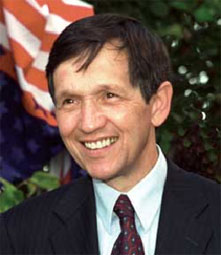
President Obama could be impeached for violating U.S. Constitution and law by going into Libya without congressional consent, but Rep. Dennis Kucinich says he doesn't want to cause that kind of havoc on the Republic, he just wants the United States to get out of Libya's civil war. While many lawmakers in general support the U.S. role in Libya, even if they want the final say on approving military action, Kucinich, D-Ohio, will introduce a joint resolution when Congress returns this week that he says “hopefully will lead us out of this mess that we've waded into in Libya.”
. . . . . . .
Kucinich said the U.S. has no business intervening in Libya because it's a civil war. He added that the rebel forces the U.S. and NATO appear to be backing are demonstrating some disturbing behaviors, including “committing some of the same practices that they accused Colonel Qaddafi of.” Beyond that, he added, the whole operation stinks of a bid for the oil fields of Benghazi, where the rebels have set up their stronghold.
Military action passes 60-day threshold, but Obama won't seek congressional approval
The White House is skipping a legal deadline to seek congressional authorization of the military action in Libya — but few on the Hill are objecting.
Under the War Powers Resolution of 1973 a president can only send troops into combat for 60 days without congressional mandate. That deadline fell Friday, but in absence of pressure from Congress, White House officials say they think they're on solid ground continuing U.S. involvement in the mission, now led by NATO, without formal congressional sign-off — as long as consultations with Congress continue.
In that spirit President Barack Obama sent a letter to congressional leaders Friday saying U.S. involvement remains critical and welcoming congressional input.
Phi Beta Iota: Unconstitutional, illegal, immoral — business as usual.
Second, the plaintiff. Fiona Havlish. She was also the lead in the 2002 filing against Bin Laden et al, but in that case the current lawyer was second on a long list of firms that participated. She was a prime force behind a class action lawsuit seeking $100 billion in compensation. Her husband died in the South Tower, not in Pennsylvania. The timing of this, post Bin Laden Show, is suspect.
Third, the defectors. Three of them A proper investigation will surely find that they have been in close consultation with the Iranian Liberation nut-jobs that are being encouraged by State, DoD, and CIA to play with public perceptions. There is no way these three can withstand scrutiny, and we hope that Iran chooses to confront these almost certain lies in some public manner. Remember Chalabi & CURVEBALL?
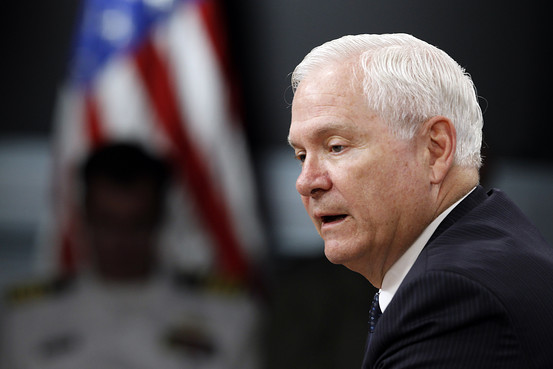
I think the best description of Robert Gates is that he is a very smart bureaucrat who exemplifies the concept of go along to get along. He demonstrated this admirably in his farewell ‘warning’ as reported in the Wall Street Journal. This was a “guns or butter” speech designed to reassure the defense industrial complex that the safety of the U.S. will depend on the continued acquisition of pointless complex and expensive weapons systems.
Rather interestingly in this speech Gates ignored two pieces of information that might have caused him to reconsider his advocacy of super weapons systems.
America can be a superpower or a welfare state, but not both.
Phi Beta Iota Sidenote: BOTH of the above “choices” are corruption incarnate. The correct choice was articulated by Thomas Jefferson: “A Nation's best defense is an educated citizenry.”
EXTRACT:
In a series of farewell speeches, Mr. Gates has warned against cuts to weapon programs and troop levels that would make America vulnerable in “a complex and unpredictable security environment,” as he said Sunday at Notre Dame. On Tuesday at the American Enterprise Institute, Mr. Gates noted that the U.S. went on “a procurement holiday” in the 1990s, when the Clinton Administration decided to cash in the Cold War peace dividend. The past decade showed that history (and war) didn't end in 1989.
Robert Steele Sends. This is personal. In1995, Gates was one of four Americans invited to address the French national conference on “Waging War and Peace in the 21st Century.” He followed me on the schedule, and on hearing my presentation, sashayed up to the stage, sniffed dismissively, and said “I'm not even going to touch that.” As we now know, I nailed it in 1989 for General Al Gray, in 1992 for the Whole Earth Review, again in 1995 for all in France (and separately in USA for COSPO under Joe Markowitz and for US Government as a Whole), and again in 2000 for NATO. And onward to the UN and various multinational audiences who lack a single nation ready to play a leadership role in the M4IS2 arena. Robert Gates was arrogant then, he is ignorant now….and he does “do maintenance,” that is all he has done as a placeholder at Defense. Gate's farewell comments are crap, pure and simple. He has overseen the waste of America's blood, treasure, and spirit with abject amorality that Dick Cheney would be proud of. He has failed to demand what Senator Sam Nunn (D-GA) called for–a strategy, a force structure (the four forces after next) suited to the 21st Century, and an acquisition system with integrity.
Robert M. Gates is one of those people the Beltway Consensus refers to as a “serious adult”: not overtly partisan, measured in his pronouncements, possessed of actual knowledge about the job he has been charged to do. The adulation he has received is certainly understandable if we grade on a curve; his predecessor, Donald Rumsfeld, established an Olympic record for petty vanity, nasty abrasiveness, and disastrous professional judgment. Such a collective sigh of relief greeted Rumsfeld's departure that his successor was bound to shine in comparison.
But what of Gates's record on his own merits? He is given to making such comments as, “In my opinion, any future defense secretary who advises the President to again send a big American land army into Asia or into the Middle East or Africa should ‘have his head examined,' as General MacArthur so delicately put it.” A normal person would infer that he is opposed to the types of military intervention that have contributed significantly to a near-bankruptcy of the country. Yet in practice he has taken concrete measures to protract the very problem he professes to deplore.