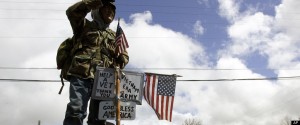
I wonder if people who insist upon using the i-word ever think about the impact it has on human lives. “What part of ‘illegal' don't you understand?!” they say. Well, as an undocumented immigrant, I need people to understand the traumatic effect this racist language has on us and our families. Many people who don't experience this reality don't seem to realize the inescapable feelings of inferiority it creates. Or that we can get to a transparent, thorough dialogue on human rights and humane immigration solutions only when we remove the i-word as a central piece of the conversation.
COMMENT by Robert David Steele Vivas as Posted at Huffington Post
I like this, a great deal. Am cross-posting it to Phi Beta Iota the Public Intelligence Blog.
I strongly agree that allowing corporations to abuse the environment, communities, and their employees with the added protection of “personality” is a travesty, and one that my Virtual Cabinet has already addressed here at Huffington Post.
The URL for the Virtual Cabinet is: http://www.huffingtonpost.com/robert-david-steele
With respect to how the USA has treated immigrants over the centuries, I am now ready to say that this abusive exploitation, of Chinese, of Irish, of others, combined with our genociding of the Native Americans and our enslavement of Black Africans, needs to be defined and treated as “Other Atrocities,” one of the high-level threats to humanity identified by the United Nations High-Level Panel on Threats, Challenge, and Change.
My review of their report is here: http://phibetaiota.net/2008/05/a-more-secure-world-our-shared-responsibility-report-of-the-secretary-generals-high-level-panel-on-threats-challenges-and-change-a-more-secure-world-our-shared-responsibility-report-of-the-s/
However, what really touches me about this note [disclosure: I am a white Hispanic] is the author's clear angst over the racism that he has felt, and his very articulate call for a dialog and understanding. This is where I think we need to go, and I will address this with the Virtual Cabinet in the weeks to come.
WASHINGTON — Three weeks before a Jordanian double agent set off a bomb at a remote Central Intelligence Agency base in eastern Afghanistan last December, a C.I.A. officer in Jordan received warnings that the man might be working for Al Qaeda, according to an investigation into the deadly attack.
But the C.I.A. officer did not tell his bosses of the suspicions — brought to the Americans by a Jordanian intelligence officer — that the man might try to lure Americans into a trap, according to the recently completed investigation by the agency.
The internal investigation documents a litany of breakdowns leading up to the attack at the Khost base that killed seven C.I.A. employees, the deadliest day for the spy agency since the 1983 bombing of the American Embassy in Beirut. Besides the failure to pass on warnings about the bomber, Humam Khalil Abu-Mulal al-Balawi, the C.I.A. investigation chronicled major security lapses at the base in Afghanistan, a lack of war zone experience among the agency’s personnel at the base, insufficient vetting of the Jordanian, and a murky chain of command with different branches of the intelligence agency competing for control over the operation.
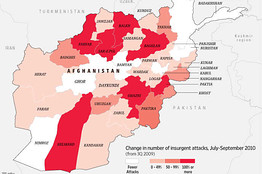
PUL-E-KHUMRI, Afghanistan—The Taliban's influence in northern Afghanistan has expanded in recent months from a few hotspots to much of the region, as insurgents respond to the U.S.-led coalition's surge in the south by seizing new ground in areas once considered secure.
Taliban militants stop traffic nightly at checkpoints on the road from Kabul to Uzbekistan, just outside Baghlan province's capital city of Pul-e-Khumri, frequently blowing up fuel convoys and seizing travelers who work with the government or the international community.
Deja Vu Back Centuries
In many areas here and the rest of the north, the Taliban have effectively supplanted the official authorities, running local administrations and courts, and conscripting recruits.
– – – – – – –
The Taliban have consolidated their war gains by tapping into broad disillusionment with the incompetence and venality of Afghan government officials.
“People don't love the Taliban—but if they compare them to the government, they see the Taliban as the lesser evil,” said Baghlan Gov. Munshi Abdul Majid, an appointee of President Hamid Karzai.
Phi Beta Iota: Based on what we now know about Viet-Nam, we predict that the military-industrial complex will declare victory in November 2012, and inform the new President that the US military has been entirely “used up” in Afghanistan and Iraq, and therefore we need to increase the Pentagon budget to rebuy the military from scratch.
UPDATE of 19 Oct to resurface the CORE COMMON ISSUE and add THIRD PARTY book reviews (immediately below the line). The legislative proposal still needs work, e.g. ballot access not well covered, but this is the starting point. It was created by Jim Turner and Robert Steele based in large part on points made by Ralph Nader is his book Crashing the Party–Taking on the Corporate Government in an Age of Surrender. We cannot understand why Ralph Nader, Ron Paul, Cynthia McKinney, and Jackie Salit–and Mike Bloomberg–don't get serious about this ONE THING they can all agree on….
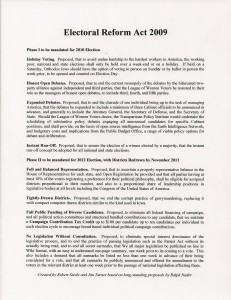
Click on either of the images to see a collection of documents on Democracy in America as it could be, should be, must be. The Republic has been destroyed by a combination of domestic enemies and a public slow to realize that it was being disenfranchized.
Click on the page below to read the single page summary of eight simple reforms, most conceived by Ralph Nader, as refined by Jim Turner (Nader #2 for many years) and Robert Steele.
Electoral Reform Act of 2009
Only recently have major financial figures such as John Bogle and Peter Peterson come forward with works that call into question the integrity, santiy, and viability of the Republic as it is now being looted by Wall Street and the two-party tyranny. Below are several titles worthy of study, with links to the summary reviews of those titles by Robert Steele. Below them are twice as many titles capturing the spirit of the Republic that has been in re-gestation for decades. The mood of Middle America is clear: we want our Republic back, and we want both government and commerce to be open, honest, and in the public service. We are going to get what we want by 2012, peacefully, on the strength of our numbers and our common collective intelligence.
Use the Reviews menu to rapidly survey over 1,400 non-fiction books all focused on the future of the Republic and the Earth in the context of restoring the faith of humanity in itself. Each review leads back to both the Amazon page, and to the original review on Amazon should you wish to vote on the review.
On Sunday, 60 Minutes reported on a visit to San Diego, where a yearly “Stand Down” event for homeless veterans is designed to change lives in just three days.
A skeptical Scott Pelley found that while the event's clean, safe and empathetic environment can't fix the problems homeless veterans face, the event serves as a “ceasefire” to show vets that they aren't alone.
Phi Beta Iota: There are two threads here, the first being that attention is healing and nurturing, whether it is new-borne babies or hardened vets. The second is that this is a complete break from treating homeless vets or homeless anyone as “the other” that is not “noticed” as if they did not exist. San Diego has done a good thing with this annual event, it ought to take place all across America.
How are we going to reduce Vermont’s carbon footprint and at the same time protect Vermont’s agricultural heritage and family farms, create local jobs, and stimulate small business formation? Is utility-scale wind part of the solution? I would suggest the answer is no.
For a number of reasons, utility-scale turbines are not the best and most appropriate tool to reduce Vermont’s carbon footprint; while they may be effective in other states, they are a misfit for our landscape. First of all, it’s a tiny drop in a big bucket. Electrical generation in Vermont contributes less than 1 percent of Vermont’s carbon foot print; heating with fuel oil and burning transportation fuels account for the overwhelming percentage. It would be far more effective, for instance, to increase dramatically the number of homes that heat with safe, clean, automatic biomass heat, using pellets of wood or grass grown and pelleted in Vermont.
Second, even if we wanted to focus on reducing our carbon footprint for electricity, we should look to a resource far more abundant in Vermont than wind: sun. Vermont’s wind resources are estimated to be about 1/620 of its solar resources. It would take less than 7,000 acres of Vermont’s agricultural lands to site enough solar electric generation to meet ALL of Vermont’s current power needs. This amounts to just 0.6% of Vermont’s 1.2 million acres of open farmland. And all of this with no bulldozing, no blasting, no noise pollution or health hazards, and no 400 foot towers strung along our mountain ridgelines.
Phi Beta Iota: The following is borrowed from a colleague commenting on the full article above. We agree.
Let the battle begin! Jock's analysis of the problematic nature of siting industrial-scale windmills in VT raises a much larger political/philosophical question about what kind of energy future we should be investing in. The forces of the current centralized power station/gigantic distribution network system will naturally favor very large-scale sourcing for renewables, and the mainstream media are quite comfortable framing the discussion of renewables as if a simple overhaul of the sources of our electricity sources were the only issue on the table.
How many times have you read that some area of the country (usually in the south-western desert or more recently along a north-south axis in the farm belt states) could supply all of the electrical demand of the United States? This vision is very common, and assumes that we will also be building of thousands and thousands of miles of high-voltage distribution lines. And where will those lines be built? Is there any doubt that federal and state governments will eagerly put their powers of eminent domain to work in order to run these lines wherever they want them to go, with “energy security” justifying their work?
Supporters of the gigantic renewables model believe that solving our energy problems involves no changes in business-as-usual beyond changing the source of the energy used to power everything else in today's global economy.
But if we take Jock's arguments about the unsuitability of gigantic renewables for the state of Vermont seriously, we have to ask whether the same arguments do not carry the same weight wherever we might turn. If we believe that this argument can be generalized, then the challenge to the current system goes far beyond the question of what technologies we happen to be using to generate electricity. Gigantic renewables do not threaten the current distribution of political power; the localized model inherent in Jock's approach is a profound threat to that same distribution of political power. Building gigantic windmills is a fairly trivial problem compared with moving to a truly localized system.
The rapidly emerging/evolving new field medical doctrine is usually termed Tactical Combat Casualty Care. Not sure how fast it will migrate to civilian sector due to litigation risks.
EXTRACT GOOD: Gone from their repertoire are difficult or time-consuming maneuvers, such as routinely hanging bags of intravenous fluids. On the ground, medics no longer carry stethoscopes or blood pressure cuffs. They are trained instead to evaluate a patient's status by observation and pulse, to tolerate abnormal vital signs such as low blood pressure, to let the patient position himself if he's having trouble breathing – and above all to have a heightened awareness that too much medicine can endanger the mission and still not save the patient.
EXTRACT BAD: But something has happened in the usually smooth communication between dispatch center, aircraft and hospital. No ambulance pulls up to the helicopter. Reece and Helfrich wait. They wait. The pilots radio the dispatcher that they've arrived with a critically injured soldier. Reece and Helfrich, helmeted and inaudible, gesture wildly to people outside the emergency room door to come over. Two other patients have also recently arrived. But that's not the problem. There's an available ambulance 100 yards away. But it doesn't move.
Phi Beta Iota: What has been done in TACTICAL combat medicine in the ten years of constant war has been nothing short of sensational and inspiring. NOTE that it is not just technology, but HUMAN enhancement. This has NOT characterized the rest of the US military nor the rest of the US Government which has the added disadvantage of not having the funding nor the education-intelligence-research mindset needed to enter the 21st Century.